


















Lesson 36 of 45 · Disease and Neurotechnology
Alzheimer and Parkinson disease
Compare the two most common neurodegenerative diseases: amyloid and tau in Alzheimer disease, dopamine loss in Parkinson disease, and what treatments do.
Neurodegenerative diseases kill neurons slowly, usually over years, and the symptoms depend on which neurons are lost. Alzheimer disease mostly harms memory circuits; Parkinson disease mostly harms the dopamine neurons that feed the basal ganglia. Because you know those circuits from earlier lessons, you can already predict many of the symptoms.
Educational information only. This lesson does not diagnose or advise on treatment. Memory loss or movement changes should be assessed by a doctor.
What you will learn
- The brain changes in Alzheimer disease and what is known about causes
- The brain changes in Parkinson disease and how treatment works
- What Huntington disease and ALS add to the picture
- Which questions remain open
Key terms
Amyloid-beta: a sticky peptide cut from amyloid precursor protein; it forms plaques.
Tau: a protein that stabilizes microtubules; in disease it becomes abnormal and forms tangles.
Substantia nigra: midbrain nucleus whose dopamine neurons project to the striatum.
Lewy body: an inclusion containing alpha-synuclein.
Levodopa: a dopamine precursor that crosses the blood-brain barrier.
Alzheimer disease
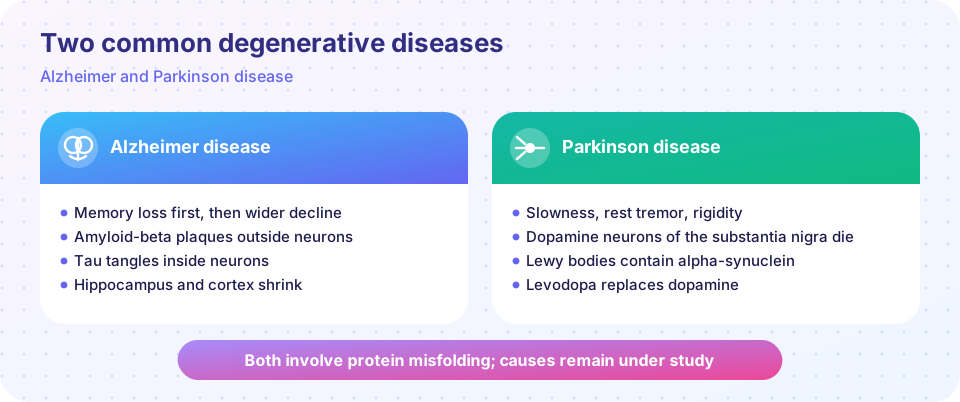
In 1906 Alois Alzheimer described a woman, Auguste Deter, with memory loss, disorientation and paranoia. After her death he found plaques and tangles in her cortex. We still use those two hallmarks.
- Amyloid plaques are extracellular deposits of amyloid-beta. The peptide is cut from amyloid precursor protein (APP) by two enzymes (beta- and gamma-secretase); a long form, Aβ42, clumps easily.
- Neurofibrillary tangles are intracellular aggregates of hyperphosphorylated tau.
- Neurons and synapses are lost, starting in the entorhinal cortex and hippocampus, then spreading through the cortex (Braak staging), which matches the course: new memories fail first, later language, planning and orientation.
Most cases are sporadic and begin after age 65; age is the strongest risk factor. The best known genetic risk factor is the APOE ε4 allele, which raises risk without guaranteeing disease. Rare mutations in APP, PSEN1 or PSEN2 cause early-onset familial forms, which led to the amyloid cascade hypothesis: that Aβ accumulation starts the process and tau and neuron loss follow. Many anti-amyloid drugs failed in trials; newer antibody drugs (such as lecanemab and donanemab) clear plaques and modestly slow decline in early disease, with safety risks that need monitoring. The relative roles of amyloid, tau, inflammation and vascular health are still debated. Cholinesterase inhibitors can ease symptoms for some time but do not stop the disease.
Parkinson disease
James Parkinson described the "shaking palsy" in 1817. The core signs are bradykinesia (slowness), rest tremor, rigidity and balance problems. Dopamine-producing neurons in the substantia nigra pars compacta die; by the time signs appear, a large fraction of these neurons and of striatal dopamine is gone. Without dopamine, the direct "go" pathway (D1) is underactive and the indirect "stop" pathway (D2) overactive, so the thalamus is braked and movement is hard to start, exactly as the model from the previous chapter predicts. Surviving neurons often contain Lewy bodies with misfolded alpha-synuclein. Non-motor symptoms are common: loss of smell, sleep disorders, constipation, mood changes and sometimes dementia.
Treatment is symptomatic. Levodopa (L-DOPA) is converted to dopamine in the brain, and its use grew from work by Arvid Carlsson (Nobel Prize 2000) and Oleh Hornykiewicz. It helps greatly early on, but long-term use is complicated by motor fluctuations and involuntary movements (dyskinesias). Deep brain stimulation of the subthalamic nucleus or GPi can reduce symptoms in selected patients (next lessons). Causes involve genes (such as LRRK2 and GBA) and environment, and for most patients the cause is unknown.
Two more diseases
Huntington disease is caused by an expanded CAG repeat in the HTT gene. Roughly 40 or more repeats produce the disease, which shows involuntary movements, mood changes and cognitive decline, and strikes the striatum. It is inherited in a dominant pattern, and it was the first neurodegenerative disease for which a gene test existed. ALS (amyotrophic lateral sclerosis) selectively kills upper and lower motor neurons, so weakness spreads while senses stay normal; in most cases the cause is unknown, with a small fraction caused by mutations such as in SOD1 and C9orf72.
Common patterns
Protein misfolding, spread of pathology through connected circuits, inflammation by microglia and mitochondrial and synaptic dysfunction recur in many diseases. Whether these are causes or consequences is a major research question. Prevention research looks at blood pressure, hearing, physical activity and education as modifiable risk factors for dementia.
Common misconceptions
"Forgetting things means you have Alzheimer disease." Normal aging, stress, sleep loss and many treatable conditions affect memory; a clinician must assess persistent changes.
"Parkinson disease is only a tremor." Slowness and rigidity are central, and non-motor symptoms are common.
Try it
Press Run (or Ctrl + Enter) to see the result here.
Program input · what you'd type while the program runs
Type the answers before you press Run, one per line. Each time the program reads a line (with input()), it gets the next line from this box.
Press Run (or Ctrl + Enter) to see the console output here.
No output.
Check your understanding
Quick check · 5 questions
of 5 answered You scored / 5 · perfect!
-
1. Which pair describes the hallmarks of Alzheimer disease?
Plaques are outside neurons; tangles are inside. -
2. Why does Parkinson disease cause slowness?
Reduced dopamine tilts the basal ganglia toward inhibition of movement. -
3. What does levodopa do?
It is a precursor that crosses the blood-brain barrier. -
4. Which gene carries the CAG repeat expansion in Huntington disease?
An expanded repeat in HTT causes disease. -
5. Which regions are affected first in typical Alzheimer disease?
This matches early memory impairment.
Summary
- Alzheimer disease features Aβ plaques, tau tangles and loss of memory circuits.
- Parkinson disease features loss of nigral dopamine neurons and basal ganglia dysfunction.
- Treatments ease symptoms; disease-modifying therapy is an active area.
- Huntington disease and ALS show other selective vulnerabilities.
Next: Epilepsy and stroke
Track your progress
Create a free account to tick off lessons and pick up where you left off on any device.
of Neuroscience lessons completed