


















Lesson 37 of 45 · Disease and Neurotechnology
Epilepsy and stroke
Learn what a seizure is, why the brain's excitation and inhibition balance matters, how ischemic and hemorrhagic strokes differ, and why speed matters.
Neurodegeneration unfolds over years. Seizures and strokes arrive in seconds or minutes. Both are common, both can be treated, and both teach a lot about how brains work: one shows what happens when excitation runs unchecked, the other what happens when the brain's fuel supply is cut off.
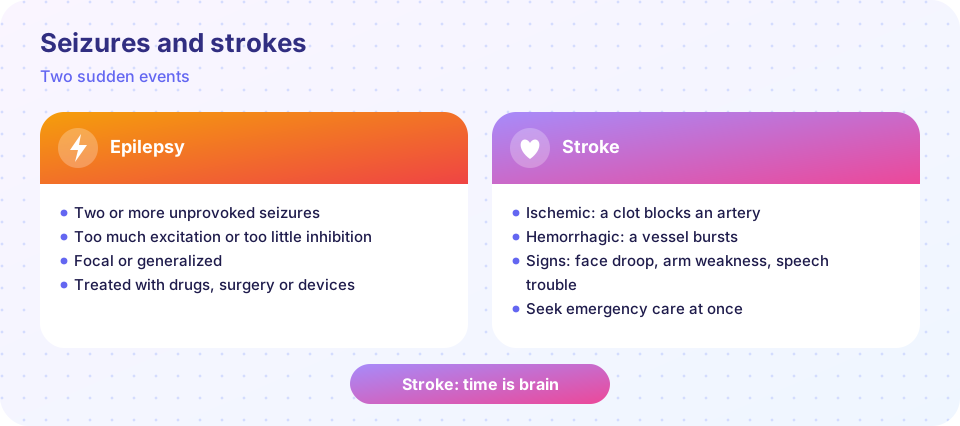
Educational information only; not medical advice. Strokes and prolonged seizures are emergencies: call your local emergency number.
What you will learn
- What a seizure is and how epilepsy is defined
- The balance of excitation and inhibition and how it can fail
- The difference between ischemic and hemorrhagic stroke
- Why "time is brain"
Key terms
Seizure: a transient episode of abnormal, excessive or synchronous neuronal activity.
Epilepsy: a tendency to have recurrent unprovoked seizures.
Excitation-inhibition balance: the ratio of glutamatergic to GABAergic drive.
Penumbra: tissue around a stroke core that is damaged but still salvageable.
Excitotoxicity: neuron injury from excessive glutamate and calcium entry.
Seizures and epilepsy
A seizure happens when large groups of neurons fire together abnormally. A single seizure can follow fever, low blood sugar, drug withdrawal or head injury. Epilepsy is diagnosed after recurrent unprovoked seizures (or a single seizure with a high risk of more); worldwide, roughly 50 million people live with it. Seizures are focal when they start in one area (symptoms depend on the area, such as twitching of one hand if motor cortex is involved) and generalized when they involve both hemispheres from the start. In a tonic-clonic seizure the body stiffens and then jerks. An absence seizure is a brief staring spell with a characteristic 3 per second spike-and-wave pattern on EEG.
Why do brains seize? Normal activity depends on a balance between glutamate-driven excitation and GABA-driven inhibition. Anything that tips it can promote seizures: reduced inhibition, more excitation, altered ion channels (many genetic epilepsies involve channels) or scar tissue after injury. Many drugs target the balance: some block voltage-gated sodium channels to limit repetitive firing, others increase GABA's action or reduce glutamate release. Most people become seizure-free with medication; when drugs fail, surgery to remove the seizure focus, vagus nerve stimulation or responsive neurostimulators may help.
What to do if someone has a seizure
The standard first-aid advice is simple: stay with them, note the time, move hard objects away, cushion the head, turn them on their side afterwards, and put nothing in their mouth. Call an emergency number if the seizure lasts more than 5 minutes, repeats without recovery, or the person is injured, pregnant or has breathing trouble.
Stroke
A stroke is a sudden loss of brain function from a blood-supply problem.
- Ischemic stroke (most strokes): a clot or narrowing blocks an artery, for example the middle cerebral artery.
- Hemorrhagic stroke: a vessel ruptures and bleeds into or around the brain.
Neurons need a constant supply of oxygen and glucose. When blood stops, energy runs out, ion pumps fail, neurons depolarize and release large amounts of glutamate, and calcium floods in: excitotoxicity. The central core dies quickly, but a surrounding penumbra is supplied by collateral vessels and can be saved if flow is restored. A frequently cited estimate is that on the order of two million neurons are lost each minute in a large untreated stroke, which is the basis of the phrase "time is brain".
The signs depend on the artery. Remember FAST: Face drooping, Arm weakness, Speech difficulty, Time to call emergency services. Treatment for ischemic stroke includes clot-dissolving drugs given within a few hours of onset and mechanical removal of large clots (thrombectomy), which can help in selected patients for many hours after onset. Brain imaging (CT) is needed first to rule out bleeding, so the right treatment depends on the type. Prevention focuses on blood pressure, blood sugar, cholesterol, not smoking and treating atrial fibrillation.
Recovery uses plasticity: neighboring regions take over, and rehabilitation exercises drive reorganization. Early, intensive and repetitive practice helps.
Common misconceptions
"You should put something in the mouth of a person who is seizing." Never do this: it can injure them and does not prevent swallowing the tongue.
"A stroke is a heart problem." It is a problem of brain blood supply, though the heart can be the source of a clot.
"If symptoms disappear, there is no need for care." A transient episode can be a warning sign and needs prompt medical assessment.
Try it
Press Run (or Ctrl + Enter) to see the result here.
Program input · what you'd type while the program runs
Type the answers before you press Run, one per line. Each time the program reads a line (with input()), it gets the next line from this box.
Press Run (or Ctrl + Enter) to see the console output here.
No output.
Check your understanding
Quick check · 5 questions
of 5 answered You scored / 5 · perfect!
-
1. Which EEG pattern is typical of an absence seizure?
Absence seizures show brief staring spells with generalized 3 Hz spike and wave. -
2. What is the penumbra in a stroke?
It is hypoperfused tissue that can recover if blood flow is restored. -
3. Which stroke type is caused by a blocked artery?
Ischemic strokes are due to clots or narrowing. -
4. What should you NOT do for someone having a tonic-clonic seizure?
Nothing should go in the mouth. -
5. What does FAST stand for?
It is a quick check for stroke signs and a reminder to call emergency services.
Summary
- Seizures arise when excitation outweighs inhibition and neurons synchronize abnormally.
- Epilepsy is recurrent unprovoked seizures; many treatments target ion channels and GABA.
- Ischemic strokes block arteries; hemorrhagic strokes rupture vessels; excitotoxicity kills neurons.
- Speed matters: the penumbra can be saved if flow is restored quickly.
Track your progress
Create a free account to tick off lessons and pick up where you left off on any device.
of Neuroscience lessons completed