


















Lesson 9 of 45 · Neurons and Glia
Glial cells: the support team of the brain
Meet the glia: astrocytes, oligodendrocytes, Schwann cells, microglia and ependymal cells, and learn how they feed, insulate, clean and shape neural circuits.
For most of the twentieth century, glia (from the Greek for "glue") were seen as filler. Today they are known to do much more: they feed neurons, insulate axons, clear spent transmitter, patrol for damage and even help decide which synapses survive. Neurons get the headlines, but a brain without glia could not work for a minute.
What you will learn
- The main types of glia and where each is found.
- How astrocytes, oligodendrocytes and Schwann cells support signaling.
- How microglia defend and prune the brain.
- Why the old "10 glia per neuron" claim is wrong.
Key terms
- Astrocyte: a star-shaped glial cell that supports neurons and blood vessels.
- Oligodendrocyte: a CNS glial cell that forms myelin around several axons.
- Schwann cell: a PNS glial cell that forms myelin around part of one axon.
- Microglia: immune cells of the CNS.
- Tripartite synapse: a synapse with three partners: presynaptic terminal, postsynaptic cell and an astrocyte.
How many glia are there?
Many textbooks used to say that glia outnumber neurons ten to one. That figure was never measured well. Counting studies on human brains (such as the work of Suzana Herculano-Houzel and colleagues, published around 2009) found about 86 billion neurons and a similar number, around 85 billion, of non-neuronal cells. The ratio differs between regions: in the cerebral cortex there are several non-neuronal cells per neuron, while in the cerebellum, with its huge number of small granule neurons, there are far more neurons than glia. Note that "non-neuronal" includes cells of blood vessels as well as glia, so the exact glial count is still debated.
Astrocytes
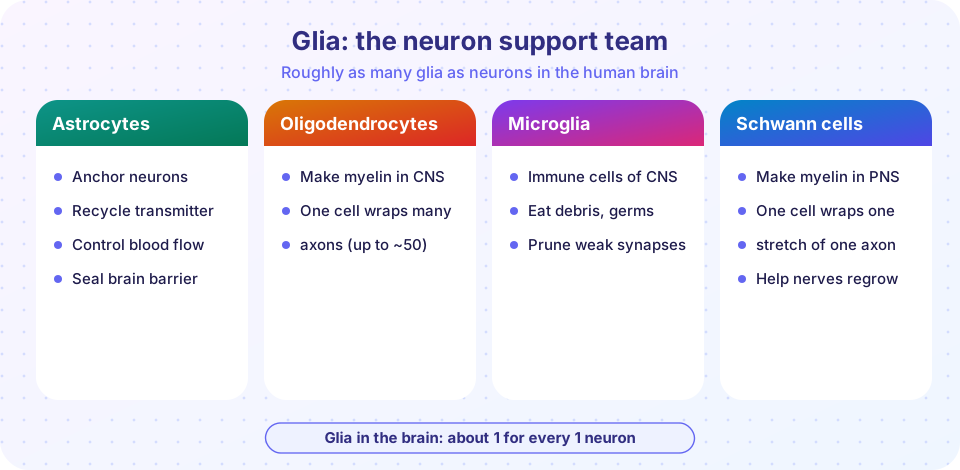
Astrocytes are star-shaped cells that fill the spaces among neurons. Each human astrocyte extends many fine processes, and one cell can touch hundreds of thousands of synapses (the number is higher in humans than in rodents). They do many jobs:
- Clearing transmitter. They take up spare glutamate from the cleft with transporters, and recycle it into glutamine, which neurons reuse. This protects neurons from over-excitation.
- Buffering potassium. Active neurons release K⁺ into the narrow space around them. Astrocytes absorb it so that the extracellular concentration stays stable.
- Fuel and blood flow. Their endfeet wrap around capillaries, they help set local blood flow to active regions (the basis of fMRI) and they store glycogen and shuttle energy substrates to neurons.
- Blood-brain barrier. They signal to capillary cells to maintain the tight junctions you met in Chapter 1.
- Shaping synapses. Astrocytes release factors that promote synapse formation, and a synapse with its astrocyte is called a tripartite synapse.
Astrocytes also show slow waves of calcium, and some researchers argue that they take part in information processing. This idea is exciting but debated, because evidence in the intact brain is harder to obtain than in dishes.
Oligodendrocytes and Schwann cells
Myelin is a membrane wrapped many times around an axon. In the CNS, one oligodendrocyte sends out several arms and myelinates internodes on several axons (often 20 to 50 in some regions). In the PNS, each Schwann cell wraps one internode of a single axon. Schwann cells also help injured peripheral nerves regrow by forming guide tubes. CNS axons regenerate far worse, partly because oligodendrocytes and scar tissue carry growth-inhibiting molecules.
Myelin lets a spike jump between nodes of Ranvier (Chapter 3). The effects of losing it appear in multiple sclerosis, in which the immune system attacks CNS myelin, and in Guillain-Barré syndrome, which affects the peripheral nerves. These conditions are described in Chapter 8.
Some unmyelinated axons in the PNS are still wrapped by Schwann cells in groups called Remak bundles. Another group of glia, oligodendrocyte precursor cells (OPCs, also called NG2 cells), remain in the adult brain and can make new myelin-forming cells, which may matter for learning new skills and for repair.
Microglia
Microglia make up a small share of cells in the CNS (commonly cited as around 5 to 15%, depending on the region). They are the brain's resident immune cells. Unlike neurons and most other glia, they arise from the embryonic yolk sac rather than from neural tissue. Their fine branches constantly scan their surroundings. They do three main things:
- Defend and clean up: they engulf dead cells, debris and pathogens.
- Prune synapses: during development they remove weak or unused synapses, a process that fine-tunes circuits. Defective pruning has been linked in research to neurodevelopmental conditions, though the causal story is not settled.
- Respond to injury: they change shape and release signaling molecules. Chronic microglial activation is found in several neurodegenerative diseases, and whether it helps or harms depends on context.
Other glia
Ependymal cells line the ventricles and the spinal canal and help circulate cerebrospinal fluid with their cilia. In the choroid plexus, specialized ependymal cells produce CSF. Satellite glial cells surround neuron cell bodies in ganglia. Radial glia guide migrating neurons in the developing cortex, and they also act as neural stem cells.
Common misconceptions
"Glia are just glue." The name is historical. Glia handle metabolism, ion balance, immune defense and synapse maintenance.
"Glia cannot signal." They do not fire spikes, but they use calcium signals and release chemicals to communicate. How much this shapes information processing is an active research question.
"There are ten times more glia than neurons." Modern counts find roughly one to one overall.
Try it
Press Run (or Ctrl + Enter) to see the result here.
Program input · what you'd type while the program runs
Type the answers before you press Run, one per line. Each time the program reads a line (with input()), it gets the next line from this box.
Press Run (or Ctrl + Enter) to see the console output here.
No output.
Check your understanding
Quick check · 4 questions
of 4 answered You scored / 4 · perfect!
-
1. Which glial cell forms myelin in the CNS?
Oligodendrocytes myelinate CNS axons; Schwann cells do it in the PNS. -
2. Which cell takes up spare glutamate from the synaptic cleft?
Astrocytes carry glutamate transporters and recycle glutamate as glutamine. -
3. What do microglia do during development?
They engulf weak or unused synapses, refining circuits. -
4. Modern counts suggest the ratio of glia to neurons in the human brain is about...
Counting studies found roughly similar numbers of neurons and non-neuronal cells overall.
Summary
- Glia are as numerous as neurons and do essential work.
- Astrocytes clear transmitter, buffer K+, regulate blood flow and shape synapses.
- Oligodendrocytes (CNS) and Schwann cells (PNS) make myelin; Schwann cells help nerve repair.
- Microglia defend, clear debris and prune synapses.
- Ependymal, satellite and radial glia have specialized roles.
Next: Chapter 2 review
Track your progress
Create a free account to tick off lessons and pick up where you left off on any device.
of Neuroscience lessons completed