


















Lesson 19 of 45 · Synapses and Neurotransmitters
Synaptic integration: EPSPs, IPSPs and summation
Learn how a neuron adds up thousands of excitatory and inhibitory inputs: EPSPs, IPSPs, temporal and spatial summation, dendritic location and the decision at threshold.
A typical cortical neuron receives thousands of synapses, some excitatory and some inhibitory, arriving at different places and times. It must turn this storm into one decision: fire or stay silent. This is synaptic integration, and it is the basic computation of the nervous system. Once you understand it, you can see how circuits make decisions, why inhibition matters and how drugs that change synaptic strength change behavior.
What you will learn
- What EPSPs and IPSPs are, and how they differ from action potentials.
- Temporal and spatial summation.
- How inhibition and dendrite geometry shape the sum.
- Where and how the neuron decides to fire.
Key terms
- EPSP: excitatory postsynaptic potential, a depolarizing change in Vm from an excitatory synapse.
- IPSP: inhibitory postsynaptic potential, a change that makes firing less likely.
- Temporal summation: adding of potentials that arrive in quick succession.
- Spatial summation: adding of potentials from different synapses at the same time.
- Shunting inhibition: inhibition that reduces the effect of other inputs by increasing membrane conductance.
Graded, not all-or-none
Unlike spikes, postsynaptic potentials are graded: their size depends on how many receptors open. A single excitatory synapse onto a cortical neuron produces an EPSP of only about 0.1 to 1 mV, tiny compared with the 15 mV gap between rest (-70 mV) and threshold (-55 mV). By contrast, at the neuromuscular junction a single motor neuron spike triggers a 50 mV potential, a safety factor so large that each spike reliably causes a muscle twitch.
EPSPs depolarize the cell because the opened channels (such as AMPA receptors) pass Na⁺ in and a bit of K⁺ out, with a reversal potential near 0 mV. IPSPs from GABA-A receptors push Vm toward E_Cl, about -65 to -80 mV, so they hyperpolarize the cell or, if Vm is near E_Cl, increase conductance and reduce the effect of excitatory inputs. Both signals spread passively along the dendrite and fade with distance (recall the length constant from Chapter 3).
Temporal summation
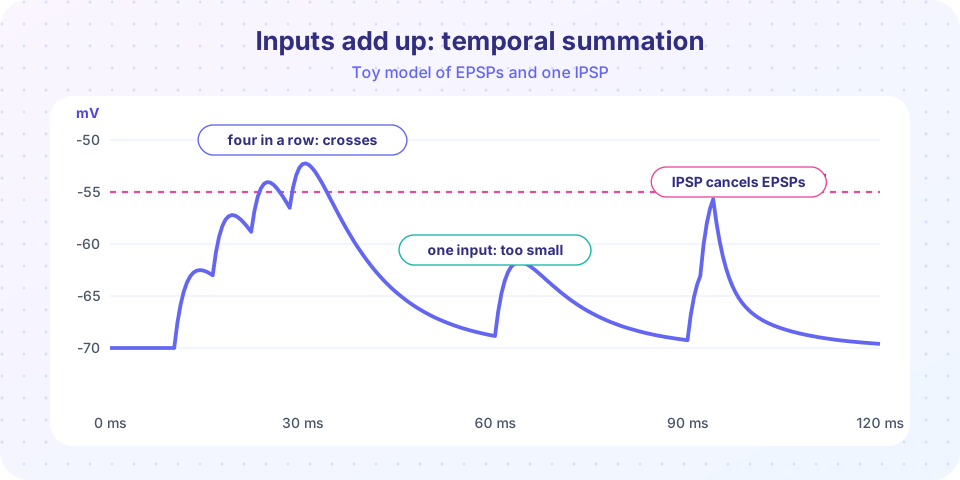
A single EPSP lasts about 10 to 20 ms, set by the membrane time constant τ = R_m·C_m. If a second EPSP arrives before the first fades, it adds on top. Several in a row can push Vm to threshold. The plot above shows this: one input is not enough, but four within 20 ms are. Neurons with longer time constants add inputs over longer windows, and ones with shorter time constants act more like coincidence detectors.
Spatial summation
Inputs from different synapses on the same neuron add up when they arrive together. A strong stimulus recruits many presynaptic neurons at once, so many EPSPs add together. A cortical neuron may need tens of coincident inputs to reach threshold. Both forms of summation work together in real life: the neuron effectively computes a weighted, leaky sum of everything it receives.
Inhibition: hyperpolarizing and shunting
IPSPs subtract from the sum. Inhibition also acts by shunting: when GABA-A channels are open, current from excitatory inputs leaks out through them, reducing the voltage change at the soma. This is why inhibition is especially powerful when it sits between the excitatory inputs and the soma, or on the soma itself. Without inhibition, circuits run away into seizures, in which large groups of neurons fire together.
Location and dendrite geometry
Inputs on thin distal dendrites are smaller by the time they reach the soma than inputs close to the cell body, because of the cable loss. Neurons compensate in several ways: distal synapses may be stronger, and active channels in dendrites can amplify signals. Some dendritic branches can generate local "dendritic spikes" and so act as small computing units, which makes a single neuron more powerful than the textbook model "sum and threshold".
The decision at the axon hillock
The summed potential is read at the axon initial segment, where Na⁺ channels are densest and the threshold is lowest (Chapter 2). If Vm there crosses threshold, a spike fires and travels down the axon. The result is a simple coding rule: the neuron's output is its firing rate, which depends on the net balance of excitation and inhibition. Drugs, learning and development change that balance, as the next chapters show.
Worked example: counting inputs
Suppose each EPSP peaks at 0.5 mV and the neuron needs to reach -55 mV from -70 mV, i.e. 15 mV. If inputs sum linearly and all arrive together, you need 15 / 0.5 = 30 simultaneous EPSPs. If 10 IPSPs of -0.5 mV (-5 mV in total) also arrive, you need 40 EPSPs, because 40 × 0.5 - 10 × 0.5 = 15 mV. Real summation is sublinear (driving force shrinks and inhibition shunts), so the true number is higher.
Common misconceptions
"EPSPs are small action potentials." EPSPs are graded and decay with distance; spikes are all-or-none and regenerate.
"Inhibition always hyperpolarizes." Often it does, but shunting inhibition can leave Vm nearly unchanged while reducing responses to excitation.
"A neuron simply adds all its inputs equally." Weights vary by synapse strength, location and timing, and dendrites perform local nonlinear computations.
Try it
Press Run (or Ctrl + Enter) to see the result here.
Program input · what you'd type while the program runs
Type the answers before you press Run, one per line. Each time the program reads a line (with input()), it gets the next line from this box.
Check your understanding
Quick check · 5 questions
of 5 answered You scored / 5 · perfect!
-
1. What is temporal summation?
A second EPSP arriving before the first has faded adds onto it. -
2. A single EPSP in a cortical neuron is typically about...
Many coincident inputs are needed to reach threshold. -
3. Shunting inhibition works by...
Open channels short-circuit excitatory current, reducing its effect at the soma. -
4. Where is the decision to fire mostly made?
The initial segment has the densest Na+ channels and lowest threshold. -
5. Why do synapses far out on thin dendrites usually have smaller effects at the soma?
Potentials decay along the dendrite with its length constant.
Summary
- EPSPs and IPSPs are graded and passive; spikes are all-or-none.
- Temporal and spatial summation add inputs; inhibition subtracts or shunts.
- Dendritic location and active dendritic properties shape the sum.
- The axon initial segment decides whether a spike fires.
Next: Chapter 4 review
Track your progress
Create a free account to tick off lessons and pick up where you left off on any device.
of Neuroscience lessons completed