


















Lesson 39 of 45 · Disease and Neurotechnology
Chapter 8 review: Disease and neurotechnology
Review Alzheimer and Parkinson disease, epilepsy, stroke and the main measurement and treatment technologies with a summary picture and a mixed ten-question quiz.
This chapter connected the normal brain to disease and to the tools used to study and treat it. Use the picture and table to check that you can match each condition to its mechanism, and each technology to its strengths.
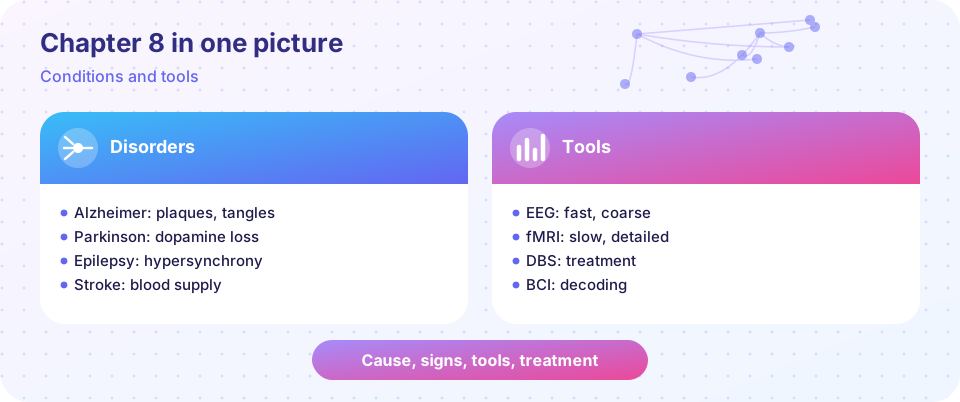
Recap table
| Topic | Mechanism or principle | Key fact |
|---|---|---|
| Alzheimer disease | amyloid plaques, tau tangles, synapse and neuron loss | memory circuits (entorhinal cortex, hippocampus) first |
| Parkinson disease | loss of nigral dopamine neurons | slowness, rest tremor, rigidity; levodopa and DBS help |
| Epilepsy | excitation-inhibition imbalance, hypersynchrony | many drugs act on sodium channels or GABA |
| Stroke | ischemia or hemorrhage; excitotoxicity | time-critical; FAST signs |
| EEG | scalp voltage | millisecond timing, coarse location |
| fMRI | BOLD signal | whole brain, seconds delay |
| DBS | implanted electrode | STN or GPi for Parkinson disease |
| BCI | decode intent | population-vector idea from motor cortex |
Check your understanding
Quick check · 10 questions
of 10 answered You scored / 10 · perfect!
-
1. Which finding is a hallmark of Parkinson disease?
Dopamine neuron loss leads to basal ganglia dysfunction. -
2. Which first-aid step is wrong for a seizure?
Never put anything in the mouth. -
3. The penumbra of a stroke is
Restoring blood flow early can rescue it. -
4. fMRI's main limit is
BOLD follows neural activity by seconds and reflects blood oxygen. -
5. Which is NOT a feature of Alzheimer disease?
Lewy bodies and dopamine loss characterize Parkinson disease. -
6. Why is the positive predictive value low for rare diseases even with a good test?
PPV depends on prevalence. -
7. Optogenetics requires
Channelrhodopsin and related proteins are targeted to cell types. -
8. Which disease is caused by an expanded CAG repeat in HTT?
Approximately 40 or more repeats lead to Huntington disease. -
9. What do hemorrhagic and ischemic strokes have in common?
One blocks a vessel and the other bleeds, but tissue lacks proper supply in both. -
10. Which brain rhythm band is typical of deep sleep?
Delta waves (0.5 to 4 Hz) dominate slow-wave sleep.
Summary
- Match disease to mechanism: plaques and tangles, dopamine loss, imbalance, ischemia.
- Match tool to question: EEG for timing, fMRI for location, DBS and BCI for intervention.
- Always interpret tests and scans with context.
Track your progress
Create a free account to tick off lessons and pick up where you left off on any device.
of Neuroscience lessons completed