


















Lesson 13 of 45 · Electrical Signaling
The action potential: threshold, spike and recovery
Follow an action potential from threshold to recovery: sodium and potassium channels, all-or-none firing, refractory periods and a Hodgkin-Huxley simulation.
A resting neuron sits quietly at about -70 mV. Push it past a threshold and it does something dramatic: within a millisecond its voltage shoots up to about +40 mV, then falls back, overshoots below rest and recovers. This brief event is the action potential, the universal currency of neural communication. It is why a nerve can carry a message from your fingertip to your spinal cord without fading, and why neurons can encode information in the timing and rate of spikes.
What you will learn
- The phases of an action potential and the channels responsible for each.
- Why the spike is all-or-none and how neurons signal strength.
- What refractory periods are and why they matter.
- How the Hodgkin-Huxley equations describe the spike, and how to simulate them.
Key terms
- Voltage-gated channel: a channel whose opening depends on membrane voltage.
- Inactivation: a state in which a channel is closed and cannot reopen until the membrane repolarizes.
- Refractory period: the time after a spike during which a second spike is impossible (absolute) or harder (relative).
- Conductance (g): how easily current flows through channels; the inverse of resistance.
- Rheobase: the weakest steady current that can make a neuron fire.
The phases, step by step
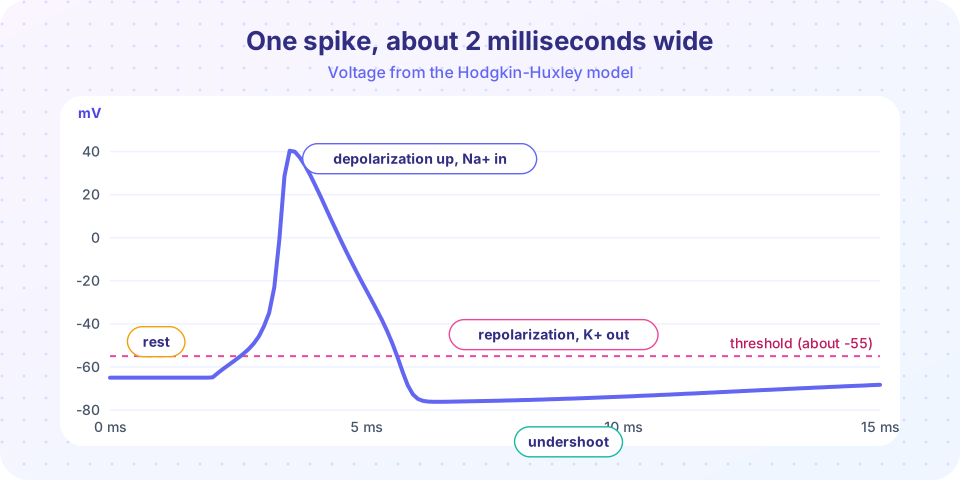
- Resting state (about -70 mV). Most voltage-gated Na⁺ and K⁺ channels are closed. Leak K⁺ channels set Vm.
- Depolarization to threshold. Input from synapses pushes Vm up. At about -55 mV (it varies between cells), enough voltage-gated Na⁺ channels open that inward Na⁺ current beats the outward K⁺ leak.
- Rising phase. Na⁺ rushes in, depolarizing the cell, which opens more Na⁺ channels. This is positive feedback, so Vm shoots toward E_Na (+61 mV) within about half a millisecond.
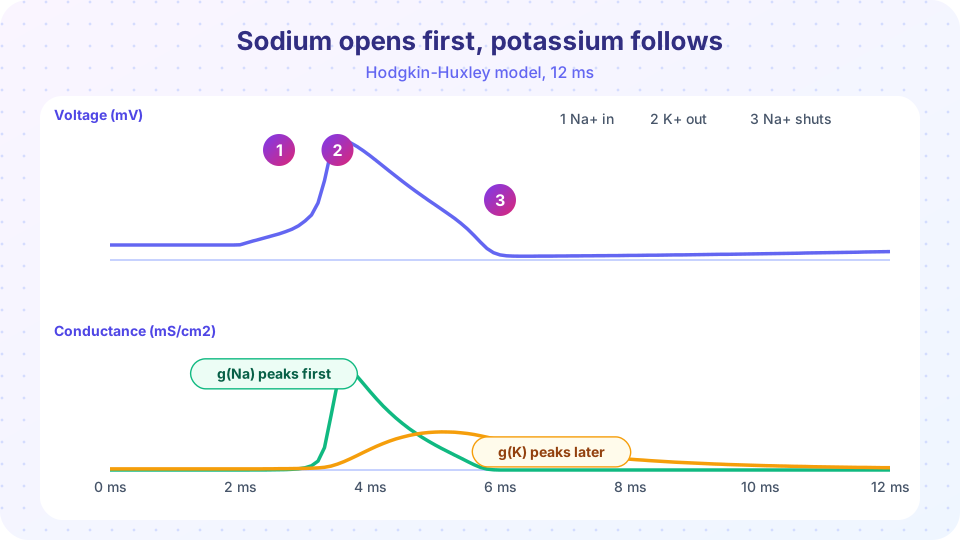
- Peak (about +40 mV). It does not reach E_Na because Na⁺ channels begin to inactivate (a second gate swings shut, after about a millisecond) and because K⁺ channels start to open.
- Falling phase. Voltage-gated K⁺ channels (the "delayed rectifier") open with a delay. K⁺ flows out, pulling Vm back toward E_K (-89 mV).
- Undershoot (afterhyperpolarization). The K⁺ channels close slowly, so Vm briefly dips below rest (about -76 mV in the model below).
- Recovery. K⁺ channels close and Na⁺ channels recover from inactivation. The pump slowly restores the small changes in concentration.
Two gates make this work. The Na⁺ channel has a fast activation gate, which opens with depolarization, and a slower inactivation gate, which closes with depolarization. The K⁺ channel only has a slow activation gate. The difference in timing is the heart of the spike.
The Hodgkin-Huxley model
In the early 1950s, Alan Hodgkin and Andrew Huxley used a voltage clamp (a device that holds Vm fixed and measures the current) on the giant axon of the squid, an axon nearly half a millimeter wide. They separated the Na⁺ and K⁺ currents and fitted equations to them. Their model treats the membrane as a circuit:
C·dV/dt = I_ext - g_Na·m³·h·(V - E_Na) - g_K·n⁴·(V - E_K) - g_L·(V - E_L)
Here C is membrane capacitance (1 µF/cm²), g values are maximum conductances (120, 36 and 0.3 mS/cm² for Na⁺, K⁺ and leak), and m, h and n are gating variables between 0 and 1, each with its own differential equation depending on V. The model predicted the spike shape, its threshold, the refractory period and the speed of the traveling spike with remarkable accuracy, and earned the 1963 Nobel Prize. It is one of the great examples of a quantitative theory in biology.
One caveat: the classical parameters are for a squid axon at 6.3 °C. Mammalian neurons at body temperature run several times faster, so a real spike lasts nearer one millisecond than the two you see here.
All-or-none, and how strength is coded
Once threshold is crossed, the spike has the same size and shape however strong the stimulus. Weak inputs below threshold produce no spike at all. This is the all-or-none principle, and it keeps signals clean over long distances. In the simulation below, a pulse of 6 µA/cm² does nothing, while 7 µA/cm² produces a full spike that peaks above +30 mV.
So how does a neuron signal that a stimulus is strong? By firing rate: stronger sustained input makes it fire more spikes per second (up to several hundred hertz in fast cells). Information can also be carried by spike timing and by which neurons fire.
Refractory periods
For a short time after a spike, a second one cannot be triggered, however strong the stimulus. This absolute refractory period exists because Na⁺ channels are inactivated and cannot reopen until the membrane repolarizes. A relative refractory period follows, when a spike is possible but needs a stronger stimulus, because extra K⁺ channels are still open. Refractory periods limit maximum firing rates (to about 200 to 1000 spikes per second in different cells) and, as you will see in the next lesson, make spikes travel in one direction along an axon.
Drugs and toxins
The channels give us some handy tools. Tetrodotoxin (TTX), from pufferfish, blocks voltage-gated Na⁺ channels and stops spikes. Tetraethylammonium (TEA) blocks K⁺ channels and prolongs the spike. Local anesthetics such as lidocaine work by blocking Na⁺ channels in pain fibers. Some inherited diseases, called channelopathies, arise from channel gene mutations that alter excitability, as in some forms of epilepsy.
Common misconceptions
"A stronger stimulus produces a bigger spike." No. The spike is all-or-none; strength is coded in rate and timing.
"Na⁺ rushing in means the cell runs out of Na⁺ gradient." Each spike moves only a tiny fraction of the ions (see the last lesson). The pump restores the gradient over time.
"The spike ends because Na⁺ runs out." It ends because Na⁺ channels inactivate and K⁺ channels open.
Try it
Press Run (or Ctrl + Enter) to see the result here.
Program input · what you'd type while the program runs
Type the answers before you press Run, one per line. Each time the program reads a line (with input()), it gets the next line from this box.
Press Run (or Ctrl + Enter) to see the result here.
Program input · what you'd type while the program runs
Type the answers before you press Run, one per line. Each time the program reads a line (with input()), it gets the next line from this box.
Check your understanding
Quick check · 5 questions
of 5 answered You scored / 5 · perfect!
-
1. What causes the rising phase of the action potential?
Na+ influx depolarizes the cell and opens more Na+ channels (positive feedback). -
2. Why does the spike stop at about +40 mV, short of E_Na?
Inactivation of Na+ channels and opening of K+ channels end the rising phase long before the gradient is used up. -
3. How does a neuron signal a stronger stimulus?
Spikes are all-or-none, so strength is coded in firing rate (and timing). -
4. The absolute refractory period exists because...
Na+ channels cannot reopen until the membrane repolarizes and they recover from inactivation. -
5. Tetrodotoxin (TTX) blocks...
TTX blocks voltage-gated Na+ channels and so abolishes spikes.
Summary
- A spike starts when Vm reaches threshold (about -55 mV) and Na⁺ channels open in a positive feedback loop.
- Na⁺ channel inactivation and delayed K⁺ channel opening end the spike and cause the undershoot.
- Spikes are all-or-none; strength is coded in firing rate and timing.
- Refractory periods limit firing rates and keep spikes moving forward.
- The Hodgkin-Huxley equations reproduce all of this with three gating variables.
Next: Conduction and myelin
Track your progress
Create a free account to tick off lessons and pick up where you left off on any device.
of Neuroscience lessons completed