


















Lesson 43 of 45 · Projects and Practice
Neuroscience glossary: chapters 5 to 8
Definitions of about fifty key terms from sensory systems, motor control, learning and memory, emotion, neurological disease and neurotechnology.
Terms are grouped by theme. Use the page like a dictionary, and test yourself with the flashcard tool at the end.
Sensory systems
| Term | Meaning |
|---|---|
| Transduction | conversion of a stimulus into an electrical signal |
| Receptive field | region of the world or body that changes a neuron's firing |
| Adaptation | reduced response to a constant stimulus |
| Topographic map | orderly neighbor-to-neighbor mapping |
| Fovea | central retinal pit with the sharpest vision |
| Rod, cone | photoreceptors for dim light and for color and detail |
| Center-surround | receptive field with opposite center and surround |
| LGN | thalamic relay for vision |
| V1 | primary visual cortex |
| Cochlea | inner-ear organ for hearing |
| Basilar membrane | strip that maps frequency to place |
| Hair cell | receptor of hearing and balance |
| Tonotopy | mapping of pitch to position |
| ITD / ILD | interaural time and level differences |
| Nociceptor | pain receptor |
| Gate control | spinal modulation of pain signals |
| Glomerulus | olfactory bulb synaptic ball for one receptor type |
Motor systems
| Term | Meaning |
|---|---|
| Motor unit | a motor neuron and its muscle fibers |
| Size principle | small units are recruited first |
| Neuromuscular junction | motor neuron-muscle synapse using ACh |
| Muscle spindle | stretch sensor |
| Golgi tendon organ | force sensor |
| Reciprocal inhibition | inhibition of the antagonist |
| CPG | central pattern generator for rhythms |
| Corticospinal tract | main descending motor pathway |
| Direct / indirect pathway | basal ganglia go and stop routes |
| Purkinje cell | output cell of the cerebellar cortex |
| Forward model | prediction of a command's sensory result |
Learning, memory and emotion
| Term | Meaning |
|---|---|
| Plasticity | experience-dependent change |
| LTP / LTD | lasting strengthening / weakening of a synapse |
| NMDA receptor | coincidence-detecting glutamate receptor |
| STDP | spike-timing-dependent plasticity |
| Engram | physical trace of a memory |
| Consolidation | stabilization of memory over time |
| Reconsolidation | restabilization after retrieval |
| Episodic / semantic | memory for events / for facts |
| Procedural memory | skills and habits |
| Place cell | hippocampal cell for a location |
| Extinction | new learning that a cue no longer predicts the outcome |
| HPA axis | hypothalamus-pituitary-adrenal stress system |
| Prediction error | difference between expected and actual outcome |
Disease and technology
| Term | Meaning |
|---|---|
| Amyloid-beta, tau | proteins that aggregate in Alzheimer disease |
| Lewy body | alpha-synuclein inclusion |
| Levodopa | dopamine precursor drug |
| Seizure | transient abnormal synchronous neuronal activity |
| Ischemia | insufficient blood supply |
| Penumbra | salvageable tissue around a stroke core |
| Excitotoxicity | injury from excess glutamate and calcium |
| EEG | scalp voltage recording |
| BOLD | blood oxygenation signal used by fMRI |
| Optogenetics | light control of genetically targeted neurons |
| DBS | deep brain stimulation |
| BCI | brain-computer interface |
Practice with the terms
Press Run (or Ctrl + Enter) to see the console output here.
No output.
Check your understanding
Quick check · 4 questions
of 4 answered You scored / 4 · perfect!
-
1. Which term means mapping of pitch to position?
Tonotopy is the frequency map of the cochlea and auditory cortex. -
2. What is an engram?
Engram is the hypothetical memory trace. -
3. What does STDP stand for?
The order of pre and post spikes sets the sign of change. -
4. What is excitotoxicity?
It is a key mechanism in stroke injury.
Summary
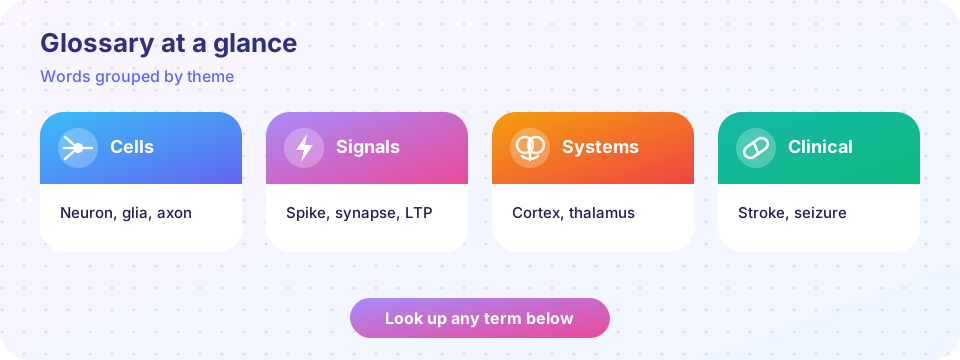
- Terms cluster into four families: sensory, motor, memory and emotion, clinical and technology.
- Knowing a term means being able to connect it to a mechanism and an example.
Next: Cheat sheet
Track your progress
Create a free account to tick off lessons and pick up where you left off on any device.
of Neuroscience lessons completed