


















Lesson 44 of 45 · Projects and Practice
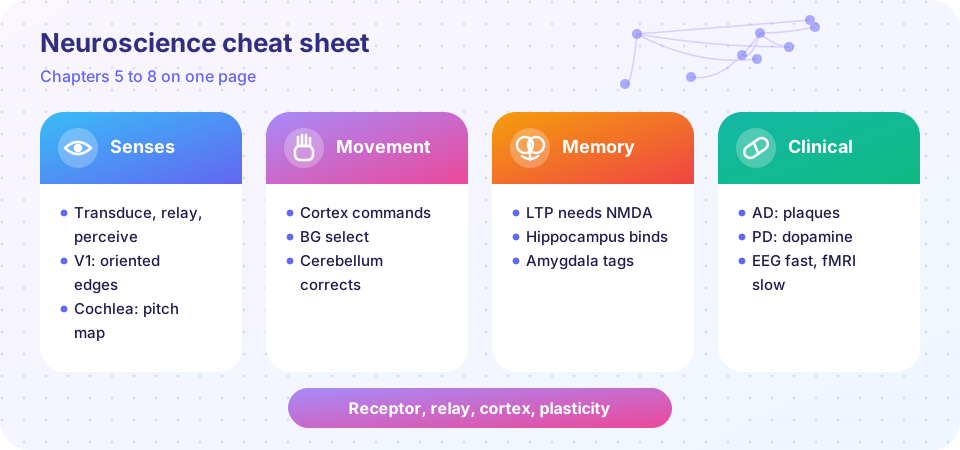
Neuroscience cheat sheet: chapters 5 to 8
A one-page recap of sensory systems, motor control, learning and memory, emotion, neurological disease and neurotechnology with the key numbers to remember.
Keep this page open when revising. It lists the most reusable facts from the second half of the course.
Sensory systems
- Plan: transduce, relay (thalamus), cortex; smell skips the thalamus.
- Photoreceptors hyperpolarize in light; three cones peak near 420, 530 and 560 nm.
- Ganglion cells: center-surround, report contrast. V1: oriented edges (Hubel and Wiesel).
- Cochlea: base = high pitch, apex = low pitch; outer hair cells amplify; K⁺ depolarizes hair cells.
- ITD up to about 0.65 ms; ILD from head shadow.
- Touch: Merkel (sustained), Meissner (flutter), Ruffini (stretch), Pacinian (vibration). Pain: A-delta fast, C slow (about 1 m/s). Smell: about 400 receptor types, combinatorial code.
Motor systems
- Lower motor neuron releases ACh; motor unit; size principle.
- Stretch reflex: spindle Ia, monosynaptic; Golgi tendon organ = force (Ib).
- Cortex commands (corticospinal tract, about 90 percent crossed); basal ganglia: direct (D1, go), indirect (D2, stop); cerebellum: Purkinje cells, error correction.
- Weak, slow, clumsy: cortex or tract, basal ganglia, cerebellum.
Learning, memory and emotion
- LTP: glutamate plus depolarization opens NMDA receptors, Ca²⁺ in, more AMPA receptors. LTD: low, prolonged calcium. STDP: pre before post strengthens.
- Declarative (hippocampus, cortex) versus nondeclarative (striatum, cerebellum, amygdala). H.M.: anterograde amnesia, intact skills.
- Place cells (hippocampus), grid cells (entorhinal cortex); replay in sleep.
- Fear: lateral amygdala learns, central amygdala drives output; extinction is new learning; Rescorla-Wagner:
ΔV = αβ(λ - V).
Disease and technology
| Topic | Remember |
|---|---|
| Alzheimer disease | amyloid plaques, tau tangles, hippocampus first |
| Parkinson disease | nigral dopamine loss; levodopa, DBS |
| Epilepsy | excitation-inhibition imbalance; 3 Hz spike-wave in absence |
| Stroke | ischemic (clot) or hemorrhagic; FAST; time is brain |
| EEG | ms timing, coarse; alpha 8 to 13 Hz |
| fMRI | BOLD, mm resolution, peaks about 5 s later |
| Optogenetics, DBS, BCI | control by light; stimulate; decode |
Quick formulas
- Conduction time:
t = distance / speed. - Decibels:
dB = 20 log10(p / p0);p0 = 20 µPa. - ITD (Woodworth):
(a/c)(θ + sin θ). - PPV:
TP / (TP + FP).
Try it
Press Run (or Ctrl + Enter) to see the result here.
Program input · what you'd type while the program runs
Type the answers before you press Run, one per line. Each time the program reads a line (with input()), it gets the next line from this box.
Press Run (or Ctrl + Enter) to see the console output here.
No output.
Check your understanding
Quick check · 3 questions
of 3 answered You scored / 3 · perfect!
-
1. Which receptor type is a coincidence detector?
It needs glutamate and depolarization together. -
2. A fast, sharp pain is carried by
A-delta fibers are thin and myelinated. -
3. Which tool shows peak signal about 5 seconds after neural activity?
The hemodynamic response is slow.
Summary
- Senses follow transduce, relay, cortex; motor control is a hierarchy with loops.
- Memory is plasticity plus systems plus emotion; disease and tools tie them together.
Next: Further study
Track your progress
Create a free account to tick off lessons and pick up where you left off on any device.
of Neuroscience lessons completed