


















Lesson 30 of 45 · Learning, Memory and Emotion
Chapter 7 overview: Learning, memory and emotion
Preview how experience changes the brain: synaptic plasticity, memory systems of the hippocampus and cortex, and how the amygdala tags emotional events.
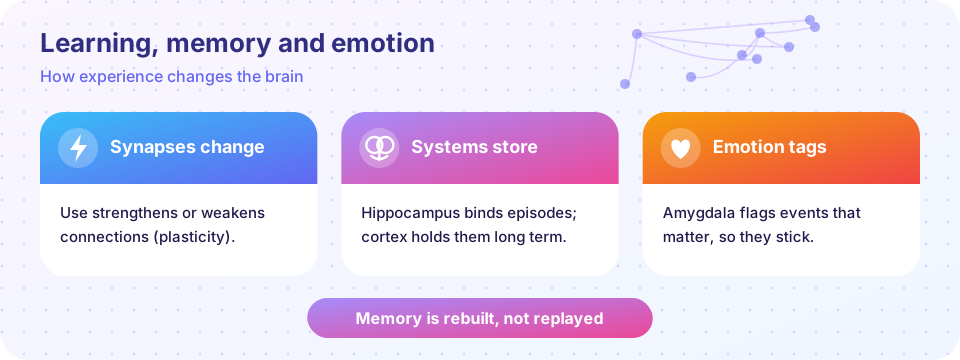
You are not the same brain you were yesterday. Every experience leaves a physical trace: synapses strengthen or weaken, new spines grow, circuits reorganize. This chapter climbs three levels: the synapse (plasticity), the system (hippocampus, cortex and the types of memory) and the emotional tag that decides what sticks.
What you will learn
- What plasticity is and why memory needs it
- The main kinds of memory and where they live
- How emotion changes what we remember
- What each lesson in the chapter covers
Key terms
Plasticity: the ability of synapses and circuits to change with experience.
Engram: the physical trace of a memory.
Consolidation: stabilization of a new memory over time.
Hippocampus: a medial temporal structure essential for forming new episodic memories.
Amygdala: an almond-shaped structure central to emotional learning.
Synapse
System
Emotion
Memory is not one thing
Psychologists and neuroscientists distinguish several kinds of memory. Working memory holds a few items for seconds and depends on prefrontal cortex. Long-term memory divides into declarative (facts and events you can state) and nondeclarative (skills, habits, conditioning). Different systems rely on different structures, which is why a person can lose one kind and keep another. Lesson 3 explores this with the most famous case in neuroscience.
From synapses to behavior
The central idea, from Donald Hebb in 1949, is that when one neuron repeatedly helps fire another, the connection between them strengthens. We now know molecular machinery that does just that. But memory is not stored by one synapse: a memory is a distributed pattern of changed connections across many cells. Experiments in mice using light-activated proteins (optogenetics) can label cells active during learning and reactivate them, showing that those cells are necessary and sufficient for some memories to be recalled.
Forgetting is normal
Hermann Ebbinghaus tested memory for nonsense syllables in the 1880s and found that retention falls steeply at first, then more slowly. Forgetting is not a malfunction: it clears space, reduces interference and favors information that is used or emotionally important.
Common misconceptions
"Memory is a video recording." Memories are reconstructed each time, and details can be altered or invented.
"We use only 10 percent of the brain." No: imaging and lesion studies show activity and function across the whole brain.
Try it
Press Run (or Ctrl + Enter) to see the result here.
Program input · what you'd type while the program runs
Type the answers before you press Run, one per line. Each time the program reads a line (with input()), it gets the next line from this box.
Press Run (or Ctrl + Enter) to see the console output here.
No output.
What is in this chapter
Check your understanding
Quick check · 4 questions
of 4 answered You scored / 4 · perfect!
-
1. Who proposed that connections strengthen when one neuron repeatedly helps fire another?
Hebb's 1949 postulate is the basis of the idea of Hebbian plasticity. -
2. What kind of memory is knowing that Paris is a capital?
Facts are semantic declarative memories. -
3. Which structure tags events with emotional importance?
The amygdala boosts consolidation of emotionally arousing events. -
4. What did Ebbinghaus's forgetting curve show?
The curve is roughly exponential or power-law shaped.
Summary
- Memory needs plasticity at synapses, systems that organize it and emotion that prioritizes it.
- There are several memory types with different neural bases.
- Forgetting is normal and adaptive.
Track your progress
Create a free account to tick off lessons and pick up where you left off on any device.
of Neuroscience lessons completed