


















Lesson 29 of 45 · Motor Systems
Chapter 6 review: Motor systems
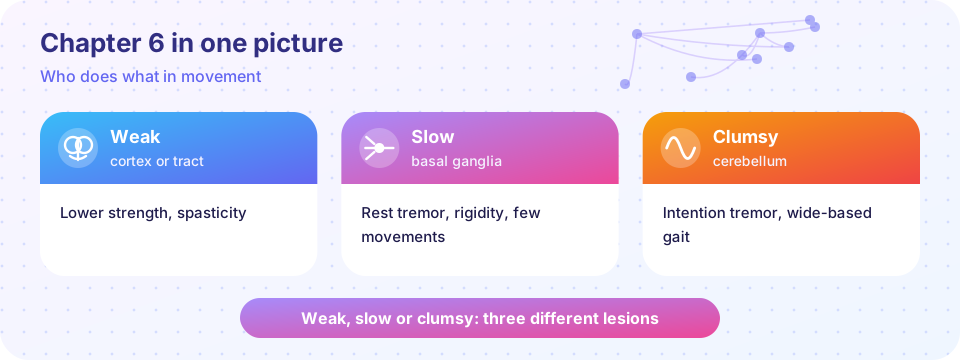
Review the motor hierarchy with a one-picture summary of weak, slow and clumsy movement, a recap table and a ten-question mixed quiz.
Movement is a team effort. You have met the lowest level (motor units and spinal reflexes) and the higher loops (cortex, basal ganglia, cerebellum). This review shows how to tell them apart by what goes wrong.
Recap table
| Level | Main job | Key facts |
|---|---|---|
| Lower motor neuron | final common path | ACh at the neuromuscular junction; motor unit |
| Spinal reflexes | fast local loops | spindle (Ia), Golgi tendon organ (Ib), reciprocal inhibition |
| Spinal CPGs | rhythm | alternating flexor/extensor bursts |
| Motor cortex | commands | corticospinal tract, ~90% crossed, population coding |
| Basal ganglia | select and start | direct (D1, go) and indirect (D2, stop) pathways |
| Cerebellum | correct and time | Purkinje cells, climbing-fiber error signals |
A thinking tool
When a movement is wrong, ask three questions: Is it weak (power fails: cortex, tract, motor neuron or muscle)? Is it slow or poor at starting (basal ganglia)? Is it clumsy and inaccurate (cerebellum)? Educational reasoning only: a real diagnosis needs a clinician.
Check your understanding
Quick check · 10 questions
of 10 answered You scored / 10 · perfect!
-
1. A doctor taps a tendon and the muscle contracts a few tens of milliseconds later. Which description is right?
The latency is short because only one synapse is in the loop. -
2. In the size principle, which units are recruited first?
Small motor neurons have lower thresholds. -
3. What does a Golgi tendon organ report?
Group Ib afferents encode tension. -
4. Which pathway lets D2-bearing striatal neurons suppress competing movements?
The indirect pathway strengthens the GPi brake. -
5. Loss of dopamine neurons in the substantia nigra mainly causes
Parkinson-type symptoms reflect an underactive direct pathway. -
6. A patient has a wide-based unsteady gait and intention tremor. Which structure is suspected?
These are classic cerebellar signs. -
7. How do alpha and gamma motor neurons cooperate in voluntary movement?
Alpha-gamma coactivation keeps spindles taut while the muscle shortens. -
8. Which of these is a central pattern generator task?
Spinal CPGs generate the basic gait rhythm. -
9. What does the population vector in motor cortex do?
Summing the contributions of cells with preferred directions predicts movement direction. -
10. Where do about 90 percent of corticospinal fibers cross?
The pyramidal decussation is in the lower medulla.
Summary
- The final common path is the lower motor neuron; reflexes and rhythm live in the cord.
- Cortex commands, basal ganglia select, cerebellum corrects.
- Weak, slow and clumsy movements point to different parts of the system.
Track your progress
Create a free account to tick off lessons and pick up where you left off on any device.
of Neuroscience lessons completed