


















Lesson 15 of 45 · Electrical Signaling
Chapter 3 review: electrical signaling
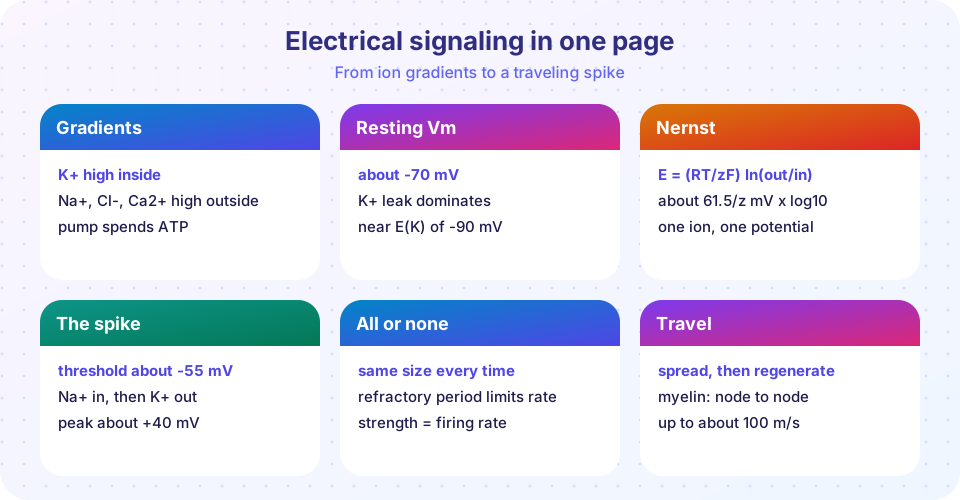
Review Chapter 3 with a one-page picture, a table of key equations and numbers, and a ten-question quiz on resting potential, spikes and conduction.
Chapter 3 took you from ions to spikes. Use this review to check that the chain of ideas is clear: unequal ions and leaky potassium channels give a resting potential, a threshold crossing triggers a regenerative sodium spike, and myelin makes the spike travel quickly.
What you will learn
- A recap of the equations and numbers of Chapter 3.
- The causal chain from gradients to a traveling spike.
- Which ideas you need for synapses in Chapter 4.
Recap table
| Topic | Remember |
|---|---|
| Resting potential | K⁺ in, Na⁺ out; Vm ≈ -70 mV; E_K ≈ -89, E_Na ≈ +61, E_Cl ≈ -64, E_Ca ≈ +123 mV |
| Nernst | E ≈ (61.5 mV / z)·log10(out/in) at 37 °C |
| Goldman | permeability-weighted: K⁺ dominates at rest |
| Action potential | threshold ≈ -55 mV, peak ≈ +40 mV, Na⁺ in then K⁺ out; all-or-none |
| Refractory | Na⁺ inactivation: absolute then relative |
| Conduction | passive spread fades; spikes regenerate; myelin gives saltatory conduction up to ≈ 100 m/s |
The causal chain
- The pump and transporters build ion gradients.
- Leak K⁺ channels let K⁺ leave, so the inside becomes negative.
- Synaptic input depolarizes the cell to threshold.
- Voltage-gated Na⁺ channels open, giving the rising phase.
- Na⁺ inactivation and delayed K⁺ opening produce the falling phase and undershoot.
- The local current ahead of the spike brings the next patch to threshold, so the spike travels.
- Myelin and thick axons make this fast.
Try it
Press Run (or Ctrl + Enter) to see the console output here.
No output.
Press Run (or Ctrl + Enter) to see the result here.
Program input · what you'd type while the program runs
Type the answers before you press Run, one per line. Each time the program reads a line (with input()), it gets the next line from this box.
Check your understanding
Quick check · 10 questions
of 10 answered You scored / 10 · perfect!
-
1. Which ion's equilibrium potential is closest to the resting potential?
K+ permeability dominates at rest, so Vm sits near E_K. -
2. Using E = (61.5/z)·log10(out/in), what is E for K+ with out = 5 mM and in = 140 mM?
61.5 × log10(5/140) = 61.5 × (-1.447) ≈ -89 mV. -
3. Raising extracellular K+ makes neurons...
A higher outside K+ raises E_K (less negative), so Vm rises. -
4. The pump moves...
3 Na+ out and 2 K+ in per ATP. -
5. What closes the Na+ channel during the spike's peak?
The inactivation gate swings shut after about a millisecond of depolarization. -
6. A stronger stimulus above threshold produces...
All-or-none; strength is coded in rate. -
7. The undershoot is caused by...
K+ channels close slowly after the spike, holding Vm near E_K. -
8. Which fibers conduct slowest?
C fibers are about 1 m/s. -
9. Where are Na+ channels densest on a myelinated axon?
Nodes hold high channel density, so spikes are regenerated there. -
10. Why can a spike not travel backward?
Inactivated Na+ channels make the region behind the front unresponsive.
Summary
- Gradients plus leak channels set -70 mV; Nernst and Goldman give the numbers.
- Spikes are regenerative, all-or-none, followed by refractory periods.
- Myelin makes conduction fast and efficient.
- Chapter 4 now explains what happens when the spike arrives at the terminal.
Next: Synapses: an overview
Track your progress
Create a free account to tick off lessons and pick up where you left off on any device.
of Neuroscience lessons completed