


















Lesson 2 of 44 · Getting Started
What Is Differential Geometry?
A friendly tour of differential geometry: local versus global, intrinsic versus extrinsic, and why a sphere cannot be flattened without stretching it.
Take a sheet of paper and roll it into a tube. Nothing is stretched or torn, and a bug walking on the paper would measure exactly the same distances as before. Now try to wrap the same sheet around a ball without creasing it. You cannot. Something is different about the sphere, and that "something" is a number you can compute at every point. Explaining that difference precisely is where differential geometry starts.
What you will learn
- The central idea: approximate a curved object by flat pieces and measure the error
- The difference between local and global questions
- The difference between intrinsic and extrinsic properties
- A short history, from Euler and Gauss to Riemann and Einstein
Key terms
Local: a property you can find by looking at a tiny neighbourhood of one point.
Global: a property of the whole shape, such as "it has a hole" or "its total area is finite".
Intrinsic: measurable from inside, without reference to a surrounding space.
Extrinsic: depends on how the shape sits in a larger space, such as 3-dimensional space.
Tangent plane: the flat plane that best approximates a surface at one point.
The central idea: zoom in until it is flat
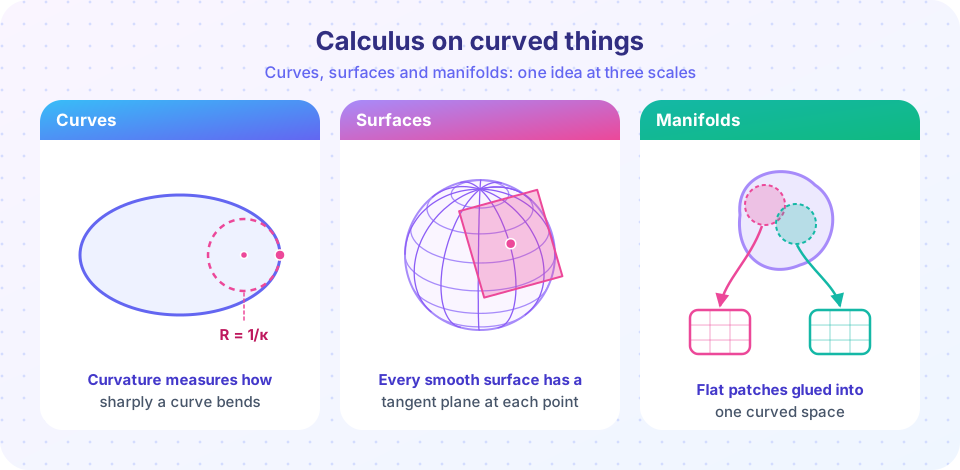
Every smooth shape looks straight if you zoom in far enough. A circle on a page looks like a line segment under a microscope, and the surface of the Earth looks like a plane to someone standing in a field. Calculus formalises this: the derivative of a curve at a point is the best linear approximation. Differential geometry asks the follow-up question: how fast does the shape peel away from its flat approximation?
- For a curve, the answer is a number called curvature: how quickly the tangent direction turns.
- For a surface, the answer is richer. A surface can bend one way along one direction and the opposite way along another (a saddle), so we get two principal curvatures, and the combinations Gaussian curvature and mean curvature.
- For a space with no surrounding space, we get a curvature tensor (chapter 8 and beyond).
Local versus global
Differential geometry has two moods. In its local mood it uses derivatives at a point and obtains formulas, such as "the curvature of a circle of radius R is 1/R everywhere". In its global mood it asks what those local numbers force on the whole shape. A classic global result you will meet in chapter 7, the Gauss-Bonnet theorem, says that if you add up the Gaussian curvature over a closed surface, the total depends only on how many holes the surface has. A sphere, a cube and a potato all give the same total, even though their local curvature is very different. Local and global are linked by integration.
Intrinsic versus extrinsic
Return to the paper tube. A cylinder is extrinsically curved (you can see it bend in space) but intrinsically flat (a bug on the paper cannot tell). The sphere is curved both ways. In 1827, Carl Friedrich Gauss proved a result he called his Theorema Egregium ("remarkable theorem"): the Gaussian curvature of a surface can be computed from distances measured on the surface alone. That is why you cannot flatten a sphere without distortion, while you can flatten a cylinder or a cone. Every flat map of the Earth distorts something.
Here is a quick numerical way to feel the difference. On a flat plane, the three angles of a triangle add up to exactly 180 degrees. On a sphere, they do not.
A very short history
- Euler and Monge (1700s) studied curvature of curves and surfaces and the ways surfaces can be bent.
- Gauss (1827) introduced intrinsic geometry and the Theorema Egregium, motivated partly by surveying and map-making.
- Riemann (1854) gave a lecture that defined curved spaces of any dimension, with no requirement that they sit in a bigger space.
- Einstein (1915) used Riemann's ideas to describe gravity as curvature of space-time.
You do not need the history to learn the subject, but it explains why the vocabulary (metric, geodesic, curvature) looks the way it does.
Common misconceptions
"Curved things must bend in 3D." Curvature of a surface, as Gauss showed, can be computed from distances on the surface alone. A shape can be curved without ever mentioning the space around it, which is the starting point of manifolds.
"A cylinder is curved, so it is like a sphere." A cylinder is flat intrinsically. You can unroll it; you cannot unroll a sphere.
"Differential geometry is only about 3D shapes." Most of its modern uses (general relativity, robotics configuration spaces, machine-learning optimisation on curved parameter spaces) live in higher dimensions.
Try it
The triangle below has its corners at the points (1, 0, 0), (0, 1, 0) and (0, 0, 1) on the unit sphere. At each corner, the program finds the directions of the two sides (tangent to the sphere) and measures the angle between them.
Press Run (or Ctrl + Enter) to see the result here.
Program input · what you'd type while the program runs
Type the answers before you press Run, one per line. Each time the program reads a line (with input()), it gets the next line from this box.
The excess over 180 degrees equals the triangle's area on a unit sphere. This is Girard's theorem, and it is our first example of curvature showing up in a measurement a bug could make.
The next calculation compares two ways of going from one point on the Earth to another: along the surface, or in a straight line through the ground. The "ground distance" is the intrinsic one; the chord is extrinsic.
Press Run (or Ctrl + Enter) to see the console output here.
No output.
Check your understanding
Quick check · 4 questions
of 4 answered You scored / 4 · perfect!
-
1. Why can a sheet of paper be rolled into a cylinder but not wrapped around a sphere?
Rolling preserves distances on the paper, so the Gaussian curvature stays zero. The sphere has positive Gaussian curvature, which cannot be removed without stretching. -
2. What is the main claim of Gauss's Theorema Egregium?
The theorem says Gaussian curvature is an intrinsic quantity: it is unchanged by bending without stretching. -
3. A triangle on the unit sphere has corner angles summing to 270 degrees. What is its area?
By Girard's theorem the area on the unit sphere equals the angle excess in radians: 90 degrees = pi / 2. -
4. Which question is global rather than local?
The number of holes is a property of the whole surface and cannot be seen in any small neighbourhood.
Summary
- Differential geometry measures how far a shape departs from its flat approximations.
- Local quantities (like curvature) come from derivatives at a point; global ones (like the number of holes) come from the whole shape.
- Intrinsic properties can be found from inside the surface; extrinsic ones depend on the surrounding space.
- A sphere's angle sum excess and its Gaussian curvature are two views of the same fact.
Track your progress
Create a free account to tick off lessons and pick up where you left off on any device.
of Differential Geometry lessons completed