


















Lesson 32 of 44 · The Gauss-Bonnet Theorem
Geodesic curvature and the local Gauss-Bonnet theorem
Split a curve's bending into normal and geodesic parts, state the local Gauss-Bonnet theorem for a region, and use it on caps and triangles on a sphere and a hyperbolic plane.
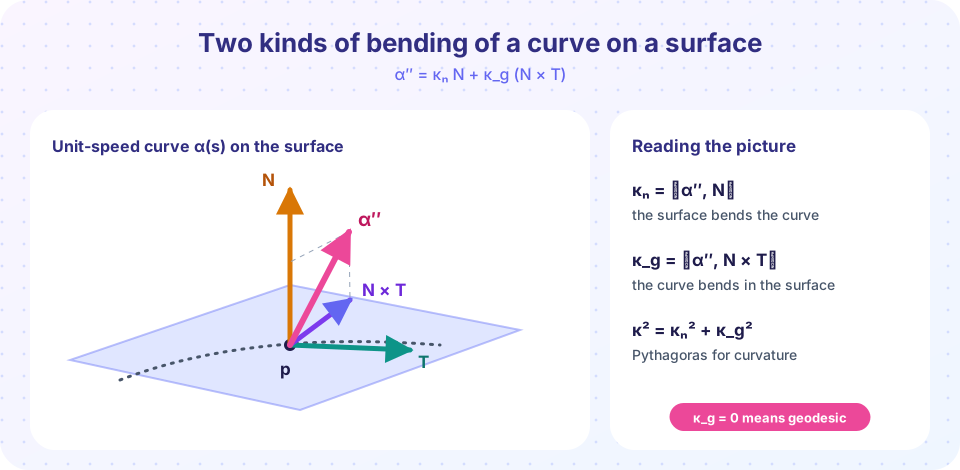
A curve on a surface bends for two different reasons. Part of its bending is forced on it by the surface: a path along the equator of a ball must curve because the ball curves. The other part is the curve's own steering within the surface: a path that deviates left or right of the straightest line available. The first part is the normal curvature you met in Chapter 5. The second is the geodesic curvature, and it is the quantity that appears when you walk around the edge of a region.
The local Gauss–Bonnet theorem says: if you walk around the boundary of a small region, the total steering you did, plus the total curvature inside, plus the corner turns, adds up to exactly one full turn, 2π, as it does in the plane. On a flat plane the interior term vanishes and you recover the old fact that a polygon's exterior angles sum to a full turn.
What you will learn
- The definition of geodesic curvature
κ_gand the identityκ² = κₙ² + κ_g². - How to compute
κ_gfor circles of latitude. - The statement of the local Gauss–Bonnet theorem with corner angles.
- Why the angles of a geodesic triangle add up to
π + ∬K dA, and what that gives on spheres and hyperbolic planes.
Key terms
Geodesic curvature κ_g: for a unit-speed curve α with tangent T = α′, κ_g = ⟨α″, N × T⟩, the signed amount by which the curve bends within the surface (positive when it turns left of T as seen along N).
Exterior angle θᵢ: at a corner of a piecewise smooth curve, the angle you must turn to go from the incoming direction to the outgoing one, in (−π, π).
Interior angle φᵢ: π − θᵢ.
Simple region: a region homeomorphic to a disk, with a simple closed piecewise smooth boundary curve traversed counterclockwise (region on the left).
Geodesic triangle: a region bounded by three geodesic arcs.
Geodesic curvature
For a unit-speed curve α(s) on an oriented surface with unit normal N, the vectors T = α′, N and N × T form an orthonormal frame, and α″ is perpendicular to T. So
α″ = κₙ N + κ_g (N × T),
with κₙ = ⟨α″, N⟩ and κ_g = ⟨α″, N × T⟩. Taking squared lengths, κ² = κₙ² + κ_g², where κ = |α″| is the curvature of α as a space curve. A curve is a geodesic exactly when κ_g = 0. Reversing the direction of travel flips the sign of κ_g; flipping N also flips it.
Example: circles of latitude
On a sphere of radius R, take the circle at polar angle θ traversed eastward, with the outward normal. As a space curve it is a circle of radius R sin θ, so κ = 1/(R sin θ). Its normal curvature is κₙ = −1/R (it bends inward, opposite to N). Then
κ_g² = κ² − κₙ² = (1/R²)(1/sin²θ − 1) = cot²θ / R².
The sign is positive in the northern hemisphere (the circle turns left toward the pole), so κ_g = cot θ / R. At the equator θ = 90°, cot θ = 0: the equator is a geodesic, as it must be.
The local Gauss–Bonnet theorem
Let R be a simple region in a coordinate patch of an oriented surface, bounded by a piecewise smooth closed curve α traversed counterclockwise with exterior angles θ₁, …, θₙ at its corners. Then
∮_α κ_g ds + ∬_R K dA + Σ θᵢ = 2π.
Why it is true (an outline). Choose an orthonormal frame e₁, e₂ of tangent fields on the region and write the unit tangent as T = cos φ e₁ + sin φ e₂. The geodesic curvature is the rate at which T turns relative to a parallel field, which is φ′ plus a correction ω(T) from how the frame itself rotates. Integrating around the boundary, the sum of the φ changes plus corner turns is 2π (the rotation index of a simple closed curve, as in the plane), and the correction term integrates, by Stokes' theorem, to −∬K dA. That gives the formula.
Checks
The plane. K = 0, so ∮κ ds + Σθᵢ = 2π. For a convex polygon κ = 0 on the sides, and the exterior angles add up to 2π. For a circle, ∮κ ds = (1/ρ)(2πρ) = 2π.
A spherical cap. On a sphere of radius R, let the region be the cap 0 ≤ θ ≤ θ₀, boundary the latitude circle (no corners). Then ∮κ_g ds = (cot θ₀ / R)(2πR sin θ₀) = 2π cos θ₀, and ∬K dA = (1/R²)·2πR²(1 − cos θ₀) = 2π(1 − cos θ₀). Their sum is 2π for every θ₀. At θ₀ = 90° (a hemisphere) the boundary is a geodesic and the whole 2π is curvature.
A geodesic triangle. All three sides have κ_g = 0. With interior angles A, B, C the exterior angles are π − A, π − B, π − C, so
∬K dA = 2π − (3π − A − B − C) = A + B + C − π.
- On a sphere of radius
R(K = 1/R²): area= R²(A + B + C − π), Girard's theorem. The octant triangle has3·(π/2) − π = π/2, areaπR²/2. - On a plane (
K = 0):A + B + C = π. - On a hyperbolic plane with
K = −1: area= π − (A + B + C), so the angle sum is less thanπ. Large triangles have a bounded area< π.
The angle sum of a triangle is therefore a curvature meter: more than π means K > 0, exactly π means flat, less than π means K < 0.
Surveying. Gauss, who worked as a surveyor, measured a large triangle between three German hilltops in the 1820s, and the story is often told that he was checking whether its angles summed to π. Earth's curvature is so gentle that any excess is far below the accuracy of 19th-century instruments: for a triangle on Earth, with R ≈ 6371 km, the excess in radians is the area divided by R², tiny unless the area is huge.
Common misconceptions
"The sum of the angles of a triangle is always 180°." That is a statement about flat geometry. On a sphere it is larger; in the hyperbolic plane it is smaller.
"κ_g is always nonnegative." It is signed. Traversing a circle clockwise instead of counterclockwise flips its sign. In the theorem the boundary must be counterclockwise (region on the left), so a hole in a region would be traversed the other way.
"Geodesic curvature is the same as ordinary curvature." Only on a plane. On a surface they differ by the normal part: κ² = κₙ² + κ_g².
Try it
First, test the theorem on a region whose boundary is not a circle: the part of the unit sphere below the wavy curve θ(φ) = 1 + 0.25 sin 3φ. We compute κ_g numerically from the 3D curve and the enclosed area ∫(1 − cos θ(φ)) dφ.
Press Run (or Ctrl + Enter) to see the result here.
Program input · what you'd type while the program runs
Type the answers before you press Run, one per line. Each time the program reads a line (with input()), it gets the next line from this box.
The sum is 2π even though neither term alone is a round number. Second, triangles. For a spherical triangle with given side lengths, compute the angles from the spherical law of cosines, then compare the angle excess with the area computed independently from L'Huilier's formula. Do the same in the hyperbolic plane with the angle defect.
Press Run (or Ctrl + Enter) to see the result here.
Program input · what you'd type while the program runs
Type the answers before you press Run, one per line. Each time the program reads a line (with input()), it gets the next line from this box.
Third, the cap as a stacked bar: the boundary term and the curvature term always fill exactly 2π.
The bar is a picture of the two formulas for the unit sphere; it is not a numerical integration.
Check your understanding
Quick check · 5 questions
of 5 answered You scored / 5 · perfect!
-
1. Which formula is correct for a unit-speed curve on a surface?
α″ splits into perpendicular parts κₙ N and κ_g (N × T), so squared lengths add. -
2. The geodesic curvature of the equator of a sphere is
The equator is a great circle, a geodesic, so κ_g = 0. -
3. For a geodesic triangle with interior angles A, B, C, the integral of K over the triangle equals
∬K dA = 2π − Σ(π − φᵢ) = A + B + C − π. -
4. In the hyperbolic plane (K = −1) the angle sum of a triangle is
∬K dA = A + B + C − π is negative, so the sum is below π. -
5. For a spherical cap bounded by a latitude circle, ∮κ_g ds + ∬K dA equals
No corners, so the local Gauss-Bonnet gives 2π.
Summary
α″ = κₙ N + κ_g (N × T);κ² = κₙ² + κ_g²; geodesics are exactly the curves withκ_g = 0.- A latitude circle at polar angle
θon a sphere of radiusRhasκ_g = cot θ / R. - Local Gauss–Bonnet:
∮κ_g ds + ∬K dA + Σθᵢ = 2π. - Geodesic triangle:
∬K dA = A + B + C − π(sphere: Girard; plane:0; hyperbolic: negative).
Track your progress
Create a free account to tick off lessons and pick up where you left off on any device.
of Differential Geometry lessons completed