


















Lesson 41 of 44 · Projects and Practice
Practice set: differential geometry of surfaces
Ten practice problems on normal curvature, K and H, geodesics, holonomy, Gauss-Bonnet and the hyperbolic plane, with worked solutions, a code checker and a self-test.
Reading mathematics is not the same as doing it. This lesson gives you ten problems that cover Chapters 5 to 8. Try each problem on paper first, then open the solution below it, then run the checker, which recomputes every answer with sympy or NumPy so you can see that the numbers are right.
What you will learn
- To choose the right formula for a curvature, geodesic or Gauss–Bonnet question.
- To check hand computations with a short program.
- Which answers are suspicious (sign errors, forgotten factors of 2, radians versus degrees).
Problems and worked solutions
Problem 1 (principal curvatures). For the surface z = x² + 3y² at the origin with upward normal, find the principal curvatures, K, H, and the normal curvature in the direction 30° from the x-axis.
Solution. Write z = ½(2x² + 6y²), so a = 2, b = 0, c = 6. The shape matrix is diag(2, 6): κ₁ = 6, κ₂ = 2. Then K = 12, H = 4. Euler's formula with the angle measured from the x-axis (the direction of curvature 2): κₙ = 2cos²30° + 6sin²30° = 2·0.75 + 6·0.25 = 3.
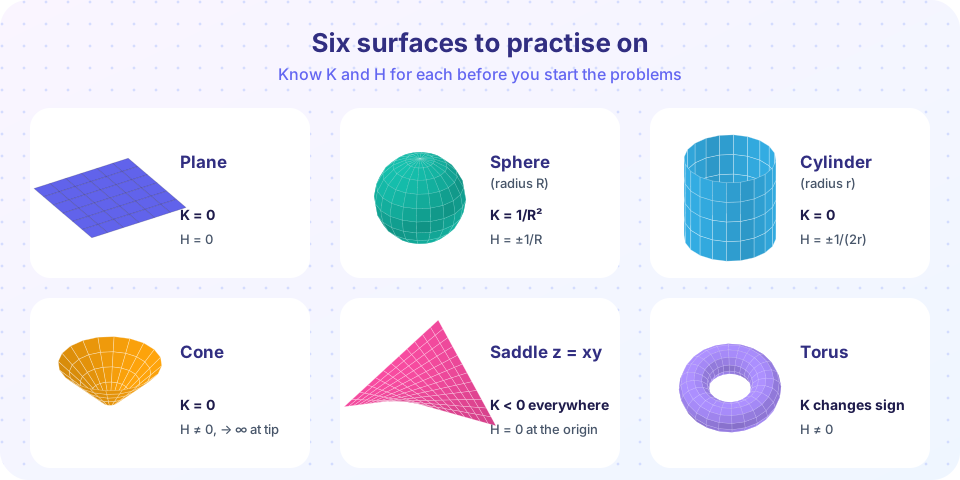
Problem 2 (cylinder). A cylinder has radius 5 cm. Find K and |H|.
Solution. Principal curvatures 0 and 1/5. So K = 0 and |H| = 1/10 = 0.1 cm⁻¹.
Problem 3 (torus). For the torus with R = 4, r = 1, find K and |H| at the point v = π/3.
Solution. K = cos v / (r(R + r cos v)) = 0.5/(4 + 0.5) = 1/9 ≈ 0.1111. |H| = (R + 2r cos v)/(2r(R + r cos v)) = (4 + 1)/(2 · 4.5) = 5/9 ≈ 0.5556.
Problem 4 (spherical triangle). A geodesic triangle on a sphere of radius 6371 km has angles 80°, 75°, 70°. Find its area.
Solution. Angle excess = 225° − 180° = 45° = π/4. Area = R² · π/4 = 6371² · 0.785398 ≈ 3.188 × 10⁷ km².
Problem 5 (cone). A cone has half-angle 30° (angle between axis and side) and slant height 10 cm. Find the angle of the flat sector that rolls into it, and the angle defect at the apex.
Solution. The base circle has circumference 2π · 10 sin 30° = 10π cm, equal to the arc of the sector of radius 10: the sector angle is 10π/10 = π (180°). The defect is 2π − π = π.
Problem 6 (Clairaut). On the unit sphere a geodesic crosses the equator at 30° to the meridian. How far north does it go?
Solution. Clairaut: r sin ψ = const. At the equator r = 1, ψ = 30°, so c = 0.5. The northernmost point has ψ = 90° and r = c = 0.5, so cos(latitude) = 0.5: latitude 60°. (It is the great circle inclined by 60° to the equator.)
Problem 7 (Gauss–Bonnet). A closed orientable surface of genus 3 has constant K = −1. Find its area.
Solution. χ = 2 − 6 = −4, ∬K dA = −8π, so area = 8π ≈ 25.13.
Problem 8 (holonomy). A vector is parallel-transported once around the circle of latitude 30° N on the unit sphere. By what angle is it rotated (mod 2π)?
Solution. Polar angle θ₀ = 60°. Enclosed cap area = 2π(1 − cos 60°) = π, so the holonomy is π: the vector comes back reversed.
Problem 9 (hyperbolic triangle). In a hyperbolic plane of constant curvature K = −1/4, a triangle has angles 50°, 40°, 30°. Find its area.
Solution. ∬K dA = A + B + C − π = −60° = −π/3, so area = (π/3)/(1/4) = 4π/3 ≈ 4.189.
Problem 10 (half-plane distance). Find the hyperbolic distance between (0, 1) and (0, e) in the metric (dx² + dy²)/y².
Solution. The vertical segment is a geodesic: length ∫₁ᵉ dy/y = ln e = 1. Check with the formula arccosh(1 + (e − 1)²/(2e)) = arccosh(cosh 1) = 1.
Sanity checks. Is K unchanged when you flip the normal? Does a flat answer (cylinder, cone) come out with K = 0? Is every angle in radians when you multiply by an area or a length?
Common misconceptions
Forgetting the 1/2 in H. H = (κ₁ + κ₂)/2, not the sum (some texts define the sum, so always check which convention is used).
Mixing degrees and radians. Angle excess in degrees must be converted before multiplying by R².
Using 4π for every closed surface. It holds only for genus 0; torus 0, genus 2 −4π, genus 3 −8π.
Try it
Check all the numerical answers with one program.
Press Run (or Ctrl + Enter) to see the result here.
Program input · what you'd type while the program runs
Type the answers before you press Run, one per line. Each time the program reads a line (with input()), it gets the next line from this box.
Now test yourself without the solutions in view. The page asks six of the problems with fresh numbers.
The self-test checks numbers only; it does not accept symbolic answers like 1/9.
Check your understanding
Quick check · 5 questions
of 5 answered You scored / 5 · perfect!
-
1. A surface has principal curvatures 3 and −2 at a point. Then K and H are
K = 3·(−2) = −6 and H = (3 − 2)/2 = 0.5. -
2. A geodesic triangle on the unit sphere has all three angles equal to 100°. Its area is
Excess = 300° − 180° = 120° = 2π/3 ≈ 2.094. -
3. The total curvature of a closed orientable surface of genus 5 is
χ = 2 − 10 = −8, so ∬K dA = −16π. -
4. Rolling a flat sector of angle 120° into a cone leaves an angle defect at the apex of
The defect is 360° − 120° = 240°. -
5. In the half-plane metric, the distance from (0, 1) to (0, 4) is
∫₁⁴ dy/y = ln 4 ≈ 1.386.
Summary
- Match the problem to the tool: Euler's formula for normal curvature,
K = κ₁κ₂, Girard's angle excess, Clairaut's relation,2πχ, the holonomy formula∬K dA. - Check units, radians and signs; check with a short program.
- Curvature of spheres
1/R², cylinders0, toricos v / (r(R + r cos v)), hyperbolic plane−1.
Track your progress
Create a free account to tick off lessons and pick up where you left off on any device.
of Differential Geometry lessons completed