


















Lesson 14 of 44 · Surfaces and Parametrizations
Tangent Planes and Normal Vectors
Find the tangent plane of a surface from r_u and r_v, compute the unit normal for patches, graphs and level sets, and understand orientation and change of parameters.
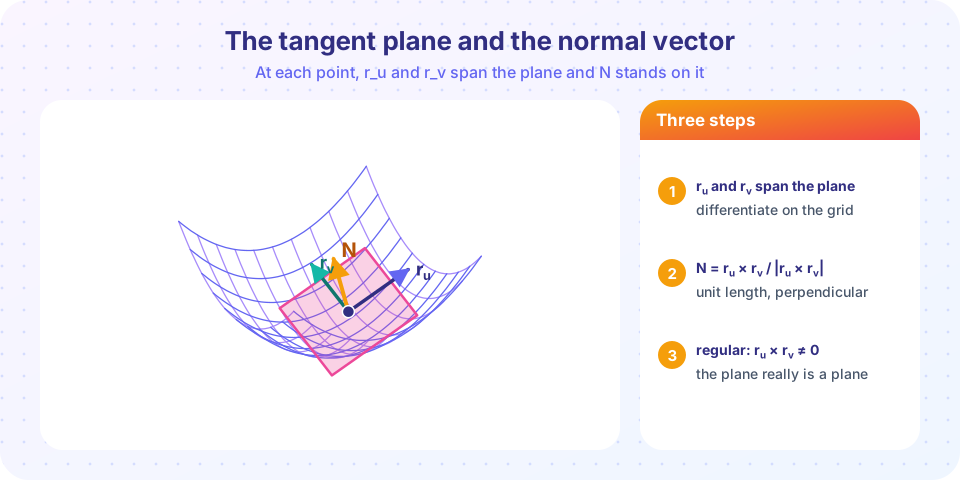
At each point of a smooth surface there is one plane that touches it flatly: the tangent plane. Every velocity of every curve drawn on the surface through that point lies in this plane, and the single direction at right angles to it is the normal. Normals decide how light bounces off a surface in computer graphics, which way a boat floats on a curved hull, and which side of the surface a flow crosses. This lesson shows how to compute both from a parametrization.
What you will learn
- The tangent plane as the span of
r_uandr_v - The formula for the unit normal, and its form for graphs and level sets
- What orientation of a surface means
- Why the tangent plane does not depend on the parametrization
Key terms
Tangent plane T_p S: the set of all velocity vectors of curves on S through p.
Unit normal N: (r_u × r_v) / |r_u × r_v|.
Normal line: the line through p in the direction of N.
Orientation: a continuous choice of unit normal over the surface.
Gradient: ∇F = (F_x, F_y, F_z); it is perpendicular to the level surfaces of F.
The tangent plane
Let r(u, v) be a patch and p = r(u₀, v₀). We saw that a curve on the patch has velocity r_u u′ + r_v v′. Since u′ and v′ can be any numbers, the velocities of all curves through p fill out exactly the set
T_p S = { a r_u + b r_v : a, b in R }
If r_u and r_v are linearly independent (neither is zero and they are not parallel), this is a plane through the origin. Placed at p, the tangent plane is the set of points p + a r_u + b r_v. It is the best flat approximation of the surface at p, the 2D version of the tangent line to a curve.
The normal vector
Two independent vectors r_u and r_v have a cross product that is nonzero and perpendicular to both. Scaling it to length 1 gives the unit normal
N = (r_u × r_v) / |r_u × r_v|.
The equation of the tangent plane at p is then (X − p) · N = 0.
Sphere. For the unit sphere in spherical coordinates, r_u × r_v = sin u · (sin u cos v, sin u sin v, cos u) = sin u · r. Since sin u > 0 on 0 < u < π, N = r: the normal points straight out from the centre, as expected.
Graph. For z = f(x, y) with r(u, v) = (u, v, f(u, v)): r_u = (1, 0, f_x), r_v = (0, 1, f_y) and r_u × r_v = (−f_x, −f_y, 1), so
N = (−f_x, −f_y, 1) / sqrt(1 + f_x² + f_y²)
Level surface. If the surface is F(x, y, z) = c, any curve in it satisfies d/dt F(α(t)) = ∇F · α′ = 0, so ∇F is perpendicular to every tangent vector, and N = ∇F / |∇F| (when ∇F ≠ 0). For the sphere x² + y² + z² = 1, ∇F = 2(x, y, z), giving N = (x, y, z), the same answer.
Worked example. For the paraboloid z = (x² + y²)/2 at (0.4, 0.3): the height is f = 0.125, f_x = 0.4, f_y = 0.3, so N = (−0.4, −0.3, 1)/√1.25 and the tangent plane is z = 0.125 + 0.4(x − 0.4) + 0.3(y − 0.3) = 0.4x + 0.3y − 0.125.
Orientation
Both N and −N are unit normals. Choosing one continuously across the whole surface orients it. The patch formula picks N = r_u × r_v / |…| automatically. Swap the two parameters (use r̃(u, v) = r(v, u)) and the cross product, hence N, changes sign. Spheres, cylinders and tori can be oriented (they have an "outside" and "inside"); the Möbius band famously cannot, because walking once around it carries N back to −N.
Independence of the parametrization
Suppose another patch r̃(ũ, ṽ) covers the same surface, with u = u(ũ, ṽ) and v = v(ũ, ṽ). By the chain rule
r̃_ũ = r_u u_ũ + r_v v_ũ r̃_ṽ = r_u u_ṽ + r_v v_ṽ
so both new tangent vectors are combinations of the old ones: they span the same plane. The cross product picks up the Jacobian determinant of the change of parameters:
r̃_ũ × r̃_ṽ = (u_ũ v_ṽ − u_ṽ v_ũ) · (r_u × r_v)
If the Jacobian is positive, the unit normal is unchanged; if negative, it flips. The tangent plane belongs to the surface, not to the parametrization.
Common misconceptions
"The normal is unique." Only up to sign. The two choices correspond to the two orientations; the parametrization picks one.
"r_u × r_v is already a unit vector." Its length is the area of the little parallelogram spanned by r_u and r_v, which is usually not 1. You must divide by it to get N.
"The tangent plane touches the surface only at the point." It may cross the surface elsewhere. The tangent plane is a local approximation, not a global supporting plane (compare a saddle).
Try it
Let sympy find the normal and the tangent plane of the paraboloid at (0.4, 0.3) and confirm the numbers above.
Press Run (or Ctrl + Enter) to see the result here.
Program input · what you'd type while the program runs
Type the answers before you press Run, one per line. Each time the program reads a line (with input()), it gets the next line from this box.
The next program draws the surface, the tangent plane and the normal vector.
Press Run (or Ctrl + Enter) to see the result here.
Program input · what you'd type while the program runs
Type the answers before you press Run, one per line. Each time the program reads a line (with input()), it gets the next line from this box.
Last, orientation. The program computes r_u × r_v for the sphere in the usual order and with the parameters swapped, and checks which way each normal points.
Press Run (or Ctrl + Enter) to see the console output here.
No output.
Check your understanding
Quick check · 5 questions
of 5 answered You scored / 5 · perfect!
-
1. Which set describes the tangent plane at p = r(u0, v0)?
The plane spanned by the two tangent vectors, placed at p. -
2. For the graph z = f(x, y), the unit normal is proportional to...
r_u × r_v = (−f_x, −f_y, 1). -
3. For the sphere x^2 + y^2 + z^2 = 1, what is the gradient direction at (x, y, z)?
∇F = 2(x, y, z), which points radially outward and is perpendicular to the sphere. -
4. What happens to the unit normal if you swap u and v in a patch?
The cross product is antisymmetric: r_v × r_u = −(r_u × r_v). -
5. How does r_u x r_v change under a change of parameters?
The new tangent vectors are linear combinations of the old ones, so the cross product scales by the determinant.
Summary
- The tangent plane is spanned by
r_uandr_v; it contains every velocity of curves on the surface through the point. - The unit normal is
N = r_u × r_v / |r_u × r_v|; for graphs(−f_x, −f_y, 1)/…, for level sets∇F/|∇F|. - Swapping parameters flips
N; a surface is orientable ifNcan be chosen continuously. - The tangent plane is intrinsic to the surface; changing parameters only scales the cross product by the Jacobian.
Track your progress
Create a free account to tick off lessons and pick up where you left off on any device.
of Differential Geometry lessons completed