


















Lesson 12 of 44 · Surfaces and Parametrizations
Chapter 3 Overview: Surfaces and Parametrizations
Preview of chapter 3: how surfaces are described by patches r(u, v), how tangent vectors and normals arise, and what makes a surface regular.
Curves have one parameter. Surfaces have two, and that one extra parameter changes the picture: instead of a single tangent direction at each point there is a whole tangent plane, and instead of a normal plane there is a single normal line. This chapter builds the vocabulary for surfaces: patches, coordinate curves, tangent planes, normals and regularity. The measurements of chapter 4 (lengths, areas, bending) rest on it.
What you will learn
- What each lesson in the chapter covers
- Why surfaces need two parameters and what the grid lines mean
- The three objects you will compute again and again:
r_u,r_vand the normalN
Key terms
Surface patch: a smooth map r(u, v) from a region of the plane into space.
Coordinate curve: the curve you get by fixing one parameter and varying the other.
Tangent plane: the plane spanned by r_u and r_v at a point.
Normal vector: a unit vector perpendicular to the tangent plane.
Regular surface: a surface where r_u × r_v ≠ 0 everywhere.
The chapter in four slides
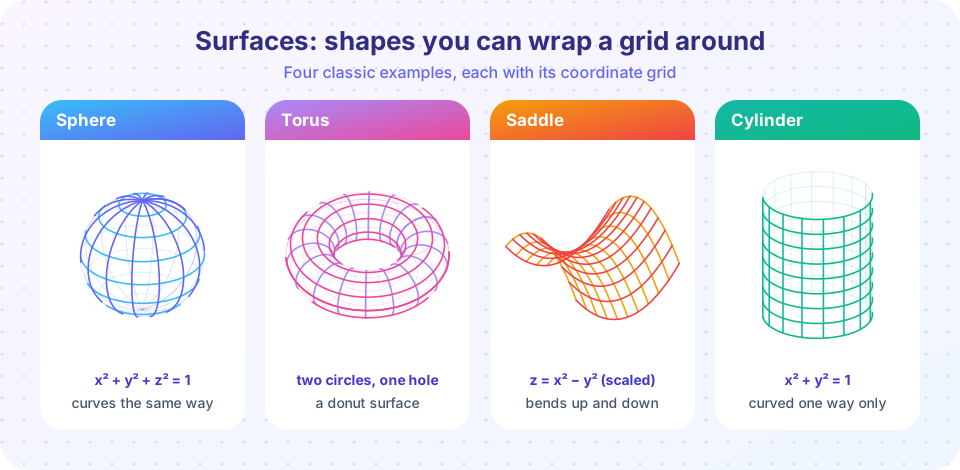
A surface is a painted grid
Tangent vectors
The normal
Regular surfaces
What each lesson covers
- Parametrized Surfaces: the map
r(u, v), coordinate curves, and curves drawn on a surface. - Tangent Planes and Normal Vectors:
r_u,r_v, the tangent plane, the unit normal and orientation. - Regular Surfaces and Standard Examples: graphs, surfaces of revolution, the helicoid, the torus and the cone.
- Chapter 3 Review: formulas on one page and a mixed quiz.
Common misconceptions
"A surface is the graph of a function." Graphs are one kind of surface. A sphere or a torus cannot be a single graph z = f(x, y), which is why we need parametrizations.
"The grid lines are part of the surface." They belong to the parametrization. The same surface can be covered by many different grids.
"A surface has one tangent vector at each point." It has a whole plane of them: any combination a r_u + b r_v.
Try it
A surface gallery before the theory. Each surface below is a parametrization (u, v) → (x, y, z) evaluated on a grid. Study how each formula produces its shape, then edit the formulas.
Press Run (or Ctrl + Enter) to see the result here.
Program input · what you'd type while the program runs
Type the answers before you press Run, one per line. Each time the program reads a line (with input()), it gets the next line from this box.
The second program asks the first question of the chapter: at a given point, what are the two tangent vectors? It differentiates numerically and compares with the exact answer for the sphere.
Press Run (or Ctrl + Enter) to see the console output here.
No output.
Check your understanding
Quick check · 4 questions
of 4 answered You scored / 4 · perfect!
-
1. How many parameters does a surface patch have?
A patch is a map r(u, v) of two parameters, so the surface is two-dimensional. -
2. What does r_u mean?
r_u = ∂r/∂u is the velocity of the u-coordinate curve through the point. -
3. Which vector is perpendicular to the tangent plane?
The cross product of two tangent vectors is perpendicular to both, hence to the plane they span. -
4. A surface is regular when...
Regularity means the two tangent vectors are never parallel (or zero), so the tangent plane always exists.
Summary
- A surface patch is a map
r(u, v); its grid lines are coordinate curves. r_uandr_vare tangent vectors; they span the tangent plane.N = (r_u × r_v) / |r_u × r_v|is the unit normal; the surface is regular where this makes sense.- Chapter 3 builds these ideas step by step; chapter 4 uses them to measure.
Next: Parametrized Surfaces
Track your progress
Create a free account to tick off lessons and pick up where you left off on any device.
of Differential Geometry lessons completed