


















Lesson 22 of 44 · Curvature
Chapter 5 overview: what curvature measures
A tour of Chapter 5: how normal, principal, Gaussian and mean curvature describe the bending of a surface, and why Gauss called one result remarkable.
A plane is flat and a sphere is not. You can feel it without any mathematics: a sheet of paper lies down on a table, but you cannot press a ball's skin flat without wrinkling it. Chapter 5 turns that feeling into numbers. By the end you will be able to take any smooth surface, stand at any point, and say how strongly and in which directions the surface bends.
The word to hold on to is curvature. For a curve, curvature was one number at each point: how fast the tangent turns. A surface has more room to bend, because there are many directions to look in. So curvature of a surface is a small family of numbers, and the whole chapter is about organizing that family.
What you will learn
- Why a surface needs several curvature numbers instead of one.
- How the lessons of this chapter build on each other, from normal curvature to the Theorema Egregium.
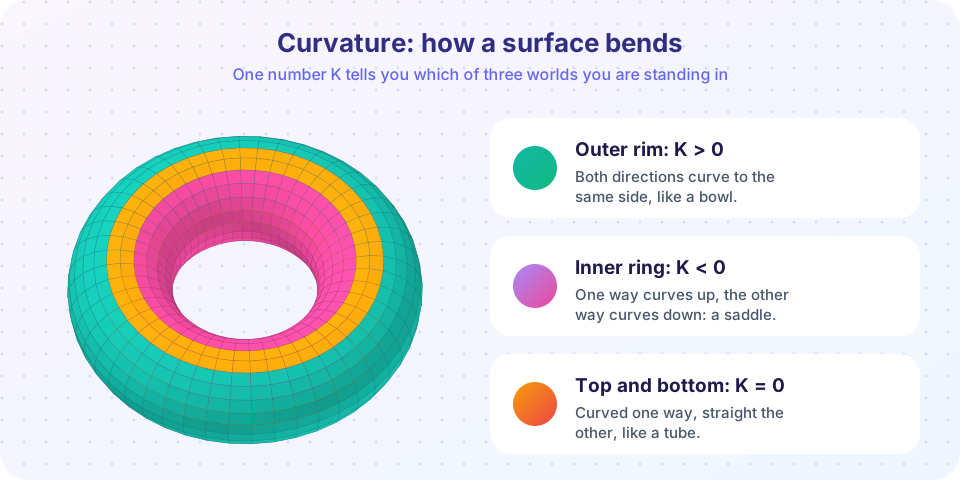
- What the sign of the Gaussian curvature K tells you at a glance.
- How you will use Python in this chapter to compute curvature from a formula for the surface.
The big picture in four steps
Slice the surface
Find the extremes
Combine them
The surprise
That is Gauss's Theorema Egregium.
What each lesson covers
- Normal curvature and principal curvatures shows how to slice a surface in every direction, why the extremes of the slices are special, and how Euler's formula ties all directions together.
- Gaussian and mean curvature multiplies and averages the principal curvatures, classifies every point as elliptic, hyperbolic, parabolic or planar, and meets minimal surfaces such as soap films.
- The Theorema Egregium proves nothing new from scratch but explains the astonishing statement that K can be computed from lengths alone, and what that means for maps of the Earth and for pizza slices.
- Chapter 5 review gives you a one-page picture of the chapter and ten mixed questions.
A first look: K on a doughnut
Before any theory, look at real numbers. A torus with big radius R (center of the hole to center of the tube) and tube radius r has Gaussian curvature K = cos v / (r (R + r cos v)), where v is the angle around the tube. You will derive this in lesson 3. For now, plot it and see the three zones from the picture above.
Press Run (or Ctrl + Enter) to see the result here.
Program input · what you'd type while the program runs
Type the answers before you press Run, one per line. Each time the program reads a line (with input()), it gets the next line from this box.
The curve crosses zero exactly where cos v = 0, the top and bottom circles of the doughnut. Positive on the outside, negative on the inside, zero in between: this is the pattern you saw in the picture.
How to read the sign of K
Here is a tiny classifier. Give it the two principal curvatures and it returns K, H and the type of point. You will build the same logic with real surfaces later.
Press Run (or Ctrl + Enter) to see the console output here.
No output.
Common misconceptions
"Curvature is about how the surface looks from outside." Part of it is. But the Gaussian curvature K turns out to be invisible to the outside: it can be measured by an ant that never leaves the surface. That is the surprise at the end of the chapter.
"A surface that bends in one direction has curvature one number." A cylinder bends around its circle and is straight along its axis. One number cannot describe that. You need both principal curvatures.
Check your understanding
Quick check · 4 questions
of 4 answered You scored / 4 · perfect!
-
1. On the outer rim of a torus the Gaussian curvature is
On the outer rim both principal directions curve toward the same side, so K = κ₁κ₂ is positive. -
2. Which lesson explains why K can be found from lengths and angles on the surface alone?
The Theorema Egregium states that K depends only on the first fundamental form. -
3. A plane has
Both principal curvatures of a plane are zero, so their product and average are zero. -
4. The function classify(0, 0.5) in the editor reports a parabolic point because
One principal curvature vanishes and the other does not, like the side of a cylinder.
Summary
- A surface bends differently in different directions, so it has two principal curvatures κ₁ and κ₂ at each point.
- K = κ₁κ₂ and H = (κ₁ + κ₂)/2 are the two standard combinations.
- The sign of K sorts points into bowl-like, saddle-like and tube-like.
- Chapter 5 ends with the Theorema Egregium: K is intrinsic.
Track your progress
Create a free account to tick off lessons and pick up where you left off on any device.
of Differential Geometry lessons completed