


















Lesson 16 of 44 · Surfaces and Parametrizations
Chapter 3 Review: Surfaces
One-page recap of chapter 3: patches, tangent vectors, normals, regularity and standard parametrizations, with a nine-question mixed quiz.
Chapter 3 gave you the language of surfaces: a patch r(u, v) paints a flat grid onto space, the partial derivatives r_u and r_v span the tangent plane, and their cross product gives the normal. Regularity (r_u × r_v ≠ 0) is the condition that makes all of this work. This review collects the formulas and then tests the whole chapter.
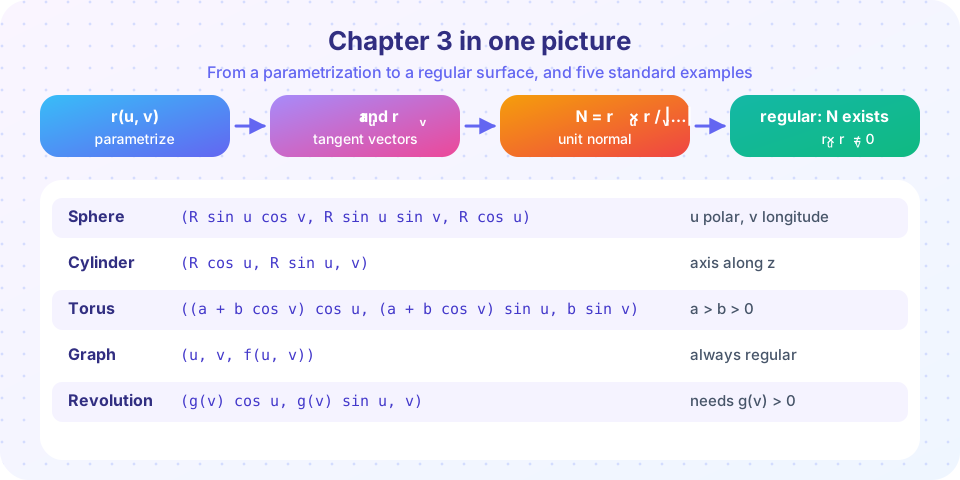
Chapter in a table
| Idea | Formula | Where |
|---|---|---|
| Patch | r(u, v) = (x, y, z) on a planar domain |
Parametrized surfaces |
| Coordinate curves | u ↦ r(u, v₀), v ↦ r(u₀, v) with velocities r_u, r_v |
Parametrized surfaces |
| Curve on a surface | α′ = r_u u′ + r_v v′ |
Parametrized surfaces |
| Tangent plane | spanned by r_u, r_v |
Tangent planes |
| Unit normal | N = r_u × r_v / ‖r_u × r_v‖ |
Tangent planes |
| Graph normal | (−f_x, −f_y, 1) / √(1 + f_x² + f_y²) |
Tangent planes |
| Level-set normal | ∇F / ‖∇F‖ |
Tangent planes |
| Regular patch | r_u × r_v ≠ 0 everywhere |
Regular surfaces |
| Surface of revolution | ‖r_u × r_v‖ = g √(g′² + h′²) |
Regular surfaces |
What you should be able to do
- Parametrize a sphere, cylinder, cone, graph or torus, and name its coordinate curves.
- Compute
r_u,r_vand the unit normal for a simple patch, by hand and in code. - Decide whether a patch is regular, and locate singular points.
- Explain why swapping
uandvflips the normal.
Try it
First, a normal vector field on a torus. The program computes r_u × r_v at grid points and checks that it points away from the centre circle of the tube everywhere.
Press Run (or Ctrl + Enter) to see the result here.
Program input · what you'd type while the program runs
Type the answers before you press Run, one per line. Each time the program reads a line (with input()), it gets the next line from this box.
Second, a numerical check that r_u × r_v scales with the Jacobian. The change of parameters u = 2s, v = t + 1 has Jacobian 2, so the cross product of the new patch should be exactly twice the old one at the matching point.
Press Run (or Ctrl + Enter) to see the console output here.
No output.
Check your understanding
Quick check · 9 questions
of 9 answered You scored / 9 · perfect!
-
1. Which vectors span the tangent plane of a patch r(u, v)?
The tangent plane consists of all combinations a r_u + b r_v. -
2. Which formula gives the unit normal of a patch?
Normalise the cross product of the tangent vectors. -
3. For the graph z = x^2 + y^2 at (1, 0), the (unnormalised) normal (−f_x, −f_y, 1) is...
f_x = 2x = 2 and f_y = 2y = 0 at (1, 0), so the vector is (−2, 0, 1). -
4. What does |r_u x r_v| measure geometrically?
The magnitude of a cross product is the area of the parallelogram it comes from. -
5. The apex of the double cone is singular because...
The surface has no tangent plane at the apex. -
6. Why does spherical-coordinate parametrization fail at the poles?
At u = 0 or π, r_v vanishes, so r_u x r_v = 0 and the patch is not regular. -
7. If you swap u and v in a patch, the unit normal...
The cross product is antisymmetric. -
8. A surface of revolution r = (g cos u, g sin u, h) has |r_u x r_v| equal to...
Computed in the lesson: |r_u × r_v| = g √(g′² + h′²). -
9. Which is true of every graph z = f(x, y) with f smooth?
The third component of r_u × r_v is always 1.
Summary
- A patch gives two tangent vectors, a tangent plane and a normal; regularity makes this work.
- Graphs, tori and helicoids are regular; cone apexes and sphere poles (in spherical coordinates) show the two kinds of failure.
- Changing parameters multiplies
r_u × r_vby the Jacobian; swappinguandvflips the normal. - Next we will measure lengths, angles and bending on these surfaces.
Next: Chapter 4 Overview: The First and Second Fundamental Forms
Track your progress
Create a free account to tick off lessons and pick up where you left off on any device.
of Differential Geometry lessons completed