


















Lesson 23 of 44 · Curvature
Normal curvature and principal curvatures
Slice a surface in every direction, measure the bending of each slice, and discover principal curvatures, principal directions and Euler's formula with worked examples.
Stand on a hillside and look downhill: the ground curves one way. Turn ninety degrees and look along the slope: it may be almost straight, or it may curve the opposite way, like on a mountain pass. A surface does not have one curvature at a point. It has a curvature for every direction you choose, and the first job of this lesson is to measure that.
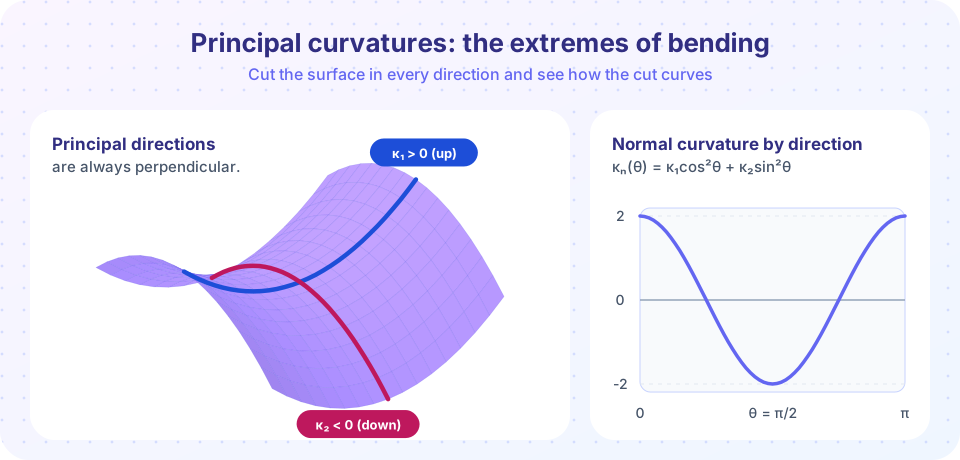
The tool is the normal section. Take the surface normal N at a point p and a direction v in the tangent plane. The plane spanned by N and v slices the surface in a curve. How sharply that curve bends is the normal curvature κₙ(v). Then comes the beautiful part: among all directions there is a largest and a smallest value of κₙ, they sit at right angles to each other, and every other direction is a blend of the two.
What you will learn
- How the normal curvature κₙ of a direction is defined and why it only depends on the direction.
- How to compute κₙ from the first and second fundamental forms.
- What the shape operator is and why its eigenvalues are the principal curvatures.
- How Euler's formula gives the normal curvature in every direction from just two numbers.
Key terms
Normal section: the curve where the plane through p spanned by N and a tangent direction v meets the surface.
Normal curvature κₙ(v): the signed curvature of that curve at p. Positive if the curve bends toward N.
Shape operator S: the linear map S(w) = −dN(w) on the tangent plane; it records how the normal tilts as you move.
Principal curvatures κ₁, κ₂: the maximum and minimum of κₙ; the eigenvalues of S.
Principal directions: the unit vectors e₁, e₂ where those extremes happen.
Umbilic point: a point where κ₁ = κ₂ and every direction is principal.
Normal curvature: slicing the surface
Choose a unit tangent vector v at p. Any curve α(s) on the surface with α(0) = p, α′(0) = v and unit speed has an acceleration vector α″. Split it into a part along the normal and a part in the tangent plane:
α″ = κₙ N + (tangential part)
The number κₙ = ⟨α″, N⟩ is the normal curvature. It looks as if it might depend on which curve you picked, but it does not. Since α′ is always tangent, ⟨α′, N⟩ = 0 all along the curve. Differentiate once more:
⟨α″, N⟩ + ⟨α′, N′⟩ = 0, so κₙ = −⟨α′, dN(α′)⟩ = ⟨α′, S(α′)⟩.
Only α′ = v appears on the right. This is Meusnier's theorem: all curves on the surface through p with the same tangent vector have the same normal curvature, and a general curve of curvature κ making angle φ with the normal satisfies κₙ = κ cos φ. The normal section is simply the curve with φ = 0.
The formula with the two fundamental forms
If the surface is x(u, v) and the tangent vector is w = a xᵤ + b xᵥ, then the numerator ⟨w, S w⟩ is the second fundamental form and the denominator |w|² is the first:
κₙ = (e a² + 2f a b + g b²) / (E a² + 2F a b + G b²)
Here E, F, G are the coefficients of the first fundamental form and e, f, g those of the second (e = ⟨xᵤᵤ, N⟩, f = ⟨xᵤᵥ, N⟩, g = ⟨xᵥᵥ, N⟩). It is a ratio of two quadratic forms in the direction (a, b). The ratio does not change if you scale (a, b), which is why it is a function of direction only.
The shape operator and its eigenvalues
Writing κₙ = ⟨v, S v⟩ shows that normal curvature is the quadratic form of the linear map S. A key fact: S is self-adjoint, meaning ⟨S v, w⟩ = ⟨v, S w⟩. In coordinates this is the symmetry of the second fundamental form (f appears twice). The spectral theorem from linear algebra then gives two things:
Shas two real eigenvaluesκ₁ ≥ κ₂.- Eigenvectors for different eigenvalues are perpendicular.
On a unit vector v = cos θ e₁ + sin θ e₂, using S e₁ = κ₁ e₁ and S e₂ = κ₂ e₂:
κₙ(θ) = κ₁ cos²θ + κ₂ sin²θ (Euler's formula)
That is why κ₁ and κ₂ are the maximum and minimum of κₙ: the formula is a weighted average of them, with weights cos²θ and sin²θ that add to 1.
To compute them in coordinates, form the matrix of S in the basis xᵤ, xᵥ:
[S] = [[E, F], [F, G]]⁻¹ · [[e, f], [f, g]]
Its eigenvalues are κ₁, κ₂. (The matrix itself is not symmetric when the basis is not orthonormal, but the eigenvalues are real.)
Worked example 1: a graph at a critical point
Take z = ½(a x² + 2b xy + c y²) at the origin. The tangent plane there is horizontal, N = (0, 0, 1), so E = G = 1, F = 0, and e = a, f = b, g = c. Then [S] = [[a, b], [b, c]] and the principal curvatures are the eigenvalues of that symmetric matrix.
For z = x² − y² we have a = 2, b = 0, c = −2: principal curvatures 2 and −2, along the x-axis and the y-axis. That is the saddle in the picture.
For z = x² + y² we have a = c = 2: an umbilic point with κ₁ = κ₂ = 2.
Worked example 2: a cylinder and a sphere
A cylinder of radius r with the outward normal: along the axis the surface is straight (κ = 0); around the circle it bends away from the outward normal, so κ = −1/r. The principal curvatures are 0 and −1/r.
A sphere of radius R with the inward normal: every normal section is a great circle, which bends toward the center, so κ₁ = κ₂ = 1/R. Every point of a sphere is umbilic.
Orientation. Flipping the normal N → −N flips the sign of every principal curvature. Always say which normal you are using. Products like κ₁κ₂ do not change sign, which is one reason Gaussian curvature is so convenient.
Common misconceptions
"The principal directions are the directions of the coordinate lines." Only by luck. Principal directions come from the eigenvectors of S, and they are perpendicular, while coordinate curves of a parametrization are generally not.
"Curvature of the normal section and curvature of the surface curve are the same." Only when the curve is the normal section. A general curve has κₙ = κ cos φ, so its own curvature κ is at least |κₙ|.
"A surface with large principal curvature is large." Curvature is bending per unit length. A small bowl bends more sharply than a large one.
Try it
First, compute the forms and principal curvatures of several surfaces symbolically. The helper builds E, F, G, e, f, g from any parametrization and returns the eigenvalues of the shape operator at a point.
Press Run (or Ctrl + Enter) to see the result here.
Program input · what you'd type while the program runs
Type the answers before you press Run, one per line. Each time the program reads a line (with input()), it gets the next line from this box.
Notice the signs. They depend on the orientation Xu × Xv that the code picks: for this cylinder it points outward, giving −1/2 and 0, while for this sphere it points inward, giving +1/2. A single value in the list means a double eigenvalue, an umbilic point. Swap u and v in a parametrization and every sign flips.
Second, check Euler's formula by actually slicing a surface. We take a quadratic graph, cut it with vertical planes in many directions, measure the curvature of each slice numerically, and compare with the formula.
Press Run (or Ctrl + Enter) to see the result here.
Program input · what you'd type while the program runs
Type the answers before you press Run, one per line. Each time the program reads a line (with input()), it gets the next line from this box.
The dots lie on the curve, and the curve never leaves the band between κ₂ and κ₁. Third, explore the same idea by hand.
This is a demonstration of the formula on the model surface z = ½(κ₁x² + κ₂y²), not a general surface solver. Drag θ and watch the pink dot ride the curve between κ₂ and κ₁.
Check your understanding
Quick check · 5 questions
of 5 answered You scored / 5 · perfect!
-
1. Meusnier's theorem says that two curves on a surface through p with the same tangent direction have the same
κₙ = ⟨α″, N⟩ depends only on α′(0), so curves with the same tangent have the same normal curvature. -
2. Euler's formula says that for a direction at angle θ from the first principal direction, κₙ equals
At θ = 0 the direction is e₁ and κₙ must equal κ₁, which fixes the cos² term for κ₁. -
3. The principal directions at a point are perpendicular because
S is symmetric with respect to the inner product, and the spectral theorem gives orthogonal eigenvectors. -
4. For z = x² − y² at the origin the principal curvatures (upward normal) are
Here a = 2, b = 0, c = −2, so the shape matrix is diag(2, −2). -
5. A sphere has the same normal curvature in every direction. A point like this is called
At an umbilic point κ₁ = κ₂, so κₙ does not depend on the direction.
Summary
- The normal curvature
κₙ(v) = II(v, v) / I(v, v)measures how a normal section bends; it depends only on the directionv. - The shape operator
S = −dNis self-adjoint, so it has real eigenvaluesκ₁, κ₂(principal curvatures) with perpendicular eigenvectors (principal directions). - Euler's formula
κₙ(θ) = κ₁cos²θ + κ₂sin²θgives every direction from two numbers. - At an umbilic point κ₁ = κ₂ and all directions are principal; flipping the normal flips signs.
Track your progress
Create a free account to tick off lessons and pick up where you left off on any device.
of Differential Geometry lessons completed