


















Lesson 26 of 44 · Curvature
Chapter 5 review: curvature
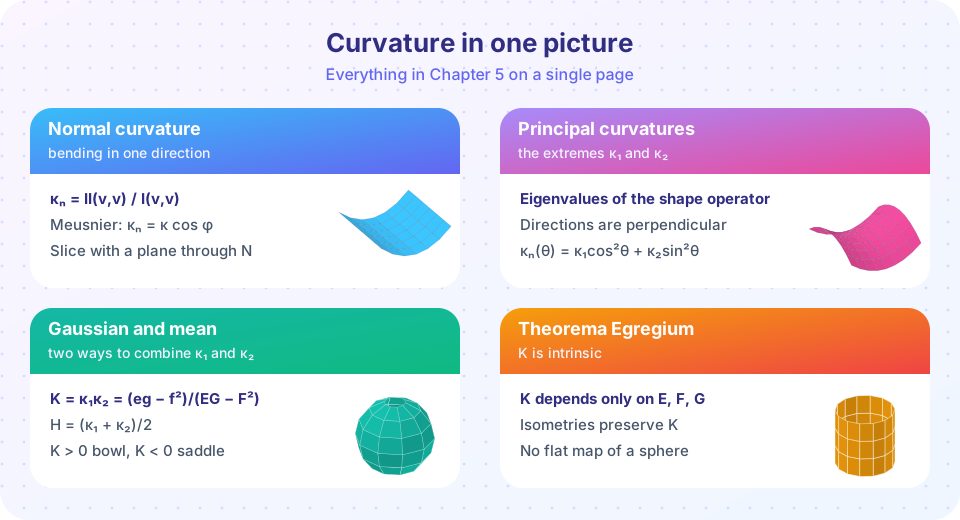
Review Chapter 5 with a one-page picture, a recap table, a numerical check on an ellipsoid, a practice drill and ten mixed questions on curvature.
You have now met the four big ideas of surface curvature: normal curvature, principal curvatures, the pair K and H, and the Theorema Egregium. This review puts them side by side so that you can see how one grows out of the other, tests them on a surface you have not seen yet, and ends with ten questions that mix everything.
What you will learn
- How the four lessons of the chapter fit into one chain of ideas.
- How to check a general curvature computation against a closed-form answer.
- Which facts are intrinsic and which depend on the embedding.
Recap table
| Idea | Formula | Depends on the normal? | Intrinsic? |
|---|---|---|---|
| Normal curvature | κₙ(v) = II(v, v) / I(v, v) |
sign flips with N |
no |
| Principal curvatures | eigenvalues of S = I⁻¹ II |
signs flip with N |
no |
| Euler's formula | κₙ(θ) = κ₁cos²θ + κ₂sin²θ |
sign flips with N |
no |
| Gaussian curvature | K = κ₁κ₂ = (eg − f²)/(EG − F²) |
no | yes (Egregium) |
| Mean curvature | H = (κ₁ + κ₂)/2 |
flips with N |
no |
| Point types | sign of K |
no | yes |
| Minimal surface | H = 0 |
no | no |
The chain of thought is: slice the surface, collect the slices into a quadratic form, diagonalize it, and combine the two eigenvalues. Only the product K survives bending, which is why the whole subject of intrinsic geometry (the next chapters, and later manifolds) is built on it.
Try it
A general check of the machinery on a surface we have not studied: an ellipsoid with semi-axes a = 1, b = 2, c = 3. The closed form for the Gaussian curvature at the point (a, 0, 0) is a²/(b²c²), and at (0, b, 0) it is b²/(a²c²). Compute K from the forms and compare.
Press Run (or Ctrl + Enter) to see the result here.
Program input · what you'd type while the program runs
Type the answers before you press Run, one per line. Each time the program reads a line (with input()), it gets the next line from this box.
The two values of K match the closed forms, the product of the eigenvalues equals K, and H² ≥ K as the inequality predicts. Now drill the two formulas until they are automatic.
This is a practice tool, not a measurement of anything.
Check your understanding
Quick check · 10 questions
of 10 answered You scored / 10 · perfect!
-
1. Normal curvature in direction v is computed as
κₙ is the ratio of the second to the first fundamental form. -
2. The principal directions at a non-umbilic point are
They are eigenvectors of the self-adjoint shape operator. -
3. For κ₁ = 3 and κ₂ = −1 the normal curvature at 45° from the first principal direction is
κₙ = 3·cos²45° + (−1)·sin²45° = 3/2 − 1/2 = 1. -
4. Which pair describes a point of a sphere with radius 5 (any normal)?
κ₁ = κ₂ = ±1/5, so K = 1/25 and |H| = 1/5. -
5. A surface with H = 0 everywhere is
H = 0 defines minimal surfaces; the plane is the trivial example, the catenoid and helicoid are others. -
6. If K > 0 at a point, the surface near that point
Both principal curvatures have the same sign, so the surface is bowl-shaped. -
7. Which quantity is intrinsic?
Only K is determined by the first fundamental form (Theorema Egregium). -
8. On a torus, where is K = 0?
K = cos v / (r(R + r cos v)) vanishes where cos v = 0. -
9. Why can no flat map of the Earth be perfect?
A distance-preserving map would be a local isometry, impossible when K differs. -
10. A cylinder of radius r can be unrolled without stretching because
K = 0 and the first fundamental form equals that of the plane in suitable coordinates.
Summary
- Normal curvature
κₙ = II/Ihas extremesκ₁, κ₂in perpendicular principal directions, and Euler's formula fills in the rest. K = κ₁κ₂andH = (κ₁ + κ₂)/2;Kignores the normal's sign,Hfollows it;H² ≥ K.- Signs of
K: bowl, saddle, tube, flat. - The Theorema Egregium makes
Kintrinsic, so isometries preserve it and flat maps of the sphere must distort.
Track your progress
Create a free account to tick off lessons and pick up where you left off on any device.
of Differential Geometry lessons completed