


















Lesson 43 of 44 · Projects and Practice
Differential geometry cheat sheet
One-page cheat sheet of the key formulas of differential geometry of surfaces: fundamental forms, curvatures, Egregium, geodesics, Gauss-Bonnet and manifolds, plus a calculator.
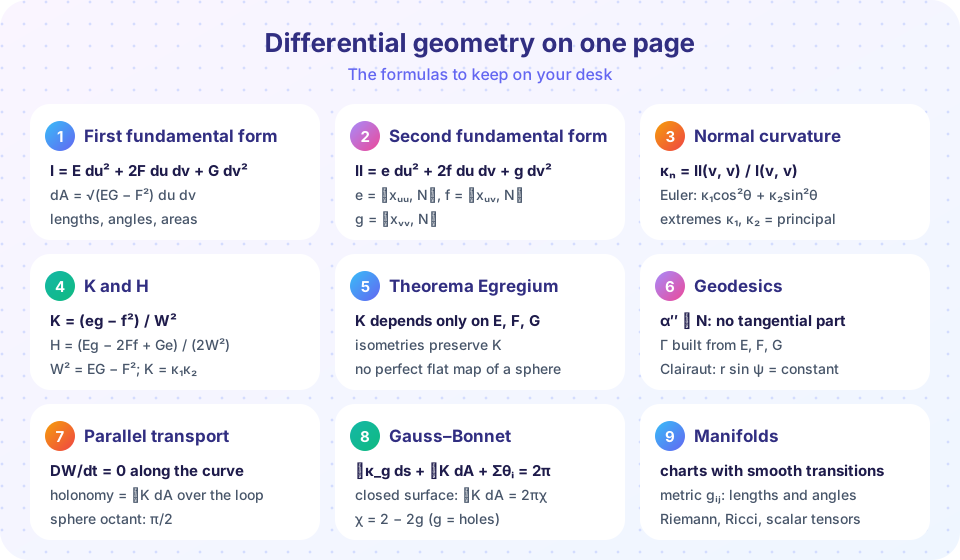
This page puts the formulas of the course in one place. Print it, tape it above your desk, and use the calculators below to check your hand computations. Each card of the picture corresponds to a short section of text, so you can read the formulas with their conditions.
What you will learn
- Where each formula applies and which symbols it uses.
- How to go from
E, F, G, e, f, gtoK,Hand the principal curvatures in one step. - A quick checklist of surfaces with their
KandH.
The formulas with their conditions
Setup. A regular parametrized surface x(u, v), with unit normal N = xᵤ × xᵥ / ‖xᵤ × xᵥ‖. Write W² = EG − F².
1. First fundamental form. I = E du² + 2F du dv + G dv² with E = ⟨xᵤ, xᵤ⟩, F = ⟨xᵤ, xᵥ⟩, G = ⟨xᵥ, xᵥ⟩. It gives length ∫√(E u′² + 2F u′v′ + G v′²) dt, area ∬ W du dv and angles.
2. Second fundamental form. II = e du² + 2f du dv + g dv² with e = ⟨xᵤᵤ, N⟩, f = ⟨xᵤᵥ, N⟩, g = ⟨xᵥᵥ, N⟩. It depends on the choice of N (sign).
3. Normal and principal curvatures. κₙ(v) = II(v, v)/I(v, v). The shape operator S = [[E, F], [F, G]]⁻¹ [[e, f], [f, g]] has eigenvalues κ₁, κ₂, the principal curvatures, with perpendicular eigenvectors. Euler: κₙ(θ) = κ₁cos²θ + κ₂sin²θ.
4. K and H. K = κ₁κ₂ = (eg − f²)/W². H = (κ₁ + κ₂)/2 = (Eg − 2Ff + Ge)/(2W²). And κ = H ± √(H² − K). Surfaces with H = 0 are minimal.
5. Theorema Egregium. K is determined by E, F, G and their derivatives. For F = 0:
K = −1/(2√(EG)) [ ∂ᵤ(G_u/√(EG)) + ∂ᵥ(E_v/√(EG)) ]. Isometries preserve K.
6. Geodesics. α″ ∥ N, equivalently κ_g = ⟨α″, N × T⟩ = 0. Equations uᵏ″ + Γᵏᵢⱼ uⁱ′ uʲ′ = 0 with Γᵏᵢⱼ = ½ gᵏˡ(∂ᵢg_{jl} + ∂ⱼg_{il} − ∂ₗg_{ij}). Constant speed. Clairaut on surfaces of revolution: r sin ψ = const.
7. Parallel transport and holonomy. Ẇᵏ + Γᵏᵢⱼ u̇ⁱ Wʲ = 0. Around a simple loop bounding R: rotation ≡ ∬_R K dA (mod 2π).
8. Gauss–Bonnet. Local: ∮κ_g ds + ∬K dA + Σθᵢ = 2π (disk). Geodesic triangle: ∬K dA = A + B + C − π; on a sphere of radius R, area = R²(A + B + C − π). Global: ∬_S K dA = 2πχ, χ = V − E + F = 2 − 2g. Polyhedra: total angle defect = 2πχ.
9. Manifolds. Charts with smooth transition maps; tangent vectors v = Σ vⁱ ∂/∂xⁱ with components changing by the Jacobian; metric gᵢⱼ; Riemann tensor Rρσμν = ∂μΓρνσ − ∂νΓρμσ + ΓρμλΓλνσ − ΓρνλΓλμσ; Ricci R_{σν} = Rρσρν; scalar R = gσν R_{σν}. For surfaces Ricci = K g, R = 2K.
Quick reference: K and H of standard surfaces
| Surface | K |
H (up to sign) |
|---|---|---|
| Plane | 0 |
0 |
Sphere, radius R |
1/R² |
1/R |
Cylinder, radius r |
0 |
1/(2r) |
| Cone | 0 |
≠ 0 |
Torus (R, r) |
cos v / (r(R + r cos v)) |
(R + 2r cos v) / (2r(R + r cos v)) |
Catenoid a |
−1 / (a² cosh⁴(v/a)) |
0 |
Helicoid c |
−c² / (c² + v²)² |
0 |
Graph z = f(x, y) |
(f_xx f_yy − f_xy²) / (1 + f_x² + f_y²)² |
|
| Hyperbolic plane | −1 |
The graph formula is a good shortcut for any surface of the form z = f(x, y): no parametrization needed. For z = xy at (1, 1) it gives K = −1/9.
Try it
First, a function that turns the six coefficients into everything else. We test it on two cases with known answers: the torus at v = π/3 (R = 4, r = 1) and the surface z = xy at the point (1, 1).
Press Run (or Ctrl + Enter) to see the result here.
Program input · what you'd type while the program runs
Type the answers before you press Run, one per line. Each time the program reads a line (with input()), it gets the next line from this box.
The two cases agree with the closed forms, and the principal directions are perpendicular (in the metric) as the theory says. Now the same as an interactive calculator.
This calculator applies the formulas to the numbers you type; it does not check that the numbers come from a real surface.
Check your understanding
Quick check · 4 questions
of 4 answered You scored / 4 · perfect!
-
1. Which formula gives the Gaussian curvature from the two fundamental forms?
The second option is the mean curvature H. -
2. For K = −4 and H = 0 the principal curvatures are
κ = H ± √(H² − K) = ±2. -
3. The geodesic triangle formula on a sphere of radius R is
Girard's theorem: ∬K dA = A + B + C − π with K = 1/R². -
4. The scalar curvature of a surface with Gaussian curvature K is
Ricci = K g, and its trace is 2K.
Summary
- Fundamental forms → shape operator →
κ₁, κ₂→KandH: one chain of formulas. Kis intrinsic; geodesics, transport and holonomy are intrinsic; Gauss–Bonnet linksKto topology.- Manifolds replace
E, F, Gbygᵢⱼand add the Riemann tensor.
Next: Where to go next
Track your progress
Create a free account to tick off lessons and pick up where you left off on any device.
of Differential Geometry lessons completed