


















Lesson 5 of 44 · Getting Started
Chapter 1 Review: Getting Started
A one-page recap of chapter 1: vectors, derivatives, parametrizations and plotting, with a ten-question quiz mixing all the lessons.
You now have the toolkit for the rest of the course: you know what differential geometry is for, you can compute with dot and cross products and derivatives of vector functions, and you can draw curves and surfaces from their parametrizations. This review collects the main facts on one page and then tests them.
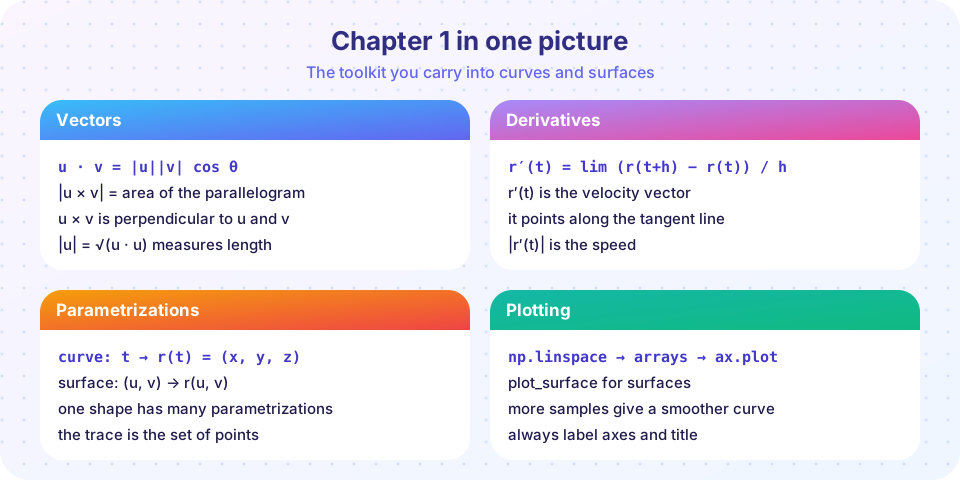
Chapter in a table
| Idea | Key formula or fact | Lesson |
|---|---|---|
| Local and global | Zoom in until flat; curvature measures the departure; holes are global | What Is Differential Geometry? |
| Intrinsic and extrinsic | Gaussian curvature can be found from distances on the surface (Theorema Egregium) | What Is Differential Geometry? |
| Dot product | u · v = ‖u‖ ‖v‖ cos θ; zero means perpendicular |
Calculus Toolkit |
| Cross product | ‖u × v‖ = parallelogram area; result is perpendicular to both |
Calculus Toolkit |
| Derivative | r′(t) = limit of secant vectors = velocity |
Calculus Toolkit |
| Unit vectors | ‖T‖ = 1 implies T · T′ = 0 |
Calculus Toolkit |
| Sampling | np.linspace for t, np.meshgrid for (u, v) |
Plotting with Python |
| Checking | polyline length tends to arc length | Plotting with Python |
What you should be able to do
- Compute an angle between vectors and the area of a parallelogram by hand.
- Differentiate a vector function such as
r(t) = (t, t², t³)and find its speed. - Explain, in a sentence, why a sphere cannot be flattened without distortion.
- Plot a curve and a surface from a parametrization, and check one numerically.
Try it
A short challenge: for the curve r(t) = (t, t², t³) (the "twisted cubic") the program finds the velocity, the speed and the angle between the velocity and acceleration at t = 1. Compute each by hand first: r′ = (1, 2t, 3t²), r″ = (0, 2, 6t).
Press Run (or Ctrl + Enter) to see the result here.
Program input · what you'd type while the program runs
Type the answers before you press Run, one per line. Each time the program reads a line (with input()), it gets the next line from this box.
Press Run (or Ctrl + Enter) to see the result here.
Program input · what you'd type while the program runs
Type the answers before you press Run, one per line. Each time the program reads a line (with input()), it gets the next line from this box.
Check your understanding
Quick check · 9 questions
of 9 answered You scored / 9 · perfect!
-
1. Which is an intrinsic quantity of a surface?
Distances along the surface can be measured by someone living on it; normals need the surrounding space. -
2. For u = (2, 0, 0) and v = (0, 3, 0), what is |u × v|?
The vectors are perpendicular with lengths 2 and 3, so the parallelogram is a 2 by 3 rectangle with area 6. -
3. If u · v = 0 for nonzero vectors, then the vectors are...
cos θ = 0 means θ = 90 degrees. -
4. A curve has r(t) = (cos t, sin t, t). Its speed is...
r′ = (−sin t, cos t, 1), so |r′| = √(1 + 1) = √2. -
5. If |T(t)| = 1 for all t, then T′ · T equals...
Differentiating T · T = 1 gives 2 T · T′ = 0. -
6. Which pair of numpy calls builds the (u, v) grid for a surface patch?
Sample each parameter with linspace and combine them with meshgrid. -
7. As you add samples, the polyline length of a smooth curve...
Chords are shorter than the arcs they replace, and the gap shrinks as the chords get shorter. -
8. Gauss's Theorema Egregium implies which of these?
The sphere's Gaussian curvature is nonzero and intrinsic, so no flat map preserves distances. -
9. What is the derivative r′(t) geometrically?
It is the limit of (r(t+h) − r(t)) / h and gives the velocity vector.
Summary
- Differential geometry measures departure from flatness, locally with derivatives and globally with integrals.
- Dot product for angles, cross product for areas and perpendiculars, derivative for tangents.
- A unit vector is perpendicular to its derivative: the seed of the Frenet frame.
- Sample, compute and plot, then check with a number.
Track your progress
Create a free account to tick off lessons and pick up where you left off on any device.
of Differential Geometry lessons completed