


















Lesson 35 of 44 · Manifolds and Beyond
Chapter 8 overview: manifolds and beyond
A tour of Chapter 8: how everything you learned on surfaces generalizes to manifolds of any dimension, with charts, tangent spaces, metrics and curvature tensors.
Everything so far lived on surfaces sitting in three-dimensional space. We used the surrounding space for convenience: the normal vector, the shape operator, the principal curvatures. But the Theorema Egregium told us the important quantities, lengths, angles, geodesics, parallel transport and even K, never needed the surrounding space at all. They only needed the first fundamental form.
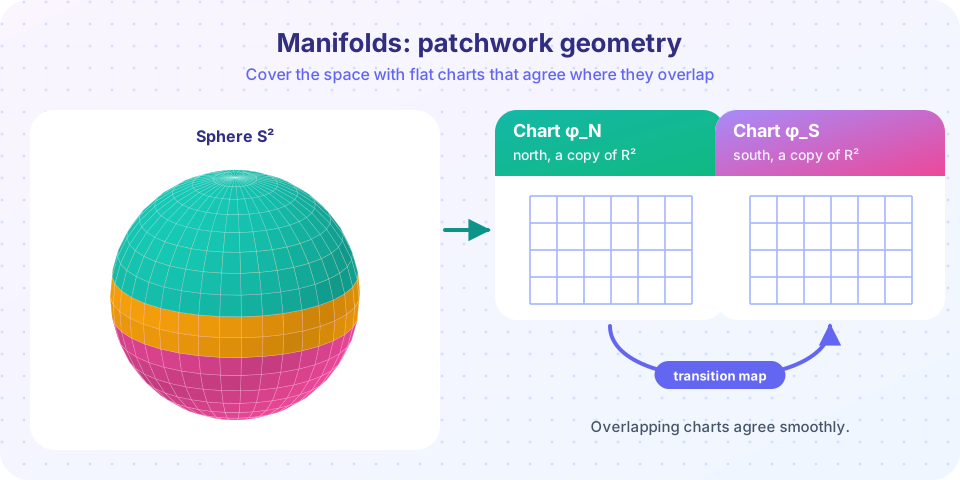
This suggests a bolder idea. Why not study spaces that are not sitting inside anything? A manifold is a space that looks like ordinary flat space near each of its points, so you can do calculus there, even though globally it may be curved, twisted or have holes. Chapter 8 is the doorway: it explains the definition, shows what tangent vectors become, and then builds the Riemannian metric and the curvature tensor that carry all of our surface results to any dimension. This is the language of general relativity and of much of modern geometry.
What you will learn
- Why manifolds are the natural setting for the ideas of this course.
- How the three lessons of the chapter build the definition step by step.
- Which examples of manifolds you will meet, from circles to spacetime.
The big picture
Charts
Compatibility
Tangent spaces
Geometry
The surface theory, in every dimension.
What each lesson covers
- Smooth manifolds and tangent spaces defines charts, atlases and transition maps with the sphere, shows how to turn curves into tangent vectors, and explains differentials of maps.
- Riemannian metrics and the curvature tensor puts a metric on a manifold, rediscovers the Christoffel symbols and geodesics, defines the Riemann, Ricci and scalar curvatures and works out the hyperbolic plane.
- Chapter 8 review summarizes and tests.
Where manifolds appear
- Surfaces such as the sphere, torus and the surface of a vase: dimension 2.
- Configuration spaces. The set of positions of a double pendulum is a torus: two angles. The set of orientations of a rigid body is a 3-dimensional manifold, the rotation group.
- Spacetime. In general relativity the universe is modeled as a 4-dimensional manifold with a metric of Lorentzian signature, and gravity is its curvature.
- Data. Many data sets lie near a low-dimensional manifold inside a huge space.
A first look at an atlas
No single flat map covers a whole sphere without tearing it, but two overlapping maps do. Stereographic projection from the north pole (0, 0, 1) and from the south pole (0, 0, −1) are the classical pair: each works everywhere except at the pole it projects from.
Press Run (or Ctrl + Enter) to see the result here.
Program input · what you'd type while the program runs
Type the answers before you press Run, one per line. Each time the program reads a line (with input()), it gets the next line from this box.
Every point except the two poles has coordinates in both charts, and the conversion between them is the smooth map w ↦ w/|w|² on the plane minus the origin. For the circle, here is the same story with angles:
Press Run (or Ctrl + Enter) to see the console output here.
No output.
Note that the shift is 0 or 2π: constant on each piece of the overlap, so the transition map is smooth (its derivative is 1).
Common misconceptions
"A manifold must be a surface in space." No. The definition uses charts only. Embedding in ℝⁿ (the Whitney theorem says it can always be done in some ℝⁿ) is a convenience, not part of the definition.
"Coordinates are part of the space." They are not: a chart is a choice. A good theory (and every quantity that matters, such as K) must not depend on the choice.
Check your understanding
Quick check · 4 questions
of 4 answered You scored / 4 · perfect!
-
1. A manifold is a space that
Locally Euclidean is the core of the definition. -
2. How many stereographic charts are needed to cover the sphere S²?
Each chart misses one projection pole, so two cover the sphere. -
3. The transition map between the two stereographic charts of S² is
It is inversion in the unit circle, smooth away from 0. -
4. Which of these is a manifold example from physics?
The two angles of a double pendulum form a torus.
Summary
- Manifolds generalize surfaces: spaces that look like
ℝⁿlocally, described by charts that overlap smoothly. - Intrinsic geometry (metric, geodesics, curvature) extends to every dimension.
- Chapter 8 builds the definition, tangent spaces, the Riemannian metric and the curvature tensors.
- The sphere needs two charts; their transition is
w ↦ w/|w|².
Track your progress
Create a free account to tick off lessons and pick up where you left off on any device.
of Differential Geometry lessons completed