


















Lesson 28 of 44 · Geodesics
Geodesic equations and classic examples
Derive the geodesic equations with Christoffel symbols, then solve them on the plane, cylinder, sphere and torus and use Clairaut's relation on surfaces of revolution.
A curve on a surface is straight from the inside when nothing pushes it sideways within the surface. Its acceleration, as a vector in space, may be large, but it must point straight out of or into the surface, along the normal. This lesson turns that sentence into two ordinary differential equations that you can solve by computer, and then checks the answers on four surfaces.
The key players are the Christoffel symbols Γᵏᵢⱼ. They look intimidating, but they are just bookkeeping for how the coordinate frame tilts as you move, and they are computed from E, F, G alone. Because they only involve the first fundamental form, geodesics are an intrinsic notion, in the same spirit as the Theorema Egregium.
What you will learn
- The definition of a geodesic and why it has constant speed.
- How the geodesic equations with Christoffel symbols arise from
α″. - How to compute Christoffel symbols from a metric.
- Clairaut's relation for surfaces of revolution and examples on the sphere and torus.
Key terms
Geodesic: a curve α on a surface whose acceleration α″ has no component tangent to the surface.
Christoffel symbols Γᵏᵢⱼ: the coefficients in x_{ij} = Γ¹ᵢⱼ xᵤ + Γ²ᵢⱼ xᵥ + (normal part), where x_{ij} denotes a second partial derivative.
Inverse metric gⁱʲ: the inverse of the matrix [[E, F], [F, G]].
Surface of revolution: a surface formed by rotating a profile curve about an axis; its parallels are circles, its meridians are the profile curves.
Clairaut constant: the conserved quantity r sin ψ of a geodesic on a surface of revolution.
Definition and first consequences
Let α(t) lie on the surface, with unit normal N along it. It is a geodesic if
α″(t) ∥ N(t) for all t.
Two consequences are immediate. First, ⟨α′, α″⟩ = 0 because α′ is tangent and α″ is normal, so |α′|² has derivative 2⟨α′, α″⟩ = 0: a geodesic has constant speed. Second, the geodesic curvature κ_g = ⟨α″, N × α′/|α′|⟩ vanishes, which is the statement from the previous picture: α″ = κₙ N.
The equations
Write α(t) = x(u(t), v(t)). The chain rule gives
α″ = xᵤ u″ + xᵥ v″ + xᵤᵤ u′² + 2 xᵤᵥ u′v′ + xᵥᵥ v′².
Each second partial derivative x_{ij} splits into a tangential part and a normal part:
x_{ij} = Γ¹ᵢⱼ xᵤ + Γ²ᵢⱼ xᵥ + h_{ij} N
with h₁₁ = e, h₁₂ = f, h₂₂ = g. Setting the tangential part of α″ to zero gives the geodesic equations
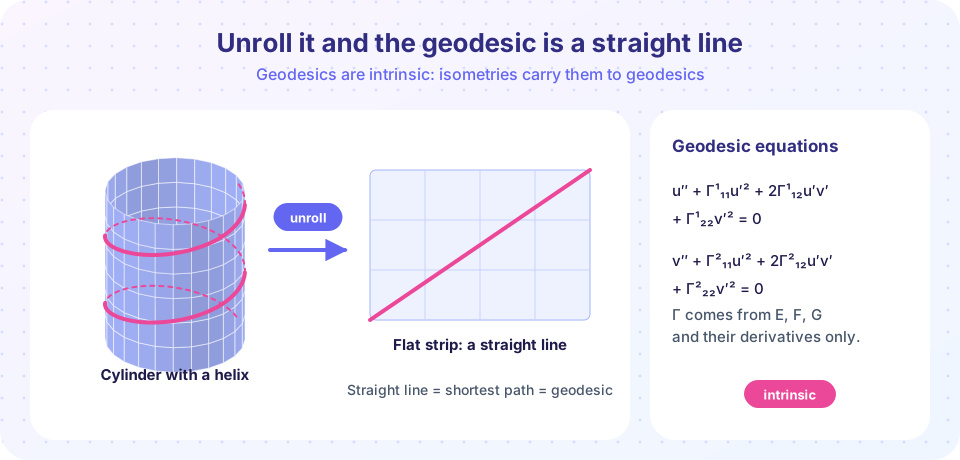
u″ + Γ¹₁₁ u′² + 2 Γ¹₁₂ u′v′ + Γ¹₂₂ v′² = 0
v″ + Γ²₁₁ u′² + 2 Γ²₁₂ u′v′ + Γ²₂₂ v′² = 0
The symbols are determined by the metric: with gᵢⱼ the entries of [[E, F], [F, G]] and gⁱʲ its inverse,
Γᵏᵢⱼ = ½ Σₗ gᵏˡ ( ∂ᵢ g_{jl} + ∂ⱼ g_{il} − ∂ₗ g_{ij} ).
For orthogonal coordinates (F = 0) the six symbols are
Γ¹₁₁ = E_u/(2E), Γ¹₁₂ = E_v/(2E), Γ¹₂₂ = −G_u/(2E), Γ²₁₁ = −E_v/(2G), Γ²₁₂ = G_u/(2G), Γ²₂₂ = G_v/(2G).
Because the system is second-order in two unknowns, a geodesic is determined by a starting point and a starting velocity (direction and speed). That is why you can fire geodesics in a fan from any point.
Worked examples
Plane (polar coordinates ignored). In Cartesian coordinates E = G = 1, all Γ = 0, so u″ = v″ = 0: straight lines at constant speed.
Cylinder. x = (r cos u, r sin u, v) has E = r², G = 1, both constant, so every Γ is zero and u″ = v″ = 0. The solutions are u = u₀ + a t, v = v₀ + b t: vertical lines (a = 0), circles (b = 0) and helices. Unrolling is the same as using ũ = r u as a flat coordinate.
Unit sphere with u the polar angle and v the azimuth: E = 1, G = sin²u. Then Γ¹₂₂ = −sin u cos u, Γ²₁₂ = cot u and all others vanish. The equations are
u″ − sin u cos u · v′² = 0, v″ + 2 cot u · u′v′ = 0.
The meridians (v constant, u″ = 0) and the equator (u = π/2, so cos u = 0) satisfy them. Every other great circle is a rotated copy.
Torus x = ((R + r cos v) cos u, (R + r cos v) sin u, r sin v): E = (R + r cos v)², G = r². The symbols are Γ¹₁₂ = −r sin v / (R + r cos v) and Γ²₁₁ = (R + r cos v) sin v / r, so
u″ − (2 r sin v / (R + r cos v)) u′v′ = 0, v″ + ((R + r cos v) sin v / r) u′² = 0.
The outer equator (v = 0) and inner equator (v = π) are geodesics (sin v = 0); the circles around the tube (u′ = 0) are geodesics; but the top circle v = π/2 is not, since then v″ = −(R/r)u′² ≠ 0.
Clairaut's relation
A surface of revolution has x(t, θ) = (r(t) cos θ, r(t) sin θ, h(t)), so E = r′² + h′² (profile speed) and G = r². Because the metric does not depend on θ, the θ-equation says d/ds(r² θ′) = 0 along a geodesic. Let ψ be the angle between the geodesic and the meridian. The speed in the θ direction is r θ′ = |α′| sin ψ, so for a unit-speed geodesic
r · sin ψ = c (constant).
Consequences: a geodesic can never enter a region where r < |c| (it would need sin ψ > 1), so geodesics on a vase wind around the waist and bounce back from the narrow parts; a geodesic with c = 0 is a meridian; and a geodesic that starts parallel to a parallel circle at the largest-radius circle (ψ = 90°, r = r_max) stays on it.
Symmetry and conservation. Clairaut's relation is the first example of a theme you will see again: a symmetry of the metric (rotation here) gives a conserved quantity along geodesics. It is the same idea as conservation of angular momentum.
Common misconceptions
"Geodesic equations are the same as straight-line equations." Only if all Γ vanish, as in the plane or on the cylinder in these coordinates. The Γ terms are what bend coordinate-line paths into the straightest paths.
"Two points are joined by exactly one geodesic." On a sphere two non-antipodal points have infinitely many geodesics joining them (one short arc, the long arc, plus ones that wind around more times), and antipodal points have infinitely many short ones.
"Christoffel symbols are tensors." They are not: they depend on the coordinate system and are zero in Cartesian coordinates on the plane but not in polar ones.
Try it
First let the computer produce Christoffel symbols from any metric using the general formula.
Press Run (or Ctrl + Enter) to see the result here.
Program input · what you'd type while the program runs
Type the answers before you press Run, one per line. Each time the program reads a line (with input()), it gets the next line from this box.
You should recognize −sin(2u)/2 = −sin u cos u and 1/tan u = cos u / sin u for the sphere, and the two torus symbols from above (the program lists each symbol once for the pair of lower indices). Next, integrate the sphere's equations numerically and check that the result is a great circle: its points must all lie in a plane through the center.
Press Run (or Ctrl + Enter) to see the result here.
Program input · what you'd type while the program runs
Type the answers before you press Run, one per line. Each time the program reads a line (with input()), it gets the next line from this box.
The printed numbers show that every path stays in a plane through the origin (the dot product with the plane's normal is about 10⁻¹⁰ or smaller) and that the speed stays at 1. Finally, a torus. Its geodesics wind around, and Clairaut's constant c = (R + r cos v)² u′ must stay fixed along each one.
Press Run (or Ctrl + Enter) to see the result here.
Program input · what you'd type while the program runs
Type the answers before you press Run, one per line. Each time the program reads a line (with input()), it gets the next line from this box.
The conserved quantity is constant to many digits, and so is the speed. Each geodesic stays between two circles around the tube where |c| equals R + r cos v: that is Clairaut's barrier.
Check your understanding
Quick check · 5 questions
of 5 answered You scored / 5 · perfect!
-
1. Why does a geodesic have constant speed?
d/dt |α′|² = 2⟨α′, α″⟩ = 0 when α″ is perpendicular to the tangent plane. -
2. On a cylinder of radius r the geodesics through a point include
All Γ vanish in the coordinates (u, v), so u and v are linear in t. -
3. Clairaut's relation r sin ψ = constant arises from
The metric does not depend on the angle θ, so r²θ′ is conserved. -
4. On the torus the top circle v = π/2 is
There v″ = −(R/r) u′², which is not zero while u′ ≠ 0. -
5. A geodesic on a surface of revolution with Clairaut constant c cannot enter regions where
Since sin ψ ≤ 1, we need r ≥ |c| along the curve.
Summary
- A geodesic has
α″ ∥ N; it has constant speed and zero geodesic curvature. - In coordinates:
uᵏ″ + Γᵏᵢⱼ uⁱ′ uʲ′ = 0withΓcomputed fromE, F, G. - Plane and cylinder:
Γ = 0; sphere:Γ¹₂₂ = −sin u cos u,Γ²₁₂ = cot u; solutions are great circles. - Clairaut: on a surface of revolution
r sin ψis constant along a geodesic, from the rotational symmetry. - A geodesic is determined by its starting point and velocity.
Track your progress
Create a free account to tick off lessons and pick up where you left off on any device.
of Differential Geometry lessons completed