


















Lesson 25 of 44 · Curvature
The Theorema Egregium: curvature without leaving the surface
Gauss's remarkable theorem says Gaussian curvature depends only on lengths measured inside the surface. See why, check it with code, and learn why no flat map of Earth is perfect.
In 1827 Carl Friedrich Gauss published a paper on curved surfaces that contained a result he called theorema egregium, Latin for "remarkable theorem". Remarkable is right. We defined K as the product of two principal curvatures, and each of those depends on how the surface bends in the space around it, on the normal vector N. You would expect K to depend on that outside view too. It does not.
Theorema Egregium. The Gaussian curvature K of a surface can be computed from the first fundamental form E, F, G and its derivatives alone.
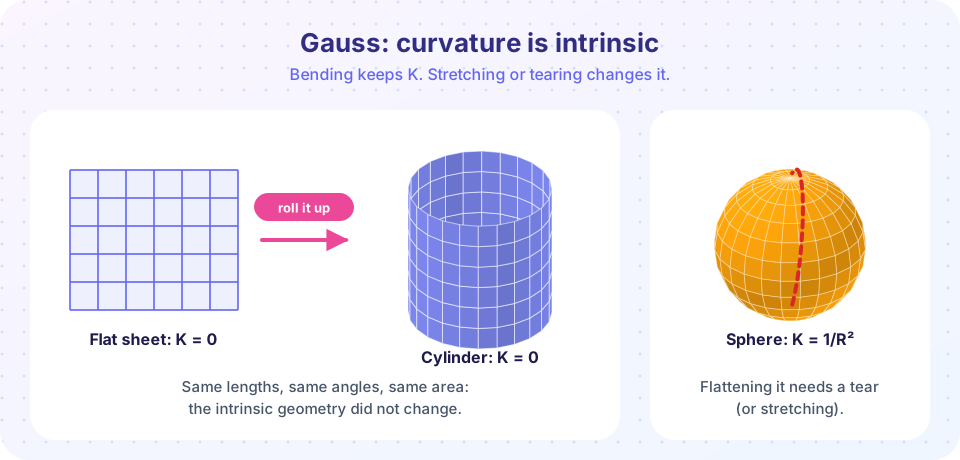
That means a tiny creature living on the surface, with a ruler and a protractor but no ability to look at the space around it, can measure K. Everything that preserves lengths on the surface preserves K, even if it changes how the surface sits in space.
What you will learn
- What an isometry between surfaces is and why it preserves K.
- Gauss's formula for K in orthogonal coordinates, and how to use it.
- Why a cylinder and cone are flat but a sphere is not, and what this means for maps.
- How an ant could measure K with a piece of string.
Key terms
Intrinsic quantity: anything you can compute from lengths and angles measured inside the surface (that is, from E, F, G).
Extrinsic quantity: anything that also needs the surrounding space, such as the normal vector or the principal curvatures.
Isometry: a smooth map between surfaces that preserves the first fundamental form, hence lengths, angles and areas.
Local isometry: an isometry between small patches; the sphere and the plane are not even locally isometric, but the plane and the cylinder are.
Geodesic circle: the set of points at a fixed intrinsic distance ρ from a point.
Gauss's formula
When the coordinates are orthogonal (F = 0), the Gaussian curvature is
K = −1 / (2√(EG)) · [ ∂/∂u ( G_u / √(EG) ) + ∂/∂v ( E_v / √(EG) ) ]
where subscripts are partial derivatives. Only E and G appear, so only the first fundamental form is needed. (For F ≠ 0 there is a longer expression due to Brioschi, still built from E, F, G only.)
Worked example: the sphere
Take a sphere of radius R with u the azimuth and v the polar angle from the north pole. Then
E = R² sin²v, F = 0, G = R², so √(EG) = R² sin v.
Since G does not depend on u, G_u = 0. And E_v = 2R² sin v cos v, so
E_v / √(EG) = 2 cos v, and its v derivative is −2 sin v.
Plug in: K = −1/(2R² sin v) · (−2 sin v) = 1/R². This agrees with the principal-curvature calculation of the last lesson (κ₁κ₂ = (1/R)(1/R)), but now we never used a normal vector.
Why isometries preserve K
An isometry maps one surface to another so that the first fundamental form of the second, written in the pulled-back coordinates, equals that of the first. If E, F, G are the same functions of (u, v) on both surfaces, then Gauss's formula gives the same K at corresponding points. That is the whole proof of invariance: the formula only reads E, F, G.
Consequences you can feel
A cylinder is intrinsically flat. Roll a sheet of paper into a tube. Distances and angles drawn on the paper do not change, so the tube has the same E, F, G as the plane: K = 0. The principal curvatures (0 and 1/r) do change from the plane's 0 and 0, but their product does not. Similarly a cone, away from its tip, is rolled-up paper.
The catenoid and helicoid are the same intrinsic surface. A helicoid with parameter c and a catenoid with a = c can be bent into each other through a family of minimal surfaces without stretching, if you match v_helicoid = a sinh(v_catenoid / a). The Python below checks that their K agrees at matching points.
A sphere cannot be mapped to a plane without distortion. If such a map preserved lengths it would be a local isometry, and K = 1/R² would have to equal 0. It does not. Every flat map of the Earth distorts distances, angles, areas, or a mix. Mercator keeps angles but inflates areas near the poles; equal-area maps squash shapes. This is a theorem, not a lack of cartographic talent.
Pizza. Fold a slice of pizza along its length and it stays stiff when you hold it by the crust. Bending the slice across makes a surface curved in one direction. If the slice then tried to droop along its length it would have to curve in the second direction as well and acquire K ≠ 0, which stretching would be needed for. Since the cheese and dough resist stretching, the slice stays straight. That is the Theorema Egregium at lunchtime.
An ant measures K with string
On a sphere of radius R, a circle of intrinsic radius ρ has circumference C(ρ) = 2πR sin(ρ/R), which is less than the flat value 2πρ. The shortfall measures curvature. Bertrand, Diguet and Puiseux showed
K = lim_{ρ→0} 3 (2πρ − C(ρ)) / (π ρ³)
Check on the sphere: C ≈ 2π(ρ − ρ³/(6R²)), so 2πρ − C ≈ πρ³/(3R²) and the limit is 1/R². The ant needs only a rope of length ρ and a way to measure how long the circle at that distance is. No view of the outside world.
Extrinsic vs intrinsic at a glance. The mean curvature H, the principal curvatures and the normal are extrinsic: bend a plane into a cylinder and H goes from 0 to 1/(2r). The Gaussian curvature K is intrinsic: it stays 0.
Common misconceptions
"If a surface is curved in space then K ≠ 0." A cylinder is visibly curved, yet K = 0. What K = 0 says is that, measured from inside, the surface is flat.
"Isometric means congruent in space." Isometric means the same inside. A flat sheet and the cylinder made from it are isometric but not congruent in space.
"A sphere could be flattened with clever cutting." Cutting is allowed, but each piece would still have to be stretched, because K ≠ 0 cannot be removed without changing lengths.
Try it
First compute K from E, F, G only, using the orthogonal formula, and compare it with the value computed from the second fundamental form.
Press Run (or Ctrl + Enter) to see the result here.
Program input · what you'd type while the program runs
Type the answers before you press Run, one per line. Each time the program reads a line (with input()), it gets the next line from this box.
Second, check that the catenoid and the helicoid, two surfaces that look nothing alike, have the same curvature at matching points.
Press Run (or Ctrl + Enter) to see the result here.
Program input · what you'd type while the program runs
Type the answers before you press Run, one per line. Each time the program reads a line (with input()), it gets the next line from this box.
Third, the ant with a string. We use the circumference formula of a geodesic circle on a sphere of radius 2 and see the estimate converge to K = 1/R² = 0.25.
Press Run (or Ctrl + Enter) to see the result here.
Program input · what you'd type while the program runs
Type the answers before you press Run, one per line. Each time the program reads a line (with input()), it gets the next line from this box.
Last, roll a cone out of paper. The flat sector has angle 2π sin α; the angle you cut away is where all the curvature of the apex hides.
This is a drawing of the cut-and-roll construction, not a physics simulation.
Check your understanding
Quick check · 5 questions
of 5 answered You scored / 5 · perfect!
-
1. Which of these quantities is NOT preserved when a flat sheet is rolled into a cylinder?
H changes from 0 to 1/(2r) because it depends on the embedding. Lengths, angles and K are intrinsic. -
2. The Theorema Egregium says that K can be computed from
K depends only on E, F, G and their derivatives. -
3. Why can no flat map of the whole sphere preserve all distances?
A distance-preserving map would be a local isometry, which would force the two K values to agree. -
4. In the ant experiment, a circle of radius ρ on a positively curved surface has circumference
On a sphere C = 2πR sin(ρ/R) < 2πρ. The shortfall measures K. -
5. A cone (away from its apex) has K equal to
A cone is locally isometric to a plane (roll a sector of paper), so K = 0.
Summary
Kdepends only onE, F, Gand their derivatives: it is intrinsic (Gauss, 1827).- Isometries preserve
K; mean curvature and the principal curvatures are extrinsic and can change. - Plane, cylinder and cone are locally isometric (
K = 0); the sphere (K = 1/R²) is not isometric to any piece of the plane, so every flat map of the Earth distorts. - An ant can measure
Kfrom circle circumferences:K = lim 3(2πρ − C)/(πρ³). - The catenoid and helicoid are locally isometric, with matching
K.
Next: Chapter 5 review
Track your progress
Create a free account to tick off lessons and pick up where you left off on any device.
of Differential Geometry lessons completed