


















Lesson 31 of 44 · The Gauss-Bonnet Theorem
Chapter 7 overview: the Gauss-Bonnet theorem
A tour of Chapter 7: how total Gaussian curvature of a closed surface equals 2π times its Euler characteristic, with polyhedra as a first example.
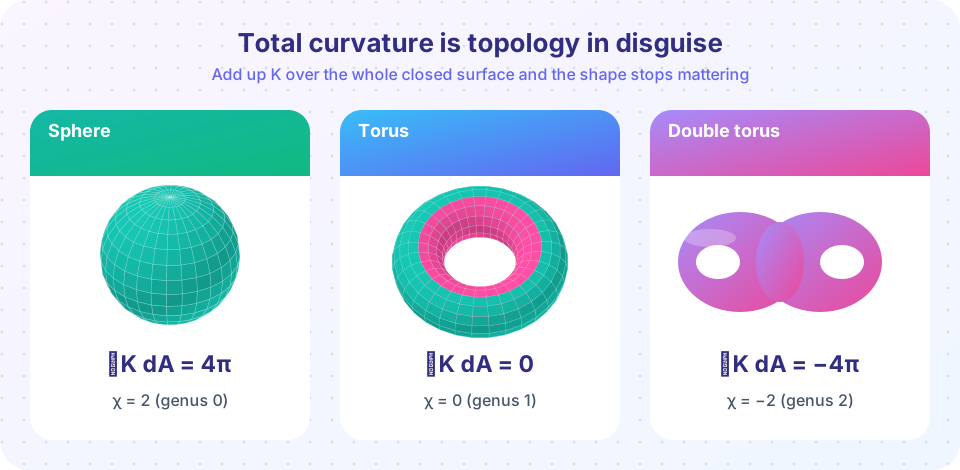
Pick up a rubber ball and squash it into an egg, a pear or a potato. Its curvature changes from point to point: sharper at the tips, flatter on the sides. Now add up the Gaussian curvature K over the whole surface, weighting by area. You always get the same number: 4π. The shape did not matter. A doughnut always gives 0. A pretzel with two holes gives −4π.
This is the Gauss–Bonnet theorem, and it is the first great theorem of this course: a quantity defined with calculus (the integral of K) turns out to depend only on a counting property of the surface, its number of holes. It joins geometry (curvature) and topology (holes) in one equation.
What you will learn
- What the theorem says in its local, global and polyhedral forms.
- How the three lessons of this chapter lead up to it.
- Why total curvature depends only on the number of holes.
The road map
Step 1: bending of a curve
Step 2: a patch
Step 3: the whole surface
The answer
∬K dA = 2π χ
What each lesson covers
- Geodesic curvature and the local Gauss-Bonnet theorem separates the bending of a curve into a normal part and a geodesic part, then proves the theorem for a region in a coordinate patch, with triangles as the main example.
- The global theorem and the Euler characteristic glues the local statements together, introduces
χ = V − E + F, and draws consequences: which surfaces can have positive, zero or negative curvature everywhere. - Chapter 7 review collects everything and tests it.
A first experiment: curvature lives in the corners
A polyhedron has zero curvature on its flat faces and along its edges (an edge can be unfolded flat). All the curvature sits at the vertices. The natural measure of how much is concentrated at a vertex is the angle defect: 2π minus the sum of the face angles meeting there. Add the defects over all vertices and you get the total curvature of the polyhedron. The next program does exactly that for four solids: the cube, the tetrahedron, the octahedron and a square picture frame (which has one hole).
Press Run (or Ctrl + Enter) to see the result here.
Program input · what you'd type while the program runs
Type the answers before you press Run, one per line. Each time the program reads a line (with input()), it gets the next line from this box.
Spheres (cube, tetrahedron, octahedron) give χ = 2 and a total defect of 4π ≈ 12.566. The picture frame has a hole, so χ = 0 and the defects cancel to zero: positive defects at the outer corners, negative ones at the corners of the hole. That is the polyhedral Gauss-Bonnet theorem.
The table to remember
The Euler characteristic of the closed orientable surface with g holes is χ = 2 − 2g. Total curvature is 2πχ.
Press Run (or Ctrl + Enter) to see the console output here.
No output.
Common misconceptions
"A bumpy sphere must have larger total curvature." Bumps add positive curvature on the bulges and negative curvature in the dents, and they exactly cancel. Total curvature stays 4π.
"Curvature is zero on the edges of a cube." Along an edge you can unfold the two faces into one flat sheet, so there is no curvature there. The curvature of the cube sits at the corners.
Check your understanding
Quick check · 4 questions
of 4 answered You scored / 4 · perfect!
-
1. The total Gaussian curvature of any smooth closed surface shaped like a sphere is
∬K dA = 2πχ and χ = 2 for a sphere. -
2. The total Gaussian curvature of a torus is
χ = 0 for a torus, so ∬K dA = 0. -
3. Where is the curvature of a cube concentrated?
Faces and edges can be unfolded flat; each corner has angle defect π/2. -
4. The Euler characteristic of a closed surface with g holes is
χ = 2 for the sphere (g = 0), 0 for the torus (g = 1), −2 for g = 2.
Summary
- Gauss–Bonnet connects the integral of
Kto the number of holes of the surface. - The local form involves a boundary curve's geodesic curvature and corner angles; the global form is
∬K dA = 2πχ. - On a polyhedron, curvature is the angle defect at the vertices and the total is
2πχ. χ = 2 − 2g: sphere4π, torus0, double torus−4π.
Track your progress
Create a free account to tick off lessons and pick up where you left off on any device.
of Differential Geometry lessons completed