


















Lesson 34 of 44 · The Gauss-Bonnet Theorem
Chapter 7 review: Gauss-Bonnet
Review Chapter 7 with a one-page picture, a table of the three forms of Gauss-Bonnet, an annulus check on a torus, a polyhedron defect table and ten mixed questions.
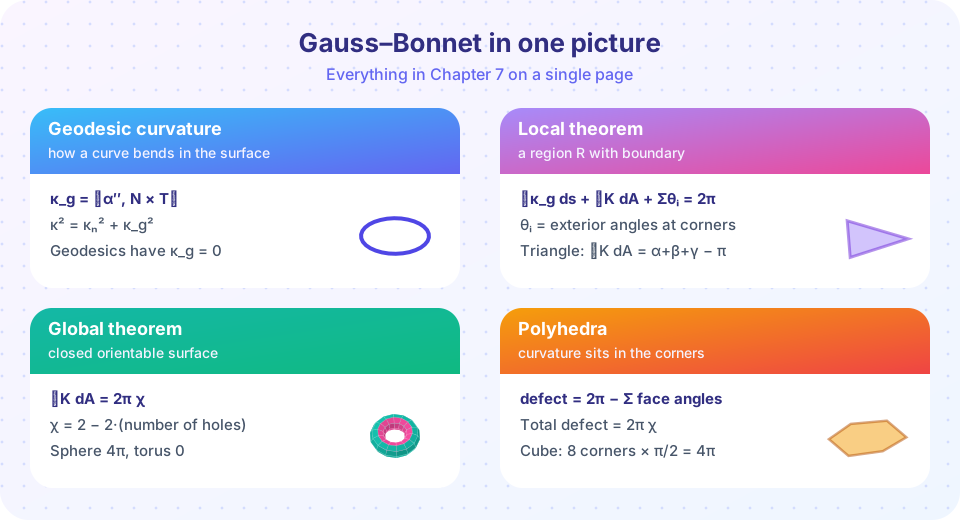
Chapter 7 had a single story told at three scales. For a curve, the geodesic curvature measures its steering inside the surface. For a small region, the steering along the boundary plus the curvature inside plus the corner turns make one full turn. For a closed surface, gluing the small regions makes the boundary terms cancel and leaves a whole number: the Euler characteristic. This review puts the three forms side by side and tests the theorem on a region that is not a disk.
What you will learn
- How the local, global and polyhedral forms of Gauss–Bonnet relate.
- How to apply the theorem to a region with a hole, where
2πbecomes2πχ(region). - Which computations to do first when asked to check the theorem.
The three forms
| Form | Statement | Typical use |
|---|---|---|
| Local, disk region with corners | ∮κ_g ds + ∬K dA + Σθᵢ = 2π |
caps, geodesic triangles, curvilinear polygons |
Local, any compact region R with boundary |
∮κ_g ds + ∬K dA + Σθᵢ = 2πχ(R) |
annuli (χ = 0), regions with holes |
| Global, closed surface | ∬K dA = 2πχ, χ = 2 − 2g |
sphere 4π, torus 0, genus 2 −4π |
| Polyhedron | Σ (2π − face angles at v) = 2πχ |
cube, soccer ball: 4π |
Geodesic triangle special case: ∬K dA = A + B + C − π.
Try it
A region that is not a disk. Take the outer half of a torus (R = 3, r = 1), the band |v| < π/2 where K > 0. It is an annulus, so χ = 0, and the theorem predicts ∮κ_g ds + ∬K dA = 0. The boundary has two circles (the top circle v = π/2 and the bottom circle v = −π/2), each traversed with the region on its left.
Press Run (or Ctrl + Enter) to see the result here.
Program input · what you'd type while the program runs
Type the answers before you press Run, one per line. Each time the program reads a line (with input()), it gets the next line from this box.
Each boundary circle has κ_g = −1/R (the circle bends toward the axis, away from the outside region), so the two circles contribute −2π each, cancelling the 4π of positive curvature. Now the polyhedral form for several famous solids, using only the angles at one vertex.
Press Run (or Ctrl + Enter) to see the console output here.
No output.
In every row the total defect is 720° = 4π and χ = 2.
Check your understanding
Quick check · 10 questions
of 10 answered You scored / 10 · perfect!
-
1. The local Gauss–Bonnet theorem for a disk region with corners reads
Boundary steering plus interior curvature plus corner turns make one full turn. -
2. A geodesic triangle on the unit sphere with angles 100°, 70° and 60° has area
Area = A + B + C − π = 230° − 180° = 50° ≈ 0.873 radians. -
3. For a closed surface of genus 3 the total Gaussian curvature is
χ = 2 − 2·3 = −4, so ∬K dA = 2π(−4) = −8π. -
4. A cone-like vertex of a polyhedron has face angles 90°, 90°, 90°. Its angle defect is
360° − 270° = 90° = π/2. -
5. Along a geodesic edge of a triangle, the geodesic curvature is
That is the definition of geodesic: κ_g = 0. -
6. For the outer half of a torus (an annulus), Gauss–Bonnet says ∮κ_g ds + ∬K dA equals
An annulus has Euler characteristic 0. -
7. The Euler characteristic of a torus triangulated with V = 16, E = 48, F = 32 is
16 − 48 + 32 = 0. -
8. If a closed surface has K > 0 everywhere, it must be
∬K dA > 0 forces χ > 0, hence χ = 2 for orientable closed surfaces. -
9. The angles of a small geodesic triangle in the hyperbolic plane add up to
∬K dA = A + B + C − π < 0 when K < 0. -
10. Why is the total curvature of a golf ball the same as that of the Earth?
Gauss–Bonnet makes total curvature depend only on topology.
Summary
- Geodesic curvature measures steering inside the surface; the local theorem balances it with curvature and corner turns to
2π(or2πχ(R)for a region with holes). - Global form:
∬K dA = 2πχ,χ = 2 − 2g; polyhedral form: total angle defect= 2πχ. - Geodesic triangles:
A + B + C − π = ∬K dAmeasures curvature. - Topology constrains geometry: positive curvature everywhere forces a sphere.
Track your progress
Create a free account to tick off lessons and pick up where you left off on any device.
of Differential Geometry lessons completed