


















Lesson 24 of 44 · Curvature
Gaussian and mean curvature
Combine the principal curvatures into K and H, classify points as elliptic, hyperbolic or parabolic, compute both for a torus, and meet minimal surfaces.
Two numbers at every point are still a lot to carry around. Mathematicians prefer one number when possible, and there are two natural ways to squeeze κ₁ and κ₂ into a single value: multiply them, or average them. The product is the Gaussian curvature K. The average is the mean curvature H. They answer different questions, and the difference between those questions is the heart of this lesson.
K tells you what kind of bending you have: bowl, saddle or tube. H tells you how much the surface is bending on average, and whether a film of soap stretched across it would feel a pull. Both are computed from the two fundamental forms with a short formula.
What you will learn
- How to compute
KandHfromE, F, G, e, f, g. - How to classify a point as elliptic, hyperbolic, parabolic or planar.
- Which of
KandHchange when you flip the normal. - What a minimal surface is and why soap films have
H = 0.
Key terms
Gaussian curvature K: K = κ₁κ₂ = det(S), the determinant of the shape operator.
Mean curvature H: H = (κ₁ + κ₂)/2 = ½ tr(S), half the trace of the shape operator.
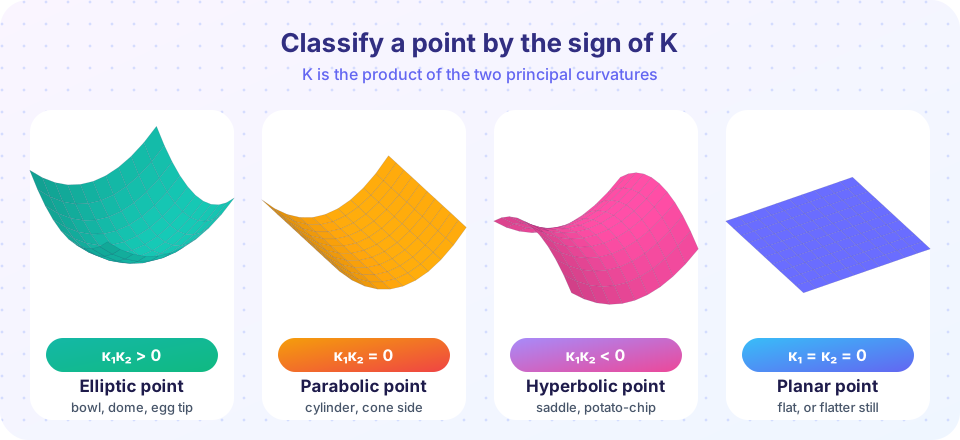
Elliptic, hyperbolic, parabolic, planar point: K > 0, K < 0, K = 0 with S ≠ 0, and S = 0.
Minimal surface: a surface with H = 0 at every point.
Gauss map: the map that sends each point of the surface to its unit normal on the unit sphere.
The formulas
Because S = [[E, F], [F, G]]⁻¹ [[e, f], [f, g]], the determinant and trace of that matrix give
K = (e g − f²) / (E G − F²)
H = (E g − 2 F f + G e) / (2 (E G − F²))
The denominator E G − F² is the squared area scale factor |xᵤ × xᵥ|², always positive for a regular surface. Two facts follow from the eigenvalue picture:
- Flip
N → −Nand both principal curvatures change sign. SoK = κ₁κ₂is unchanged, whileHchanges sign. - The principal curvatures are recovered from
KandH:κ = H ± √(H² − K). Since the square root must be real,H² ≥ Keverywhere, with equality exactly at umbilic points.
What the sign of K tells you
Near a point p, if you choose axes along the principal directions with the tangent plane as the xy-plane, the surface looks like
z ≈ ½(κ₁ x² + κ₂ y²)
to second order. So:
| Type | K | Local shape | Examples |
|---|---|---|---|
| Elliptic | K > 0 |
bowl or dome, stays on one side of the tangent plane | sphere, egg, outer rim of a torus |
| Hyperbolic | K < 0 |
saddle, crosses the tangent plane | inner ring of a torus, Pringles chip |
| Parabolic | K = 0, S ≠ 0 |
cylinder-like, curved in one direction only | cylinder, cone, torus top circle |
| Planar | S = 0 |
flat to second order | plane, or the bottom of z = x⁴ + y⁴ |
There is a lovely geometric meaning of K through the Gauss map. If a small region of area A on the surface has its normals sweeping out an area A′ on the unit sphere, then |K| ≈ A′/A. For a sphere of radius R, the whole surface (area 4πR²) maps onto the whole unit sphere (area 4π), so K = 1/R². A large |K| means the normal direction swings quickly as you move.
Worked example: the torus by hand
Let the torus be x(u, v) = ((R + r cos v) cos u, (R + r cos v) sin u, r sin v) with R > r > 0. Use the outward normal N = (cos v cos u, cos v sin u, sin v). A short computation gives
E = (R + r cos v)²,F = 0,G = r².e = ⟨xᵤᵤ, N⟩ = −(R + r cos v) cos v,f = 0,g = ⟨xᵥᵥ, N⟩ = −r.
Since F = f = 0, the coordinate directions are principal and
κ₁ = e/E = −cos v / (R + r cos v), κ₂ = g/G = −1/r.
Therefore
K = κ₁κ₂ = cos v / (r (R + r cos v))
H = (κ₁ + κ₂)/2 = −(R + 2 r cos v) / (2 r (R + r cos v))
Check the zones: K > 0 when cos v > 0, the outer half of the tube; K < 0 on the inner half; and K = 0 at v = ±π/2, the top and bottom circles. Notice that H vanishes only where R + 2r cos v = 0, which needs R ≤ 2r. For a slim doughnut with R > 2r the mean curvature never vanishes. For a fat one (r < R ≤ 2r) there is a circle on the inner side where H = 0 but K < 0, a concrete case of "H = 0 does not mean flat".
More examples to remember
| Surface | K | H (up to sign) |
|---|---|---|
| Plane | 0 |
0 |
Sphere of radius R |
1/R² |
1/R |
Cylinder of radius r |
0 |
1/(2r) |
Catenoid (a cosh(v/a) cos u, a cosh(v/a) sin u, v) |
−1/(a² cosh⁴(v/a)) |
0 |
Helicoid (v cos u, v sin u, c u) |
−c²/(c² + v²)² |
0 |
The last two have H = 0. They are minimal surfaces.
Minimal surfaces and soap films
If H = 0 everywhere then κ₂ = −κ₁ at every point, so K = −κ₁² ≤ 0: a minimal surface is saddle-shaped or flat everywhere. Why the name? The mean curvature is the rate at which area changes when you push the surface along its normal, so a surface with H = 0 is a critical point of area: no small push reduces its area to first order. A soap film stretched on a wire frame minimizes area (because surface tension pulls it as taut as possible), so it is a minimal surface. The pull of the film on a closed bubble is balanced by an air pressure difference, which is proportional to the mean curvature (the Young–Laplace law): that is why a free soap bubble is a sphere of constant H, and why a film between two rings takes the catenoid shape with H = 0.
Common misconceptions
"K = 0 means the surface is flat." No. A cylinder and a cone have K = 0 but are clearly not planes. They are flat in the intrinsic sense (you can roll them out without stretching), as the Theorema Egregium lesson will explain.
"H = 0 means K = 0." No. A saddle at the origin has H = 0 and K = −4 for z = x² − y². Minimal surfaces have K ≤ 0, usually strictly negative.
"Mean curvature and Gaussian curvature both flip sign with the normal." Only H flips. K is independent of the choice of normal.
Try it
Verify the table by computing K and H symbolically from the forms and comparing with the closed formulas at a test point.
Press Run (or Ctrl + Enter) to see the result here.
Program input · what you'd type while the program runs
Type the answers before you press Run, one per line. Each time the program reads a line (with input()), it gets the next line from this box.
The catenoid and helicoid come out with H = 0 (up to floating-point noise). Now color a torus by K to see the three zones.
Press Run (or Ctrl + Enter) to see the result here.
Program input · what you'd type while the program runs
Type the answers before you press Run, one per line. Each time the program reads a line (with input()), it gets the next line from this box.
Last, try the principal curvatures yourself. The presets set κ₁ and κ₂ to familiar shapes.
This is a demonstration of the local model z = ½(κ₁x² + κ₂y²), not a solver for arbitrary surfaces.
Check your understanding
Quick check · 5 questions
of 5 answered You scored / 5 · perfect!
-
1. If you flip the unit normal of a surface, which quantities change sign?
κ₁ and κ₂ both change sign, so their product K stays and their average H flips. -
2. A cylinder of radius r has
κ₁ = 0 along the axis and |κ₂| = 1/r around it, so K = 0 and |H| = 1/(2r). -
3. A minimal surface has H = 0 everywhere. Which statement is true?
H = 0 gives κ₂ = −κ₁, so K = −κ₁² ≤ 0. -
4. On the inner ring of a torus (cos v < 0) the Gaussian curvature is
K = cos v / (r(R + r cos v)) and R + r cos v > 0, so the sign is the sign of cos v. -
5. The sphere of radius R has K equal to
κ₁ = κ₂ = 1/R, so K = 1/R². Its Gauss map covers the unit sphere (area 4π) from area 4πR².
Summary
K = κ₁κ₂ = (eg − f²)/(EG − F²)andH = (κ₁ + κ₂)/2 = (Eg − 2Ff + Ge)/(2(EG − F²)).Kdoes not depend on the normal's sign;Hflips with it;H² ≥ K.- Positive
K: bowl. NegativeK: saddle.K = 0: tube or flat. - A torus has
K = cos v / (r(R + r cos v)): positive outside, negative inside. - Minimal surfaces have
H = 0, soK ≤ 0; soap films are minimal surfaces.
Next: The Theorema Egregium
Track your progress
Create a free account to tick off lessons and pick up where you left off on any device.
of Differential Geometry lessons completed