


















Lesson 30 of 44 · Geodesics
Chapter 6 review: geodesics
Review Chapter 6 with a one-page picture, a recap table, a numerical Clairaut check on a vase-shaped surface, a triangle holonomy calculator and ten mixed questions.
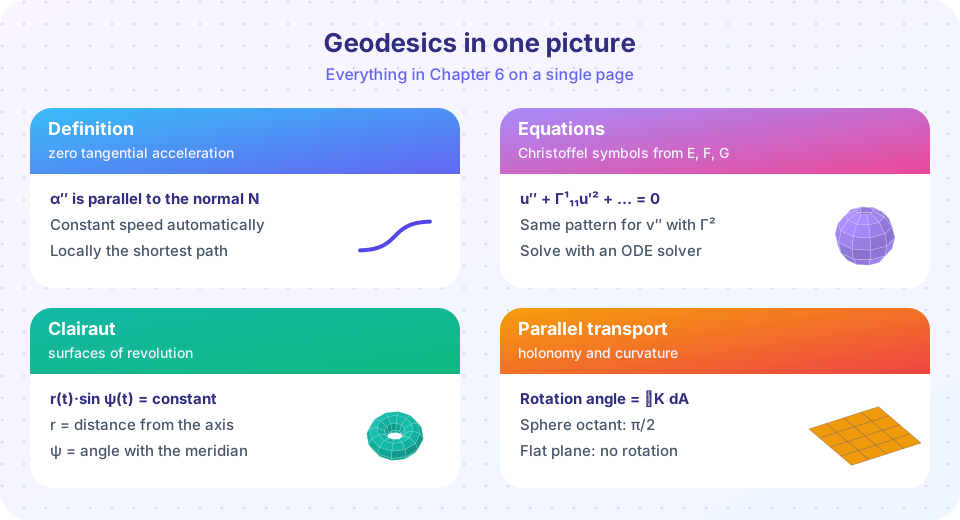
Chapter 6 gave you the straightest paths on a surface and the idea of carrying a vector along them. The two topics are two faces of one structure, the rule for differentiating tangent vectors, built from the metric. A geodesic is a curve whose own tangent vector is carried parallel to itself, and the failure of parallel transport to be path-independent is exactly the curvature.
What you will learn
- How the chapter's concepts connect: geodesic, Christoffel symbols, conserved quantities, holonomy.
- How to test Clairaut's relation on a surface you have not seen.
- How to turn a spherical triangle's angles into its holonomy.
Recap table
| Concept | Statement | Where E, F, G enter |
|---|---|---|
| Geodesic | α″ ∥ N, equivalently κ_g = 0 |
through Γᵏᵢⱼ |
| Geodesic equations | uᵏ″ + Γᵏᵢⱼ uⁱ′ uʲ′ = 0 |
Γ from E, F, G and derivatives |
| Constant speed | ‖α′‖ is constant |
automatic |
| Clairaut | r sin ψ = c on a surface of revolution |
symmetry of the metric |
| Parallel transport | Wᵏ′ + Γᵏᵢⱼ uⁱ′ Wʲ = 0 |
same Γ |
| Holonomy | Δ ≡ ∬K dA (mod 2π) |
through K |
| Sphere, plane, cylinder | great circles, lines, helices | Γ = 0 for plane and cylinder |
Try it
Test Clairaut's relation on a vase: a surface of revolution with radius profile r(z) = 1 + 0.35 cos(3z) (the vase repeats its bulges and waists along the axis). Its metric in coordinates (z, θ) is E = 1 + r′(z)², G = r(z)². The geodesic equations, from the orthogonal-coordinates symbols, are
z″ + (E_z / 2E) z′² − (G_z / 2E) θ′² = 0 and θ″ + (G_z / G) z′ θ′ = 0.
Press Run (or Ctrl + Enter) to see the result here.
Program input · what you'd type while the program runs
Type the answers before you press Run, one per line. Each time the program reads a line (with input()), it gets the next line from this box.
The constant c = r² θ′ does not move, and the geodesics start at the widest circle (z = 0, r = 1.35) and swing up and down but turn back before they reach any circle narrower than c. The larger c, the thinner the band they are trapped in (the printed ranges of z shrink from about ±0.73 to ±0.18). Next, a calculator for the holonomy of a geodesic triangle on a sphere from its angles, using Girard's formula (angle excess).
Press Run (or Ctrl + Enter) to see the console output here.
No output.
The first row reproduces the octant: excess 90°, holonomy π/2 ≈ 1.5708. A thin triangle with angles 61°, 60°, 60° has only 1° of excess, which is why surveying a small field on Earth looks flat.
Check your understanding
Quick check · 10 questions
of 10 answered You scored / 10 · perfect!
-
1. Which equation says that a curve is a geodesic?
A geodesic has α″ parallel to N, so its tangential acceleration vanishes. -
2. Geodesics on a cylinder are
Unrolled, they are straight lines at all angles. -
3. The Christoffel symbols are computed from
Γᵏᵢⱼ = ½ gᵏˡ(∂ᵢg_{jl} + ∂ⱼg_{il} − ∂ₗg_{ij}). -
4. A geodesic with Clairaut constant c on a surface of revolution cannot reach a parallel circle of radius
r sin ψ = c requires r ≥ |c|. -
5. Transporting a vector around the octant triangle on the unit sphere rotates it by
Area π/2 times K = 1. -
6. The holonomy of a small simple loop is approximately
Δ = ∬K dA ≈ K · area for small loops. -
7. Two parallel vector fields along the same curve keep a constant
Parallel transport preserves inner products, so angles and lengths are constant. -
8. On a sphere, the long arc of a great circle between two points is
It satisfies the geodesic equations but a shorter path exists. -
9. On the unit sphere the equator as a loop gives holonomy
The equator is a geodesic, and the arrow returns unchanged. -
10. Which statement about the geodesic equations is correct?
That is why geodesics are an intrinsic notion preserved by isometries.
Summary
- Geodesics: zero tangential acceleration, constant speed, intrinsic equations with Christoffel symbols.
- Symmetry gives conservation: Clairaut's
r sin ψ = c. - Parallel transport shares the Christoffel symbols, preserves lengths and angles, and detects curvature: holonomy is
∬K dA. - Sphere: great circles; plane: lines; cylinder: helices; torus: winding paths between Clairaut barriers.
Track your progress
Create a free account to tick off lessons and pick up where you left off on any device.
of Differential Geometry lessons completed