


















Lesson 7 of 44 · Curves in the Plane and Space
Parametrized Curves and Tangent Vectors
Learn what a parametrized curve is, how to find tangent vectors and tangent lines, what regular means, and why cusps and reparametrizations matter.
How do you describe a path? You could list all its points, but that is infinite. Instead we give a rule that produces the point at time t: a parametrization. This lesson explains what a parametrized curve is, how its velocity gives the tangent line, and why a curve needs one extra condition, called regularity, before its geometry makes sense.
What you will learn
- What a parametrized curve is, in the plane and in space
- How to compute the tangent vector and the tangent line
- What a regular curve is, and why cusps break regularity
- How reparametrization changes speed but not shape
Key terms
Parametrized curve: a smooth map r: I → R³ (or R²) from an interval I.
Trace: the set of points r(t) the curve passes through.
Tangent vector: the velocity r′(t).
Regular curve: r′(t) ≠ 0 for every t.
Reparametrization: a new parametrization of the same trace, r(φ(s)).
Parametrized curves
A parametrized curve in space is a triple of smooth functions:
r(t) = (x(t), y(t), z(t)), t in an interval I
You can picture t as time and r(t) as the position of a moving particle. Some standard examples:
| Curve | Parametrization | Notes |
|---|---|---|
| Line | r(t) = p + t d |
d is the direction vector |
| Circle of radius R | r(t) = (R cos t, R sin t) |
traced once for t in [0, 2π] |
| Ellipse | r(t) = (a cos t, b sin t) |
semi-axes a and b |
Graph of y = f(x) |
r(t) = (t, f(t)) |
the simplest parametrization |
| Helix | r(t) = (a cos t, a sin t, b t) |
spirals around the z-axis |
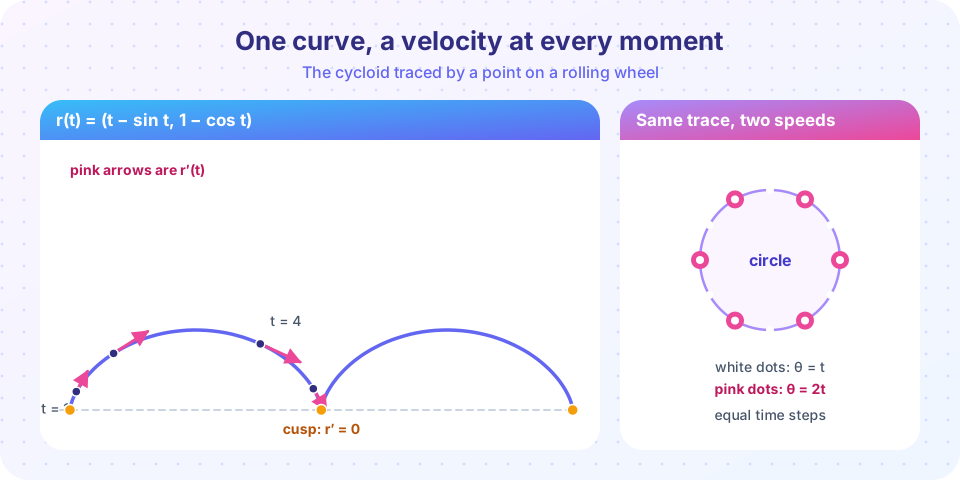
| Cycloid | r(t) = (t − sin t, 1 − cos t) |
wheel of radius 1 rolling on the x-axis |
Notice the difference between the curve as a map (the formula, which includes the speed) and the trace (the point set). Geometry is mostly about the trace; analysis needs the map.
Tangent vectors and tangent lines
The tangent vector at t₀ is r′(t₀) = (x′(t₀), y′(t₀), z′(t₀)). If it is nonzero, the tangent line at r(t₀) is
L(s) = r(t₀) + s r′(t₀), s in R.
Worked example. For the helix r(t) = (cos t, sin t, t) at t₀ = π/2: the point is (0, 1, π/2), the tangent vector is (−sin t, cos t, 1) = (−1, 0, 1), so the tangent line is (0 − s, 1, π/2 + s).
For the cycloid, r′(t) = (1 − cos t, sin t). At t = π (the top of the arch) that is (2, 0): the point moves horizontally at speed 2, twice the speed of the wheel's centre, which is a nice physical fact. At t = 0 and t = 2π the velocity is (0, 0): the point touches the ground and is momentarily at rest.
Regular curves
A curve is regular if r′(t) ≠ 0 for all t. Regularity guarantees that the tangent line exists everywhere and that the curve has no sudden stops or corners that are hiding inside a smooth formula.
The classic failure is the semicubical parabola r(t) = (t², t³). Its velocity is (2t, 3t²), which vanishes at t = 0. The trace has a sharp point (a cusp) at the origin, even though both coordinate functions are perfectly smooth. For this reason, the course assumes regular curves almost everywhere, and treats the points where r′ = 0 as special cases to inspect separately.
Reparametrization
Let φ: J → I be a smooth function with φ′ > 0 (so it is increasing and invertible). Then r̃(s) = r(φ(s)) traces the same points in the same order but at a different speed. By the chain rule:
r̃′(s) = φ′(s) r′(φ(s))
The tangent direction is unchanged and the speed is multiplied by φ′(s). For the unit circle, r₁(t) = (cos t, sin t) has speed 1, r₂(t) = (cos 2t, sin 2t) has speed 2 and r₃(t) = (cos t², sin t²) has speed 2t. These are three maps with the same trace.
Geometric quantities (length, curvature, torsion) must be the same for every regular reparametrization; they describe the trace. Kinematic quantities (speed, acceleration) change. Keeping the two apart saves much confusion. In the next lesson you will meet the best parametrization of all: the one whose speed is 1.
Common misconceptions
"If the formulas are smooth, the trace is smooth." A cusp like (t², t³) has smooth coordinates but a sharp point, because the velocity vanishes there.
"Different formulas are different curves." (cos t, sin t) and (cos 2t, sin 2t) trace the same circle. They differ as maps, not as shapes.
"The tangent vector always has length 1." It has length equal to the speed. The unit tangent T = r′ / |r′| is a separate object.
Try it
First, an interactive picture of the cycloid. Drag the slider to roll the wheel: the pink arrow is the velocity r′(t), and it shrinks to nothing at the cusps.
The next program checks regularity numerically: it scans a range of t for the smallest speed of each curve.
Press Run (or Ctrl + Enter) to see the console output here.
No output.
Finally, the same circle at different speeds, and the cusp curve. The dots mark equal time steps: they are evenly spaced along the trace for speed 1 and twice as far apart for speed 2.
Press Run (or Ctrl + Enter) to see the result here.
Program input · what you'd type while the program runs
Type the answers before you press Run, one per line. Each time the program reads a line (with input()), it gets the next line from this box.
Check your understanding
Quick check · 5 questions
of 5 answered You scored / 5 · perfect!
-
1. What is the tangent vector of r(t) = (t, t^2) at t = 3?
r′(t) = (1, 2t), so r′(3) = (1, 6). -
2. A parametrized curve is regular if...
Regular means the velocity never vanishes. -
3. Why is r(t) = (t^2, t^3) not regular at t = 0?
The velocity (2t, 3t²) is zero at t = 0, and the trace has a cusp there. -
4. How does the speed change when you reparametrize by t = phi(s)?
By the chain rule, r̃′(s) = φ′(s) r′(φ(s)). -
5. What is the speed of the cycloid r(t) = (t - sin t, 1 - cos t) at t = pi?
r′(π) = (1 − cos π, sin π) = (2, 0), so the speed is 2.
Summary
- A parametrized curve is a smooth map
t → r(t); the trace is its set of points. - The tangent vector is
r′(t); the tangent line isr(t₀) + s r′(t₀). - A curve is regular when
r′(t) ≠ 0everywhere; cusps occur where it vanishes. - Reparametrization multiplies the speed by
φ′but keeps the trace and tangent direction.
Next: Arc Length
Track your progress
Create a free account to tick off lessons and pick up where you left off on any device.
of Differential Geometry lessons completed