


















Lesson 18 of 44 · The First and Second Fundamental Forms
The First Fundamental Form
Derive the first fundamental form E du² + 2F du dv + G dv², compute it for plane, cylinder, sphere, graph and torus, and see why a cylinder is intrinsically flat.
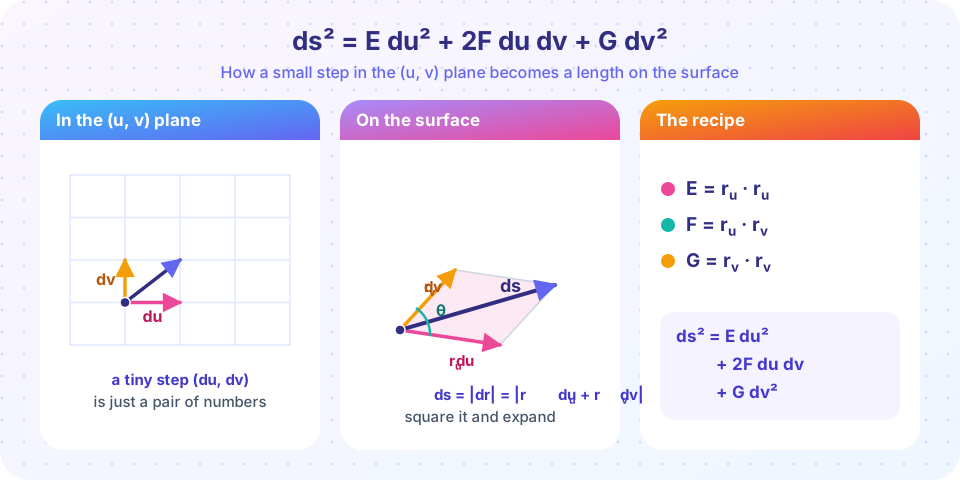
On a flat sheet, the Pythagorean theorem gives the distance: ds² = dx² + dy². On a curved surface described by parameters (u, v), the grid lines are not perpendicular and not evenly spaced, so a small step (du, dv) has a length that depends on where you are and which way you go. The recipe ds² = E du² + 2F du dv + G dv² is the first fundamental form, and it is the surface's own version of the Pythagorean theorem.
What you will learn
- How to derive
ds² = E du² + 2F du dv + G dv²from the dot product - How to compute
E, F, Gfor graphs, spheres, cylinders and tori - How to find the length of a curve on a surface from its
(u(t), v(t)) - What an isometry is, and why the cylinder is flat but the sphere is not
Key terms
First fundamental form: I(w) = w · w for tangent vectors w.
Coefficients: E = r_u · r_u, F = r_u · r_v, G = r_v · r_v.
Line element: ds² = E du² + 2F du dv + G dv².
Isometry: a map between surfaces that preserves the first fundamental form.
Orthogonal parametrization: one with F = 0.
Derivation
A small step (du, dv) in the parameter plane moves a point on the surface by approximately the tangent vector dr = r_u du + r_v dv. Its squared length is
ds² = dr · dr = (r_u du + r_v dv) · (r_u du + r_v dv)
    = (r_u · r_u) du² + 2 (r_u · r_v) du dv + (r_v · r_v) dv²
Define E = r_u · r_u, F = r_u · r_v, G = r_v · r_v; these are functions of (u, v). Then ds² = E du² + 2F du dv + G dv². As a matrix:
I(du, dv) = [du dv] · [[E, F], [F, G]] · [du dv]ᵀ
Because I(w) = |w|² > 0 for every nonzero tangent vector, the matrix is positive definite, which means E > 0 and EG − F² > 0. In fact EG − F² = |r_u × r_v|² (the Lagrange identity), the square of the area factor we met in chapter 3.
Lengths of curves on the surface
If α(t) = r(u(t), v(t)), then α′ = r_u u′ + r_v v′ and |α′|² = E u′² + 2F u′v′ + G v′², so
Length = ∫ sqrt( E u′² + 2F u′ v′ + G v′² ) dt.
The remarkable thing: once you know E, F, G, you can compute lengths without ever looking at the surface from outside. That is what "intrinsic" means.
A catalogue of first forms
| Surface | Parametrization | E | F | G |
|---|---|---|---|---|
| Plane (Cartesian) | (u, v, 0) |
1 | 0 | 1 |
| Plane (polar) | (u cos v, u sin v, 0) |
1 | 0 | u² |
| Cylinder | (R cos u, R sin u, v) |
R² | 0 | 1 |
| Sphere | (R sin u cos v, R sin u sin v, R cos u) |
R² | 0 | R² sin²u |
| Graph | (u, v, f(u, v)) |
1 + f_u² | f_u f_v | 1 + f_v² |
| Torus | ((a + b cos v) cos u, …, b sin v) |
(a + b cos v)² | 0 | b² |
For the sphere of radius R this says ds² = R² du² + R² sin²u dv²: moving along a meridian by du costs R du, while moving along a parallel by dv costs only R sin u dv, since parallels near the poles are short. For the polar plane, ds² = dρ² + ρ² dθ², the familiar polar-coordinates formula.
Worked example. On the unit sphere, the circle of latitude u = u₀ has u′ = 0, v′ = 1, so its length is ∫₀^{2π} sin u₀ dv = 2π sin u₀. At u₀ = π/3 that is π√3 ≈ 5.441. A meridian from pole to pole has v′ = 0 and length ∫₀^π du = π.
Isometries: same ruler, same geometry
Two surfaces are locally isometric if there are parametrizations on which they have the same E, F, G. Anything that can be computed from the first form is then the same on both: lengths, angles, areas, and, by Gauss's Theorema Egregium, the Gaussian curvature.
The cylinder is isometric to the plane. Parametrize the cylinder by arc length: r(x, y) = (R cos(x/R), R sin(x/R), y). Then r_x = (−sin(x/R), cos(x/R), 0) and r_y = (0, 0, 1), so E = G = 1 and F = 0: exactly the plane's form. Rolling a sheet of paper into a tube preserves every length and angle, which is what this says.
The sphere is not. Its first form R² du² + R² sin²u dv² cannot be turned into dx² + dy² by any change of variables; the proof is that the sphere's Gaussian curvature is 1/R² ≠ 0, while the plane's is 0. This is why every flat map of the Earth distorts lengths, angles or areas, a fact explored in the next lesson.
Common misconceptions
"If two surfaces have the same E, F, G they are the same surface." Only the same intrinsic geometry. A plane and a cylinder are different shapes in space.
"F = 0 always." It vanishes only when the grid lines cross at right angles. For graphs, F = f_u f_v is generally not zero.
"E and G are the lengths of r_u and r_v." They are the squares of those lengths.
Try it
First, a symbolic calculation for the graph of an arbitrary function. It should reproduce the table and the identity EG − F² = 1 + f_u² + f_v².
Press Run (or Ctrl + Enter) to see the result here.
Program input · what you'd type while the program runs
Type the answers before you press Run, one per line. Each time the program reads a line (with input()), it gets the next line from this box.
Now the cylinder and the plane. The same line (x, y) = (t, 2t) in the unrolled strip becomes a helix on the cylinder. The program computes its length in the plane (a straight segment) and as a 3D polyline on the cylinder, and draws both.
Press Run (or Ctrl + Enter) to see the result here.
Program input · what you'd type while the program runs
Type the answers before you press Run, one per line. Each time the program reads a line (with input()), it gets the next line from this box.
Finally, lengths on the sphere computed with the first form only.
Press Run (or Ctrl + Enter) to see the console output here.
No output.
Check your understanding
Quick check · 5 questions
of 5 answered You scored / 5 · perfect!
-
1. What is E in terms of the patch r(u, v)?
E = r_u · r_u, the squared length of r_u. -
2. For the unit sphere with u the polar angle, what is G?
r_v = (−sin u sin v, sin u cos v, 0), so r_v · r_v = sin²u. -
3. For the plane in polar coordinates r(u, v) = (u cos v, u sin v, 0), what is the line element?
E = 1, F = 0 and G = u², the usual polar line element. -
4. Why is a cylinder isometric to a plane?
Unrolling the cylinder gives the plane's first fundamental form exactly. -
5. What is the length of the equator of a sphere of radius R computed from the first form?
At u = π/2, √G = R, and integrating over v from 0 to 2π gives 2πR.
Summary
E = r_u · r_u,F = r_u · r_v,G = r_v · r_v;ds² = E du² + 2F du dv + G dv².- Length of a curve:
∫ √(E u′² + 2F u′v′ + G v′²) dt; the matrix[[E, F], [F, G]]is positive definite andEG − F² = |r_u × r_v|². - Isometric surfaces share the first form; the cylinder is isometric to the plane, the sphere is not.
Next: Area and Angles
Track your progress
Create a free account to tick off lessons and pick up where you left off on any device.
of Differential Geometry lessons completed