


















Lesson 13 of 44 · Surfaces and Parametrizations
Parametrized Surfaces and Coordinate Curves
Learn how a surface patch r(u, v) paints a flat grid onto a surface, how coordinate curves and curves on surfaces work, and how to parametrize sphere, cylinder and cone.
Latitude and longitude are a parametrization of the Earth: two numbers locate any point on the surface. That is the whole idea of a surface patch: to describe a two-dimensional shape in space, take a flat piece of the (u, v)-plane and map it into space with a smooth function r(u, v). This lesson shows what that means geometrically, introduces coordinate curves and curves drawn on a surface, and parametrizes the sphere, the cylinder and the cone.
What you will learn
- What a parametrized surface patch is and what its domain is
- What coordinate curves are and why their velocities are
r_uandr_v - How to describe a curve that lives on a surface using
(u(t), v(t)) - Standard parametrizations of the sphere, cylinder, cone and graphs
Key terms
Patch: a smooth map r: U → R³ where U is an open set in the (u, v)-plane.
u-curve / v-curve: the curves u ↦ r(u, v₀) and v ↦ r(u₀, v).
Partial derivatives: r_u = ∂r/∂u and r_v = ∂r/∂v.
Curve on a surface: α(t) = r(u(t), v(t)) for a plane curve (u(t), v(t)).
Chart: another name for a parametrization when thought of as a coordinate system.
A patch is a map from the plane
A parametrized surface is a smooth function
r(u, v) = ( x(u, v), y(u, v), z(u, v) ), (u, v) in a domain U
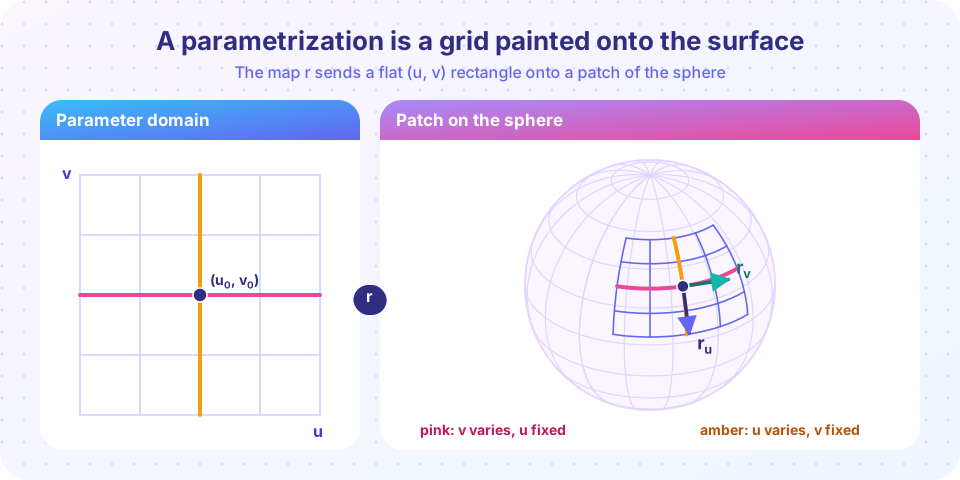
The picture to keep in mind: a sheet of graph paper (U) is bent, stretched and placed in space. The lines of the graph paper become the grid lines of the surface. This is exactly what the left-to-right arrow in the illustration above shows. Different grids on the same surface are different parametrizations.
Coordinate curves
If you hold v = v₀ and let u vary, you get the u-curve u ↦ r(u, v₀). Hold u = u₀ and you get the v-curve. Both pass through the point r(u₀, v₀). Their velocity vectors there are the partial derivatives:
r_u(u₀, v₀) = ∂r/∂u r_v(u₀, v₀) = ∂r/∂v
These are the two tangent vectors of the patch. The tangent plane (next lesson) is spanned by them.
Standard parametrizations
The sphere of radius R by spherical coordinates, with u the polar angle from the north pole and v the longitude:
r(u, v) = ( R sin u cos v, R sin u sin v, R cos u ), 0 < u < π, 0 < v < 2π
The u-curves (fixed v) are meridians, the v-curves (fixed u) are circles of latitude. For the unit sphere:
r_u = (cos u cos v, cos u sin v, −sin u) r_v = (−sin u sin v, sin u cos v, 0)
The cylinder of radius R, axis the z-axis: r(u, v) = (R cos u, R sin u, v).
The cone (a circular cone with vertex at the origin and half-angle 45°): r(u, v) = (v cos u, v sin u, v).
A graph z = f(x, y): r(u, v) = (u, v, f(u, v)). The grid lines are the curves obtained by cutting the graph with planes x = const and y = const.
The torus with centre-circle radius a and tube radius b: r(u, v) = ((a + b cos v) cos u, (a + b cos v) sin u, b sin v).
There are usually many parametrizations of the same surface. For example, the upper hemisphere is also the graph z = √(1 − x² − y²) over the unit disc, a very different grid from latitude and longitude, and one that covers the whole open hemisphere with no trouble at the pole.
Curves on a surface
A curve drawn on a patch is described by a plane curve in the domain: α(t) = r(u(t), v(t)). By the chain rule its velocity is
α′(t) = r_u u′(t) + r_v v′(t)
So every tangent vector of a curve on the surface is a combination of r_u and r_v. Examples on the unit sphere:
u = π/2(constant): the equator.v = v₀: a meridian.v = 3u: a spiral that winds one and a half times around the sphere (vgoes from0to3π) whileucarries it from pole to pole.
This idea, describing curves on a surface by curves in the parameter plane, is the engine behind chapter 4, where a small step (du, dv) in the plane is converted to a length on the surface.
Common misconceptions
"The parametrization is the surface." The surface is the set of points; a parametrization is one way to label them. Latitude-longitude and stereographic coordinates label the same sphere differently.
"A parametrization covers the whole surface." Often a single patch cannot. The spherical-coordinate patch above misses a half-meridian and degenerates at the poles, so we use several patches to cover a whole sphere.
"u and v must be lengths." They are just labels. In spherical coordinates both are angles.
Try it
The first program draws a patch of the unit sphere with its coordinate curves, next to the corresponding rectangle in the (u, v) plane, and a spiral curve in both.
Press Run (or Ctrl + Enter) to see the result here.
Program input · what you'd type while the program runs
Type the answers before you press Run, one per line. Each time the program reads a line (with input()), it gets the next line from this box.
The second program computes r_u and r_v symbolically, checks that they are perpendicular for the sphere, and evaluates the length of r_u × r_v (a quantity that will become the area element in chapter 4).
Press Run (or Ctrl + Enter) to see the result here.
Program input · what you'd type while the program runs
Type the answers before you press Run, one per line. Each time the program reads a line (with input()), it gets the next line from this box.
The last output shows something important: at the pole u = 0, r_v is the zero vector. The spherical-coordinate parametrization breaks down at the poles, even though the sphere itself is perfectly smooth there. We return to this in lesson 3.
Press Run (or Ctrl + Enter) to see the console output here.
No output.
Check your understanding
Quick check · 5 questions
of 5 answered You scored / 5 · perfect!
-
1. What is the u-curve of a patch r(u, v) through (u0, v0)?
A u-curve keeps v constant and lets u vary. -
2. For the sphere r(u, v) = (sin u cos v, sin u sin v, cos u), what are the circles u = const?
Fixing the polar angle u gives a circle of constant latitude. -
3. If alpha(t) = r(u(t), v(t)), then alpha prime(t) equals...
This is the chain rule applied to r(u(t), v(t)). -
4. What goes wrong with spherical coordinates at the poles?
At u = 0 or π, r_v = (−sin u sin v, sin u cos v, 0) vanishes. -
5. Which is a parametrization of the cylinder x^2 + y^2 = 1?
x² + y² = cos²u + sin²u = 1, and v runs along the axis.
Summary
- A parametrized surface is a smooth map
r(u, v)from a planar domain; its grid lines are coordinate curves. r_uandr_vare the velocities of the coordinate curves and are tangent to the surface.- A curve on the surface is
r(u(t), v(t))with velocityr_u u′ + r_v v′. - Sphere, cylinder, cone, graph and torus all have simple parametrizations, but one patch may not cover or stay regular everywhere.
Track your progress
Create a free account to tick off lessons and pick up where you left off on any device.
of Differential Geometry lessons completed