


















Lesson 21 of 44 · The First and Second Fundamental Forms
Chapter 4 Review: The Fundamental Forms
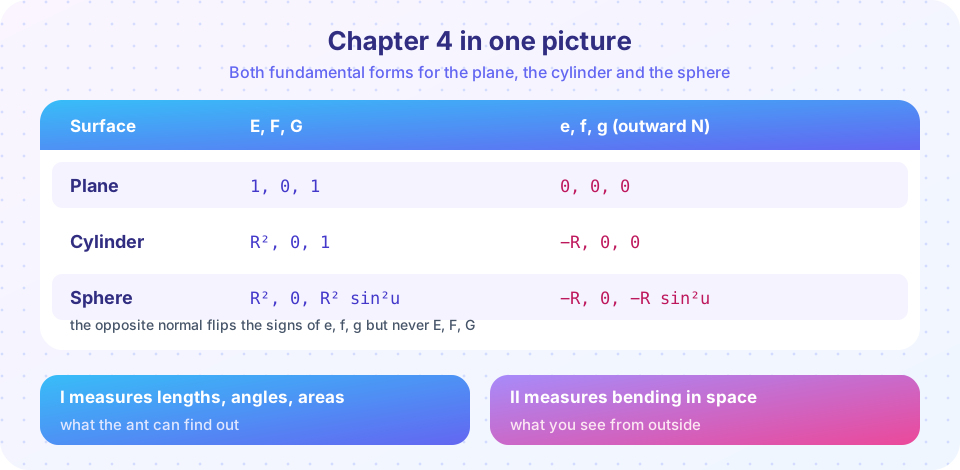
One-page recap of chapter 4: coefficients E, F, G and e, f, g for the plane, cylinder and sphere, plus a ten-question quiz mixing all four lessons.
The two fundamental forms are the measuring tools of surface theory. The first (E, F, G) tells you how to measure lengths, angles and areas on the surface. The second (e, f, g) tells you how the surface bends in space. In the next chapter, you will combine them to define curvature. This review puts the key facts on one page and then tests them.
Chapter in a table
| Idea | Formula | Lesson |
|---|---|---|
| First form | E = r_u · r_u, F = r_u · r_v, G = r_v · r_v |
First fundamental form |
| Line element | ds² = E du² + 2F du dv + G dv² |
First fundamental form |
| Length of a curve | ∫ √(E u′² + 2F u′v′ + G v′²) dt |
First fundamental form |
| Isometry | same E, F, G: the cylinder is isometric to the plane |
First fundamental form |
| Area | dA = √(EG − F²) du dv |
Area and angles |
| Angle between grid lines | cos θ = F / √(EG) |
Area and angles |
| Second form | e = r_uu · N, f = r_uv · N, g = r_vv · N |
Second fundamental form |
| Height above tangent plane | h ≈ ½ II |
Second fundamental form |
| Normal curvature | κₙ = II / I |
Second fundamental form |
What you should be able to do
- Compute
E, F, Gfor a parametrization and use them to find a curve's length, an angle or an area. - Explain why the cylinder is isometric to the plane and the sphere is not.
- Compute
e, f, gfor a graph, a cylinder or a sphere. - Interpret
II / Ias the bending in a given direction.
Try it
A numerical calculator for all six coefficients. It takes any patch, differentiates it numerically at a point, builds the unit normal from the cross product, and prints E, F, G, e, f, g. Test it with a sphere of radius 2 at (u, v) = (1, 0.5): you should get E = 4, F = 0, G = 4 sin²1 ≈ 2.832, e = −2, f = 0, g = −2 sin²1 ≈ −1.416.
Press Run (or Ctrl + Enter) to see the result here.
Program input · what you'd type while the program runs
Type the answers before you press Run, one per line. Each time the program reads a line (with input()), it gets the next line from this box.
The second program is a preview of the next chapter. Choose e, f and g (with E = G = 1, F = 0) and see the normal curvature κₙ(θ) as a function of direction. The green part is positive, the red part negative. The extreme values are the principal curvatures, which are the eigenvalues of the matrix [[e, f], [f, g]].
Check your understanding
Quick check · 10 questions
of 10 answered You scored / 10 · perfect!
-
1. For the plane r(u, v) = (u, v, 0), the pair (E, G) is...
r_u and r_v are orthonormal. -
2. A curve has (u, v) = (t, 0) on the unit sphere (u is the polar angle), from t = 0 to t = 1. What is its length?
E = 1, so ds = du and the length is 1: a meridian arc. -
3. What is the area element of a patch with E = 4, F = 0, G = 9?
√(EG − F²) = √36 = 6. -
4. The cylinder and the plane have the same...
Unrolling the cylinder gives E = G = 1, F = 0, the plane's first form. -
5. Which is true about the sign of e, f, g?
e, f, g are dot products with N. -
6. For a graph z = f(x, y), at a point where f_x = f_y = 0, the second form is...
W = 1 there, so e = f_xx, f = f_xy, g = f_yy. -
7. Which pair is the sphere of radius R's (e, g) with outward normal?
Computed in the lesson: e = −R, f = 0, g = −R sin²u. -
8. Normal curvature in a direction is...
κₙ = II/I. -
9. Which form can be determined by someone who never leaves the surface?
Lengths along the surface determine E, F, G; the second form needs N and the surrounding space. -
10. A flat map of the whole Earth can preserve which combination?
The sphere is not isometric to the plane, so at most angles (conformal) or areas (equal-area) can be preserved, not both.
Summary
I = E du² + 2F du dv + G dv²measures lengths, angles and areas; it is intrinsic.II = e du² + 2f du dv + g dv²measures bending relative to the normal; it is extrinsic.κₙ = II / Igives the curvature of each normal section.- Plane:
II = 0; cylinder:IInonzero butIflat; sphere: both nonzero.
Next: continue with the rest of the course on the Differential Geometry track page
Track your progress
Create a free account to tick off lessons and pick up where you left off on any device.
of Differential Geometry lessons completed