


















Lesson 44 of 44 · Projects and Practice
Where to go next after differential geometry
A guide to what comes after this course: Riemannian geometry, general relativity, topology, geometric analysis, graphics, robotics and machine learning, with links to related tracks.
You now know how curves and surfaces bend, how to measure that bending intrinsically, how geodesics and parallel transport work, how total curvature is controlled by topology, and how all of this extends to manifolds. That is a solid foundation. This last lesson shows where the road continues, and which other tracks on this site will help along the way.
What you will learn
- The main directions that continue from this course and what each one needs.
- Which tracks on this site cover the prerequisites.
- How curvature shows up in a first piece of Riemannian geometry: geodesic spreading.
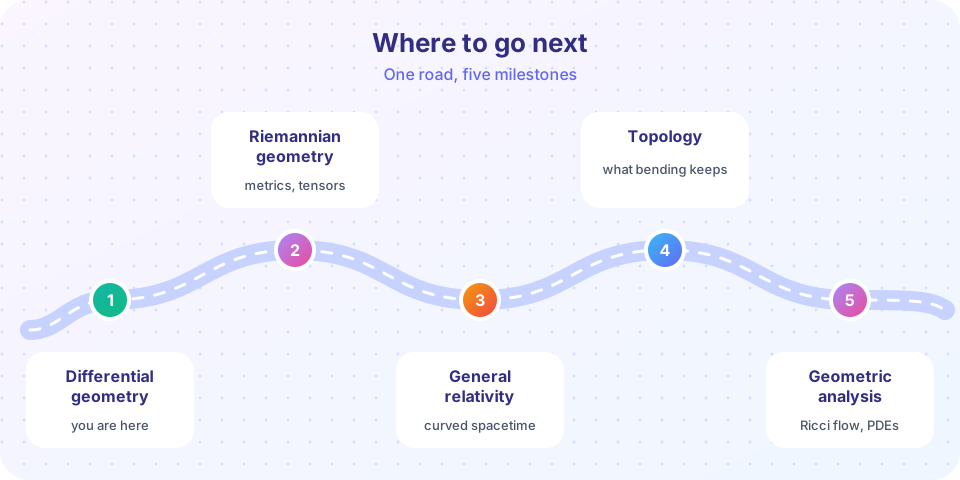
Five directions
1. Riemannian geometry. The natural continuation: manifolds with metrics in any dimension. Topics: the exponential map, Jacobi fields, comparison theorems (Rauch, Toponogov), the Hopf–Rinow theorem on completeness, the Bonnet–Myers theorem (positive Ricci curvature bounds the diameter), Hodge theory. Needs: the last chapter of this course, multivariable calculus and linear algebra.
2. General relativity. Spacetime is a 4-dimensional manifold with a Lorentzian metric. Free fall follows geodesics, and the Einstein equations relate the Ricci tensor to matter. Everything in Chapter 8 is the mathematical language of this theory. See the Relativity track for the physics, and classical mechanics for the variational ideas behind geodesics.
3. Topology. Gauss–Bonnet showed that curvature knows about holes. Algebraic and differential topology ask which spaces are the same, using invariants such as homotopy groups, homology and cohomology; de Rham cohomology links differential forms to topology. Start with the Topology track, with real analysis as background.
4. Geometric analysis. Differential equations on manifolds: the Laplace–Beltrami operator, harmonic maps, minimal surfaces (Plateau's problem), Ricci flow, which Perelman used to prove Thurston's geometrization and the Poincaré conjecture. Needs analysis and PDEs.
5. Applications.
- Computer graphics and geometry processing: meshes, discrete curvature, geodesic distance on surfaces, parametrization and remeshing. See computer graphics and numerical methods.
- Robotics: configuration spaces are manifolds (rotation groups, tori), and motion planning follows geodesics. See robotics.
- Machine learning and statistics: manifold learning assumes data lies near a low-dimensional manifold; information geometry gives statistical models a Riemannian metric (the Fisher metric). See machine learning.
- Physics beyond gravity: gauge theories use connections and curvature on bundles, the same ideas as parallel transport and the Riemann tensor.
A taste of Riemannian geometry: spreading geodesics
Here is the idea behind many comparison theorems. Launch two geodesics from the same point with a tiny angle ε between them. The distance J(t) between them at arc length t is ε times a function satisfying the Jacobi equation (on a surface)
J″ + K J = 0, J(0) = 0, J′(0) = 1.
For constant K the solution is sin(√K t)/√K for K > 0, t for K = 0, and sinh(√−K t)/√−K for K < 0. On a sphere the geodesics from the north pole refocus at the south pole (J = 0 again at t = π). In the plane they spread linearly. In the hyperbolic plane they spread exponentially. This is how curvature controls the global shape of space.
Press Run (or Ctrl + Enter) to see the result here.
Program input · what you'd type while the program runs
Type the answers before you press Run, one per line. Each time the program reads a line (with input()), it gets the next line from this box.
The plot is the intuition behind the sign of curvature: converging geodesics for K > 0, linear spreading for K = 0, exponential spreading for K < 0. Now pick a direction and get a starter reading list.
This picker offers suggestions only; the order of study is up to you.
Common misconceptions
"I must master all of differential geometry before relativity." You need manifolds, metrics, geodesics and the curvature tensor, which this course has introduced; many physics courses teach exactly that subset.
"Topology is a separate subject." Gauss–Bonnet already tied geometry and topology together. Modern geometry uses both constantly.
"Advanced means harder formulas." Often it means fewer formulas and more structure: connections and bundles replace long coordinate expressions.
Check your understanding
Quick check · 4 questions
of 4 answered You scored / 4 · perfect!
-
1. In general relativity, freely falling particles follow
Gravity is encoded in the curvature of the metric, and free fall follows geodesics. -
2. On a surface with constant K = 1, two nearby geodesics from the same point
J(t) = sin t vanishes again at t = π. -
3. Which of these is a central object of geometric analysis?
Ricci flow evolves a metric by its Ricci curvature. -
4. Configuration spaces of robot arms are typically
Joint angles form tori and rotation groups, which are manifolds.
Summary
- Natural next steps: Riemannian geometry, general relativity, topology, geometric analysis and applications.
- Jacobi's equation
J″ + K J = 0shows how curvature controls geodesic spreading. - Related tracks: Relativity, Topology, Real Analysis, Multivariable Calculus, Linear Algebra.
- Return to the course page whenever you want to revise a chapter.
Back to the Differential Geometry course.
Track your progress
Create a free account to tick off lessons and pick up where you left off on any device.
of Differential Geometry lessons completed