


















Lesson 1 of 44 · Getting Started
Course Map: How This Differential Geometry Course Works
See the whole differential geometry course at a glance: who it is for, what you need first, how the nine chapters fit together, and how to study.
Differential geometry is the study of shape using calculus. A circle, a coffee cup, the surface of the Earth and the space-time of general relativity all have something in common: near any point they look almost flat, and the way they depart from flatness can be measured with derivatives. This course teaches you how to do that measuring, step by step, with pictures you can run and change.
What you will learn
- What the course covers and how the nine chapters connect
- Which maths you should already know, and which you can pick up as you go
- How to study the lessons so the ideas stay with you
- What a first taste of the subject looks like in code
Key terms
Curve: a one-dimensional shape, described by a point that moves as a parameter t changes.
Surface: a two-dimensional shape, described by a point that depends on two parameters u and v.
Curvature: a number that says how sharply a curve or surface bends.
Intrinsic: a property that someone living inside the surface could measure, without looking at it from outside.
Manifold: a space that looks like ordinary flat space near every point, even though it may curve or loop globally.
Who this course is for
You may be a student who has just finished multivariable calculus, an engineer who wants to understand how CAD systems describe curved parts, a computer-graphics programmer who meets "normals" and "tangent frames" every day, or a physics student heading toward general relativity. The course assumes no earlier geometry beyond high school, but it does assume you are comfortable with the following:
- Derivatives and integrals of one variable. Chain rule, product rule, basic substitution.
- Partial derivatives. What
∂f/∂xmeans and how the chain rule works for functions of two variables. - Vectors in 3-space. Addition, scalar multiples, the dot product and the cross product. Lesson 3 revises these.
- A little Python. Every lesson has runnable code that uses
numpy,matplotliband sometimessympy. You do not need to be an expert; you need to be willing to change a number and press Run.
The nine chapters
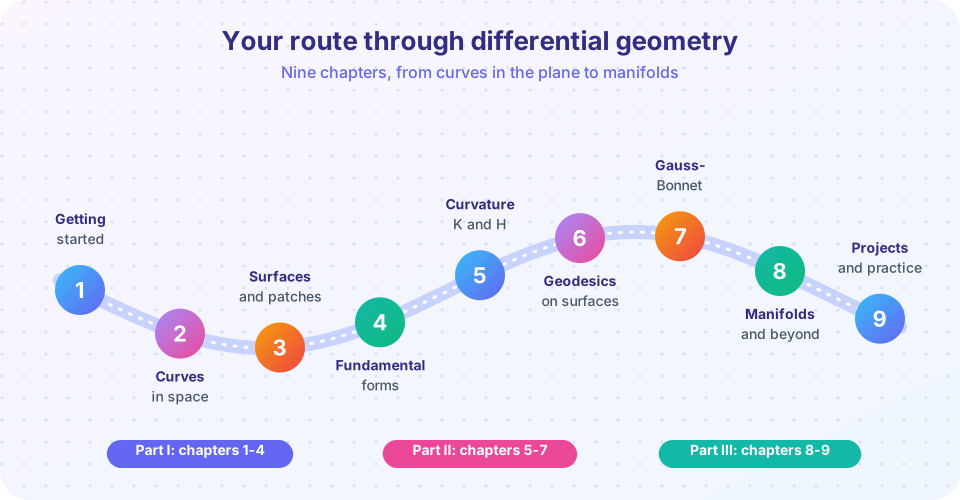
Here is the route in one picture. Press the arrows (or the right arrow key) to move through it.
Part I: the foundations
- Getting started
- Curves
- Surfaces
- Two forms
Part II: the geometry
- Curvature
- Geodesics
- Gauss-Bonnet
Part III: beyond
- Manifolds
- Projects
Chapters 1 to 4 are this half of the course.
In short: Chapter 1 sets up your tools. Chapter 2 studies curves: how fast you move, how sharply you turn, how much you twist. Chapter 3 moves up one dimension to surfaces and their tangent planes. Chapter 4 introduces the two fundamental forms, the first for measuring lengths, angles and areas on a surface, the second for measuring how it bends in space. Chapters 5 to 7 use those forms to define curvature, find shortest paths (geodesics) and prove the Gauss-Bonnet theorem, which ties local bending to global shape. Chapter 8 drops the surrounding space and meets manifolds. Chapter 9 gives you projects.
How to study
- Read with a pencil. Formulas in this subject are easy to nod along to and hard to reproduce. Copy one worked example by hand before you run the code.
- Run everything, then break it. Each
Try itblock is meant to be edited. Change a radius, flip a sign, double a speed. Predict first, then check. - Draw. Almost every concept has a picture: a tangent line, a normal vector, a patch with grid lines. If you can sketch it, you understand it.
- Use the quizzes honestly. Answer before you open the explanation. Wrong answers teach more than right ones.
- Keep a one-page formula sheet. Each chapter ends with a cheat-sheet picture you can copy.
Try it
A first taste: a curve on a sphere
The code below draws a sphere and a path on it. Do not worry about the details yet; by the end of chapter 1 you will be able to write programs like this yourself. Look instead at the idea: one list of numbers t becomes a curve, and two lists u, v become a surface.
Press Run (or Ctrl + Enter) to see the result here.
Program input · what you'd type while the program runs
Type the answers before you press Run, one per line. Each time the program reads a line (with input()), it gets the next line from this box.
A second taste: the circle that fits a curve
Below, drag the slider to move a point along the parabola y = x²/4. The page draws the tangent line and the circle that hugs the curve best at that point (the osculating circle, from chapter 2). Watch the circle shrink where the curve bends sharply and swell where it is almost straight. The number κ (kappa) is the curvature.
Check your understanding
Quick check · 4 questions
of 4 answered You scored / 4 · perfect!
-
1. What does differential geometry use to study shape?
Near each point a smooth shape looks almost flat, and derivatives measure how far it departs from flatness. -
2. Which description fits a surface in this course?
A curve has one parameter t; a surface has two parameters, u and v. -
3. What is an intrinsic property of a surface?
Intrinsic quantities, such as the lengths measured by the first fundamental form, can be found without leaving the surface. -
4. In the curvature explorer, what happens to the osculating circle where the curve bends sharply?
Radius is 1 divided by curvature, so a sharper bend means larger curvature and a smaller circle.
Summary
- Differential geometry uses calculus to measure how curves, surfaces and spaces bend.
- You need single-variable calculus, partial derivatives and basic vectors; Python helps you see everything.
- Chapters 1 to 4 build the tools (curves, surfaces, the two fundamental forms); chapters 5 to 9 use them.
- Study actively: draw, run, change numbers, and predict before checking.
Track your progress
Create a free account to tick off lessons and pick up where you left off on any device.
of Differential Geometry lessons completed