


















Lesson 6 of 44 · Curves in the Plane and Space
Chapter 2 Overview: Curves in the Plane and Space
Preview of chapter 2: how to describe curves with parametrizations, measure their length, and capture bending and twisting with curvature and torsion.
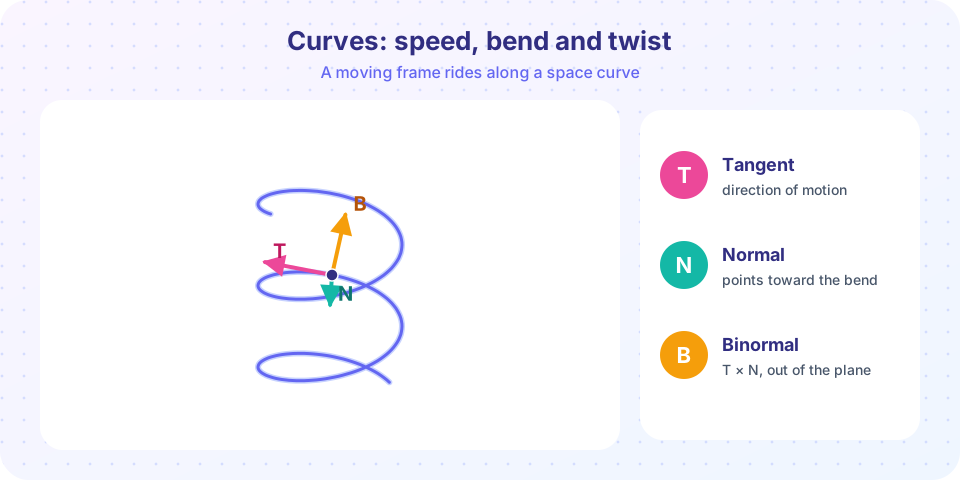
A curve is the simplest object in differential geometry, and nearly everything about surfaces is built on it. When you drive along a road, three things are happening at once: you are going somewhere at some speed, the road is turning, and (if it climbs a spiral ramp) it is twisting out of a flat plane. This chapter gives names and formulas to those three things: speed, curvature and torsion.
What you will learn
- What each lesson in the chapter covers and how they fit together
- The three numbers that describe a curve locally: speed, curvature, torsion
- Why the same shape can have many parametrizations, and which one is best
Key terms
Parametrized curve: a map t → r(t) from an interval into the plane or space.
Arc length: the length of the curve between two points, ∫ |r′(t)| dt.
Curvature κ: how fast the tangent direction turns per unit of arc length.
Torsion τ: how fast the curve twists out of its osculating plane.
Frenet frame: the moving orthonormal triple (T, N, B) attached to the curve.
The chapter in five slides
- Describe it
- Measure it
- Bend it
- Twist it
- Rebuild it
What each lesson covers
- Parametrized Curves and Tangent Vectors: parametrizations, regular curves, cusps and reparametrization.
- Arc Length: adding up tiny chords, the arc-length integral and the unit-speed parametrization.
- Curvature of Plane Curves: signed curvature, the formulas, osculating circles and reconstructing a curve from its curvature.
- Space Curves and the Frenet Frame: curvature, torsion, the Frenet-Serret equations and the helix.
- Chapter 2 Review: the formulas on one page and a mixed quiz.
Common misconceptions
"A curve is the same as its formula." The same set of points can be traced by infinitely many formulas, at different speeds. Geometric quantities such as curvature must not depend on the choice.
"Curvature is the second derivative." For a graph y = f(x) the second derivative is related but not equal: you must also divide by (1 + f′²)^(3/2) to remove the effect of slope.
Try it
Here are three curves with very different personalities: a straight line, a circle and a helix. The program estimates the curvature of each numerically, using the formula κ = |r′ × r″| / |r′|³ that you will derive in lesson 3. Notice that curvature is a property of the shape, not of how fast we traverse it.
Press Run (or Ctrl + Enter) to see the result here.
Program input · what you'd type while the program runs
Type the answers before you press Run, one per line. Each time the program reads a line (with input()), it gets the next line from this box.
You should see 0 for the line, 0.5 for the circle (that is 1/R) and about 0.917 for the helix; the exact helix value, a / (a² + b²), is derived in lesson 4.
Check your understanding
Quick check · 4 questions
of 4 answered You scored / 4 · perfect!
-
1. Which three quantities describe a space curve locally?
Speed (from the parametrization), curvature (bending) and torsion (twisting) describe the local behaviour of a space curve. -
2. What is the curvature of a straight line?
A line never turns, so its tangent direction does not change. -
3. What is the curvature of a circle of radius R?
The tangent turns through 2π radians over a length of 2πR, so the rate is 1/R. -
4. What does the osculating circle of a curve at a point do?
It touches the curve with the same tangent and the same curvature.
Summary
- Chapter 2 builds three local measurements of a curve: speed, curvature and torsion.
- Arc length gives a natural "clock" for a curve, the unit-speed parametrization.
- Curvature and torsion are geometric: they do not depend on how you parametrize.
- The Frenet frame packages the local geometry into one moving triple of vectors.
Track your progress
Create a free account to tick off lessons and pick up where you left off on any device.
of Differential Geometry lessons completed