


















Lesson 15 of 44 · Surfaces and Parametrizations
Regular Surfaces and Standard Examples
Define regular surfaces, test them with r_u x r_v, and work through graphs, surfaces of revolution, the helicoid, the torus and the cone, including where parametrizations fail.
Not every map r(u, v) produces a surface you can do calculus on. If it squashes the grid along some direction, the two tangent vectors collapse into one and the tangent plane vanishes. The cure is a simple condition: r_u × r_v ≠ 0. A surface that can be covered by patches satisfying it is called a regular surface. In this lesson you will meet the condition, apply it to a gallery of standard examples, and learn why a cone is not regular at its tip while a sphere is regular everywhere.
What you will learn
- The definition of a regular patch and a regular surface
- How to test regularity using
|r_u × r_v| - Formulas for graphs, surfaces of revolution, helicoids, tori and cones
- Why we sometimes need several patches to cover one surface
Key terms
Regular patch: a smooth r(u, v) with r_u × r_v ≠ 0 at every point (and one-to-one onto its image).
Regular surface: a set that is covered by regular patches, with smooth overlaps.
Surface of revolution: the surface swept by rotating a plane curve about an axis.
Ruled surface: a surface made of straight lines, such as a cone or a helicoid.
Singular point: a point where no tangent plane exists, such as the tip of a cone.
The regularity test
A patch r(u, v) is regular when r_u × r_v ≠ 0 everywhere, equivalently when r_u and r_v are linearly independent. The length |r_u × r_v| is the area of the parallelogram spanned by r_u and r_v; if it is zero somewhere, the parallelogram has collapsed. (We also want r to be one-to-one, so the surface does not cross itself.) A regular surface is a set S such that every point of S lies in the image of some regular patch, with overlaps that are smooth.
There is a convenient alternative description. If F(x, y, z) is smooth and ∇F ≠ 0 at every point where F = c, then the level set {F = c} is a regular surface. The sphere x² + y² + z² = 1 and the torus (√(x² + y²) − a)² + z² = b² are examples.
Graphs
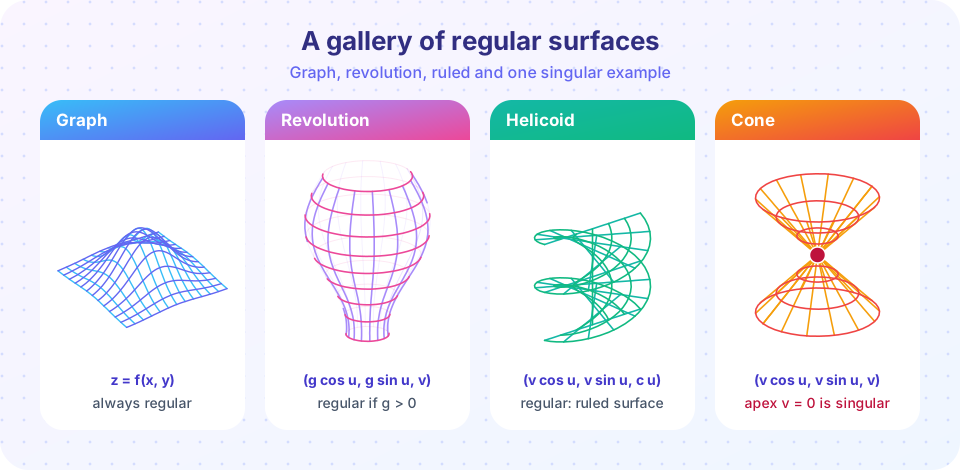
r(u, v) = (u, v, f(u, v)) always has r_u × r_v = (−f_u, −f_v, 1), whose third component is 1. So every graph of a smooth function is a regular surface, with a single patch. This is the simplest and most useful family.
Surfaces of revolution
Rotate a plane curve (g(v), h(v)), with g > 0, about the z-axis:
r(u, v) = ( g(v) cos u, g(v) sin u, h(v) ), 0 ≤ u ≤ 2π
Compute r_u = (−g sin u, g cos u, 0) and r_v = (g′ cos u, g′ sin u, h′). Then
r_u × r_v = ( g h′ cos u, g h′ sin u, −g g′ ) |r_u × r_v| = g √(g′² + h′²)
This is nonzero as long as g > 0 (away from the axis) and the profile curve itself is regular. The grid lines are circles (v = const, called parallels) and copies of the profile (u = const, called meridians).
- Sphere: profile
(sin v, cos v),g = sin v; then|r_u × r_v| = sin v, which vanishes at the polesv = 0, π. The pole is not a bad point of the sphere, only of this patch. - Torus: profile the circle
(a + b cos v, b sin v),a > b > 0. Then|r_u × r_v| = b (a + b cos v) > 0everywhere, so the torus is covered by one patch (periodic in bothuandv). - Cylinder: profile the vertical line
g = R,h = v.
The helicoid and ruled surfaces
The helicoid r(u, v) = (v cos u, v sin u, c u) is a spiral staircase: each horizontal line through the z-axis is rotated and lifted uniformly. We find r_u × r_v = (−c sin u, c cos u, −v) with length √(c² + v²). For c ≠ 0 this is never zero, so the helicoid is regular, even along the axis v = 0. It is also a ruled surface (made of straight lines) and also a minimal surface, a fact you may meet later.
The cone: a singular point
The cone r(u, v) = (v cos u, v sin u, v) has r_u × r_v = (v cos u, v sin u, −v) with length |v|√2. The parametrization is regular for v ≠ 0 (the two nappes without the apex), but at the apex v = 0 the cross product vanishes. Is the failure of the patch or of the surface? For the cone, it is the surface: no choice of parametrization can give the apex a tangent plane, because near the tip the surface is shaped like a funnel, not a plane. Remove the apex and what remains is a regular surface.
Several patches for one surface
A single patch usually cannot cover a whole closed surface. The sphere needs at least two. A convenient pair: the six hemispheres given as graphs over discs (z = ±√(1 − x² − y²), etc.), or the two stereographic projections from the north and south poles. On the overlaps, the change of parameters must be smooth with nonzero Jacobian. This idea, a surface covered by overlapping charts, is the seed of the definition of a manifold in chapter 8.
Common misconceptions
"If the patch is singular, the surface is singular." Spherical coordinates degenerate at the poles, but the sphere has a perfectly good tangent plane there, as another patch shows.
"Smooth formulas mean a smooth surface." The cone's formulas are perfectly smooth, yet the apex is a singular point of the surface.
"A surface of revolution is regular no matter what profile." The profile must stay off the axis (g > 0) and be regular itself.
Try it
First, a symbolic check of |r_u × r_v| for the sphere, torus, cone and helicoid, plus the general surface of revolution formula.
Press Run (or Ctrl + Enter) to see the result here.
Program input · what you'd type while the program runs
Type the answers before you press Run, one per line. Each time the program reads a line (with input()), it gets the next line from this box.
Next, build a surface of revolution from a profile curve. Change the profile g(v) and watch the shape change.
Press Run (or Ctrl + Enter) to see the result here.
Program input · what you'd type while the program runs
Type the answers before you press Run, one per line. Each time the program reads a line (with input()), it gets the next line from this box.
Finally, a numerical scan for singular points: the program samples a grid and reports the smallest value of |r_u × r_v| and where it occurs.
Press Run (or Ctrl + Enter) to see the console output here.
No output.
Check your understanding
Quick check · 5 questions
of 5 answered You scored / 5 · perfect!
-
1. A patch r(u, v) is regular if...
Regularity means the two tangent vectors are independent, i.e. their cross product never vanishes. -
2. Is the graph of any smooth function z = f(x, y) a regular surface?
r_u × r_v = (−f_x, −f_y, 1) is never zero. -
3. For the torus with radii a > b > 0, what is |r_u x r_v|?
From the surface of revolution formula g √(g′² + h′²) with g = a + b cos v and a unit-speed circle profile of radius b. -
4. Why is the apex of the cone a singular point of the surface?
Near the apex the surface is funnel-shaped, so it cannot be approximated by a plane. -
5. How many patches are needed to cover a whole sphere?
A sphere cannot be covered by a single regular patch; two (such as stereographic charts) are enough.
Summary
- A regular patch has
r_u × r_v ≠ 0; a regular surface is covered by such patches. - Graphs are always regular; surfaces of revolution need
g > 0; the torus and the helicoid are regular everywhere. - Singular points such as the cone's apex have no tangent plane.
- Parametrization failures (like the poles in spherical coordinates) can often be repaired with a second patch.
Next: Chapter 3 Review
Track your progress
Create a free account to tick off lessons and pick up where you left off on any device.
of Differential Geometry lessons completed