


















Lesson 17 of 44 · The First and Second Fundamental Forms
Chapter 4 Overview: The First and Second Fundamental Forms
Preview of chapter 4: how the first fundamental form measures lengths, angles and areas, and how the second fundamental form measures bending in space.
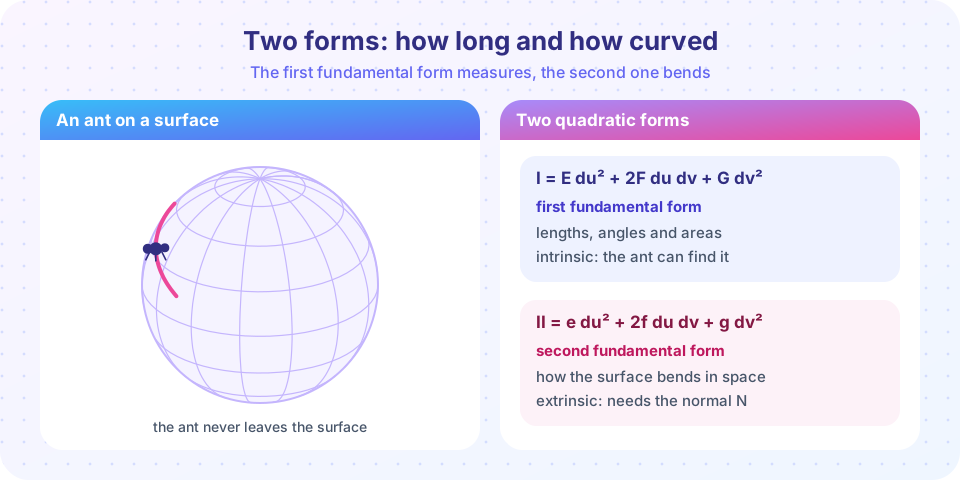
You now have surfaces, tangent planes and normals. Chapter 4 asks the two practical questions: how do I measure on a surface, and how does the surface bend? The answers are two small tables of numbers attached to every point, the coefficients E, F, G of the first fundamental form and e, f, g of the second fundamental form. Together they carry nearly everything geometric about the surface, and in the next chapter they will produce curvature.
What you will learn
- What each lesson in the chapter covers
- The idea of a quadratic form attached to a tangent plane
- The difference between intrinsic (first form) and extrinsic (second form) information
Key terms
First fundamental form I: I = E du² + 2F du dv + G dv², the squared length of a tangent step.
Second fundamental form II: II = e du² + 2f du dv + g dv², the bending of the surface in the normal direction.
Metric: another name for the first fundamental form.
Area element: dA = √(EG − F²) du dv.
Normal curvature: II / I, the curvature of a normal section in a given direction.
The chapter in five slides
Measure on the surface
What the ant knows
How it bends
Combine them
What each lesson covers
- The First Fundamental Form:
E, F, G, lengths of curves on surfaces, isometries and the surprise that a cylinder is intrinsically flat. - Area and Angles: area of regions, angles between curves, and why every flat map of the globe distorts something.
- The Second Fundamental Form:
e, f, g, normal curvature and the side view of a surface leaving its tangent plane. - Chapter 4 Review: all coefficients for the plane, cylinder and sphere, and a mixed quiz.
Common misconceptions
"E, F, G are just a way to rewrite r_u and r_v." They are the dot products of the tangent vectors, which is exactly the information needed to measure. Two different surfaces can share the same E, F, G (a plane and a cylinder do).
"The second form is about length." It is about bending: how far the surface moves away from its tangent plane in the direction of N.
"Fundamental forms depend on the surface only." They also depend on the parametrization. The geometry they encode does not.
Try it
First let sympy compute E, F, G for several surfaces at once. These are just dot products of r_u and r_v, but the results already reveal a lot: for the plane E = G = 1 and F = 0; for the cylinder E = R² and G = 1; for the sphere the G coefficient shrinks toward the poles.
Press Run (or Ctrl + Enter) to see the result here.
Program input · what you'd type while the program runs
Type the answers before you press Run, one per line. Each time the program reads a line (with input()), it gets the next line from this box.
The second program shows the key use of the first form. A curve (u(t), v(t)) in the parameter plane has length ∫ √(E u′² + 2F u′v′ + G v′²) dt on the surface. It compares this with the length of the 3D polyline for a spiral on the unit sphere. The two should agree without ever mentioning the third dimension in the first calculation.
Press Run (or Ctrl + Enter) to see the console output here.
No output.
Check your understanding
Quick check · 4 questions
of 4 answered You scored / 4 · perfect!
-
1. Which quantities does the first fundamental form give you?
It is the squared length of tangent vectors, which determines lengths of curves, angles between them and areas. -
2. What does the second fundamental form measure?
e, f, g use second derivatives of r dotted with the normal, so they record bending in space. -
3. Which form can an ant living on the surface compute?
Distances measured on the surface determine E, F, G. The second form needs the surrounding space. -
4. For the plane r(u, v) = (u, v, 0), (E, F, G) equals...
r_u = (1, 0, 0) and r_v = (0, 1, 0) are orthonormal.
Summary
- The first fundamental form
I = E du² + 2F du dv + G dv²is the metric: it gives lengths, angles and areas. - The second fundamental form
II = e du² + 2f du dv + g dv²records how the surface bends in space. - The first is intrinsic; the second is extrinsic.
- Together they lead to curvature in chapter 5.
Track your progress
Create a free account to tick off lessons and pick up where you left off on any device.
of Differential Geometry lessons completed