


















Lesson 20 of 44 · The First and Second Fundamental Forms
The Second Fundamental Form and Normal Curvature
Define the second fundamental form e du² + 2f du dv + g dv², show how it measures bending away from the tangent plane, and compute it for graphs, cylinders and spheres.
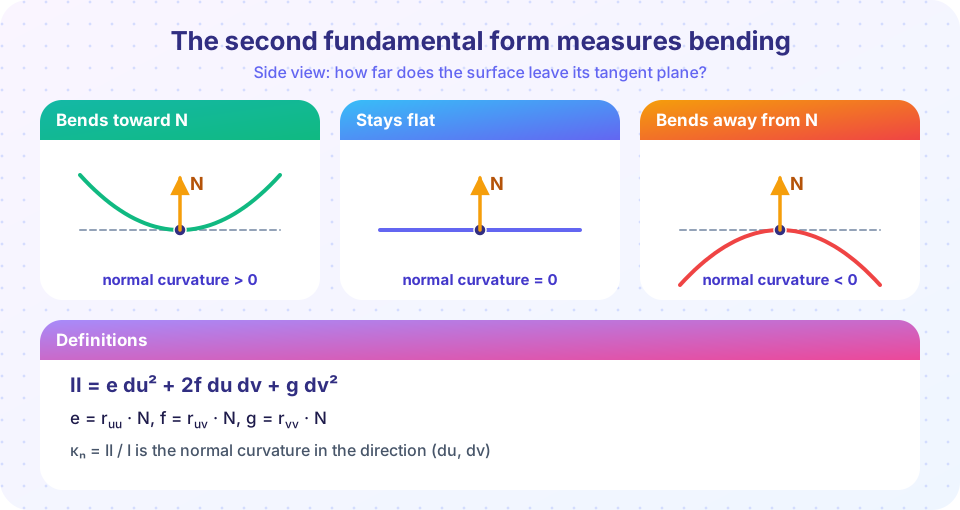
The first fundamental form cannot tell a flat sheet from a rolled tube; both give E = G = 1, F = 0. Yet the tube clearly bends in space. The missing information is how the surface leaves its tangent plane, and that is what the second fundamental form records. Picture standing at a point of the surface and looking along the tangent plane from the side: the surface curves up or down away from the plane, and the amount of curving, in each direction, is the second form.
What you will learn
- The definition
e = r_uu · N,f = r_uv · N,g = r_vv · N - Why
½ IIis the height of the surface above its tangent plane - Normal curvature
κₙ = II / Iin a given direction - How to compute
e, f, gfor graphs, cylinders and spheres
Key terms
Second fundamental form: II = e du² + 2f du dv + g dv².
Coefficients: e = r_uu · N, f = r_uv · N, g = r_vv · N.
Normal section: the curve obtained by cutting the surface with a plane containing N and a tangent direction.
Normal curvature κₙ: the curvature of that normal section, with a sign set by N.
Shape operator: the derivative of N; it encodes the same information (chapter 5).
Definition
Let N be the unit normal of a patch. Differentiate the patch twice to get r_uu, r_uv, r_vv and project each onto N:
e = r_uu · N        f = r_uv · N        g = r_vv · N
II(du, dv) = e du² + 2f du dv + g dv²
Because N · r_u = 0 everywhere, differentiating gives N_u · r_u + N · r_uu = 0, so equivalently e = −N_u · r_u, f = −N_u · r_v = −N_v · r_u, g = −N_v · r_v. In words: II measures how the normal tilts as you move along the surface, which is the right idea of bending.
Why it measures bending: the height above the tangent plane
Expand the patch to second order around (u₀, v₀):
r(u₀ + du, v₀ + dv) − r(u₀, v₀) = r_u du + r_v dv + ½ ( r_uu du² + 2 r_uv du dv + r_vv dv² ) + …
The first two terms lie in the tangent plane. Taking the dot product with N kills them and leaves the signed height of the surface above the tangent plane:
h ≈ ½ ( e du² + 2f du dv + g dv² ) = ½ II(du, dv)
So II is the quadratic term in the height function: for small steps the surface looks like the paraboloid h = ½ II. Positive values mean the surface lies on the side of N.
Normal curvature
Take a unit-speed curve α(s) = r(u(s), v(s)) on the surface through the point. Its acceleration is
α″ = r_uu u′² + 2 r_uv u′v′ + r_vv v′² + r_u u″ + r_v v″
and the last two terms are tangent, so dotting with N gives the component of acceleration normal to the surface:
κₙ = α″ · N = e u′² + 2f u′v′ + g v′² = II / I
This is the normal curvature in the direction (u′, v′). It is the same for all curves tangent to that direction (Meusnier's theorem tells how the curvature of a tilted curve relates to it). It is what you read off from a side view: the curvature of the normal section.
Computing e, f, g
Graph z = f(x, y) with W = √(1 + f_x² + f_y²): r_xx = (0, 0, f_xx), N = (−f_x, −f_y, 1)/W, so
e = f_xx / W, f = f_xy / W, g = f_yy / W
At a point where the tangent plane is horizontal (f_x = f_y = 0, W = 1) the second form is just the Hessian of f.
Cylinder r = (R cos u, R sin u, v) with outward N = (cos u, sin u, 0): r_uu = (−R cos u, −R sin u, 0), so e = −R, f = 0, g = 0. With E = R², G = 1, the normal curvature in the direction (du, dv) is κₙ = −R du² / (R² du² + dv²): it is −1/R around the tube, and 0 along the axis. The sign is negative because the tube bends away from the outward normal.
Sphere r = (R sin u cos v, R sin u sin v, R cos u) with outward N = r/R: e = −R, f = 0, g = −R sin²u. Since E = R² and G = R² sin²u, we get κₙ = II/I = −1/R in every direction. The sphere bends equally in all directions. (With the inward normal all signs flip.)
Torus: with outward N, e = −(a + b cos v) cos v, f = 0, g = −b.
The plane: e = f = g = 0.
Sign convention. Replacing N by −N flips the sign of e, f, g and of κₙ; E, F, G do not change. The sign matters when comparing, but not for quantities built from products, like Gaussian curvature, which we meet in the next chapter.
Common misconceptions
"The second fundamental form is intrinsic." It is not. A plane and a cylinder have the same first form but different second forms (zero versus nonzero).
"The sign of e, f, g is a property of the surface." It depends on the choice of N. Only combinations such as II up to sign, or eg − f², are free of that choice.
"Normal curvature is the curvature of every curve on the surface." It is the curvature of the normal section, or the normal component of a general curve's acceleration. A tilted curve has larger curvature, in agreement with Meusnier's theorem.
Try it
Let sympy compute e, f, g for the cylinder, sphere and torus with their outward normals, and for a general graph.
Press Run (or Ctrl + Enter) to see the result here.
Program input · what you'd type while the program runs
Type the answers before you press Run, one per line. Each time the program reads a line (with input()), it gets the next line from this box.
Next, a picture of normal curvature as a function of direction for the saddle z = x² − y² at the origin. There e = 2, f = 0, g = −2, E = G = 1, so κₙ(θ) = 2 cos²θ − 2 sin²θ = 2 cos 2θ: positive along the x-axis, negative along the y-axis, zero at 45 degrees. The program also checks the height ½ II against the true height of the surface.
Press Run (or Ctrl + Enter) to see the result here.
Program input · what you'd type while the program runs
Type the answers before you press Run, one per line. Each time the program reads a line (with input()), it gets the next line from this box.
Finally, a numerical check of κₙ = α″ · N on a cylinder. A straight line in the unrolled strip at angle φ becomes a helix; its normal curvature should be −cos²φ / R.
Press Run (or Ctrl + Enter) to see the console output here.
No output.
Check your understanding
Quick check · 5 questions
of 5 answered You scored / 5 · perfect!
-
1. How is the coefficient e defined?
e = r_uu · N, the normal component of the second derivative in the u direction. -
2. What does (1/2) II(du, dv) approximate?
Dotting the second-order Taylor expansion with N leaves ½ II. -
3. For a sphere of radius R with outward normal, the normal curvature in any direction is...
II/I = −1/R in every direction, because the sphere bends away from the outward normal equally in all directions. -
4. What are (e, f, g) for the plane z = 0?
All second derivatives lie in the plane, so their normal components vanish. -
5. If you replace N by -N, what happens to the first and second forms?
E, F, G use only tangent vectors; e, f, g are dotted with N, so they flip.
Summary
e = r_uu · N,f = r_uv · N,g = r_vv · N;II = e du² + 2f du dv + g dv².½ IIis the height of the surface above its tangent plane to second order.κₙ = II / Iis the normal curvature in a direction; for graphse, f, gare Hessian entries divided byW.- Cylinder:
κₙ = −cos²φ / R; sphere:−1/Reverywhere; plane:0.
Next: Chapter 4 Review
Track your progress
Create a free account to tick off lessons and pick up where you left off on any device.
of Differential Geometry lessons completed