


















Lesson 11 of 44 · Curves in the Plane and Space
Chapter 2 Review: Curves
One-page recap of chapter 2 formulas for arc length, tangent, curvature, torsion and the Frenet frame, with a nine-question mixed quiz.
You can now describe a curve with a parametrization, measure its length, and capture its bending and twisting with two numbers. This review puts every formula of the chapter on one page, shows how they connect, and then tests you with questions that mix the four lessons.
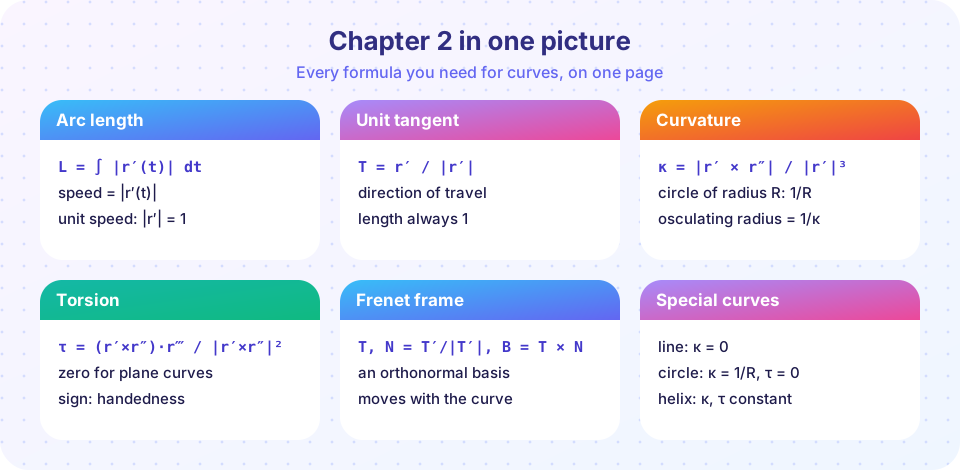
Chapter in a table
| Quantity | Formula | Meaning | Lesson |
|---|---|---|---|
| Tangent vector | r′(t) |
velocity, never zero for a regular curve | Parametrized curves |
| Arc length | L = ∫ ‖r′(t)‖ dt |
length of the trace | Arc length |
| Arc-length function | s′(t) = ‖r′(t)‖ |
gives unit speed after inversion | Arc length |
| Plane curvature | κ = (x′y″ − y′x″) / (x′² + y′²)^(3/2) |
signed rate of turning | Plane curvature |
| Graph curvature | κ = f″ / (1 + f′²)^(3/2) |
same, for y = f(x) |
Plane curvature |
| Osculating circle | radius 1/‖κ‖, centre r + N/κ |
best-fitting circle | Plane curvature |
| Space curvature | κ = ‖r′ × r″‖ / ‖r′‖³ |
bending | Frenet frame |
| Torsion | τ = (r′ × r″) · r‴ / ‖r′ × r″‖² |
twisting out of the plane | Frenet frame |
| Frenet-Serret | T′ = κN, N′ = −κT + τB, B′ = −τN |
how the frame moves | Frenet frame |
How the ideas connect
- Start with any regular parametrization
r(t). - Speed
‖r′‖converts time into length; the unit-speed version uses arc length as the clock. - The unit tangent
Tchanges direction at rateκ(bending). - The binormal
Bchanges direction at rateτ(twisting). - Rebuild:
κ(s)andτ(s)give back the curve up to a rigid motion.
Try it
A final tool: compare a numerical curvature and torsion with exact values from sympy for a conical spiral r(t) = (t cos t, t sin t, t). If both agree at t = 2, your formulas are in good shape.
Press Run (or Ctrl + Enter) to see the result here.
Program input · what you'd type while the program runs
Type the answers before you press Run, one per line. Each time the program reads a line (with input()), it gets the next line from this box.
The second program draws the curve from its curvature and torsion alone: it solves the Frenet-Serret equations step by step. With constant κ and τ you get a helix, and changing the numbers changes its radius and pitch.
Press Run (or Ctrl + Enter) to see the result here.
Program input · what you'd type while the program runs
Type the answers before you press Run, one per line. Each time the program reads a line (with input()), it gets the next line from this box.
Check your understanding
Quick check · 9 questions
of 9 answered You scored / 9 · perfect!
-
1. A particle moves with r(t) = (2t, 0, 0). What is its curvature?
It moves along a straight line; its tangent never turns. -
2. For r(t) = (R cos t, R sin t, 0), which pair (kappa, tau) is correct?
A circle has κ = 1/R and, being planar, τ = 0. -
3. Which statement about arc length is true?
Substitution shows the integral of the speed is unchanged by regular reparametrization. -
4. The curve r(t) = (t^2, t^3) fails to be regular at t = 0 because...
Regularity needs r′ ≠ 0, and r′(0) = (0, 0). -
5. For the helix with a = 1 and b = 1, what is the curvature?
κ = a/(a² + b²) = 1/2. -
6. What does a torsion of zero everywhere (with kappa nonzero) say about a curve?
B is constant, so the curve stays in one plane. -
7. At a point where the curvature is 0.25, how large is the osculating circle?
The radius is 1/κ = 4. -
8. Which equation of the Frenet-Serret system is correct?
B′ = −τ N, with N′ = −κ T + τ B and T′ = κ N. -
9. Where does the cycloid have zero speed?
r′(t) = (1 − cos t, sin t) vanishes when t is a multiple of 2π.
Summary
- Parametrization gives speed; arc length integrates it; the unit-speed parametrization uses length as the clock.
- Curvature
κmeasures bending, torsionτmeasures twisting; both are geometric. - The Frenet frame
T, N, Bobeys the Frenet-Serret equations. - Line, circle and helix are the special curves with constant
κandτ.
Track your progress
Create a free account to tick off lessons and pick up where you left off on any device.
of Differential Geometry lessons completed