


















Lesson 10 of 44 · Curves in the Plane and Space
Space Curves and the Frenet Frame
Build the Frenet frame T, N, B along a space curve, define curvature and torsion, derive the Frenet-Serret equations and compute them for the helix.
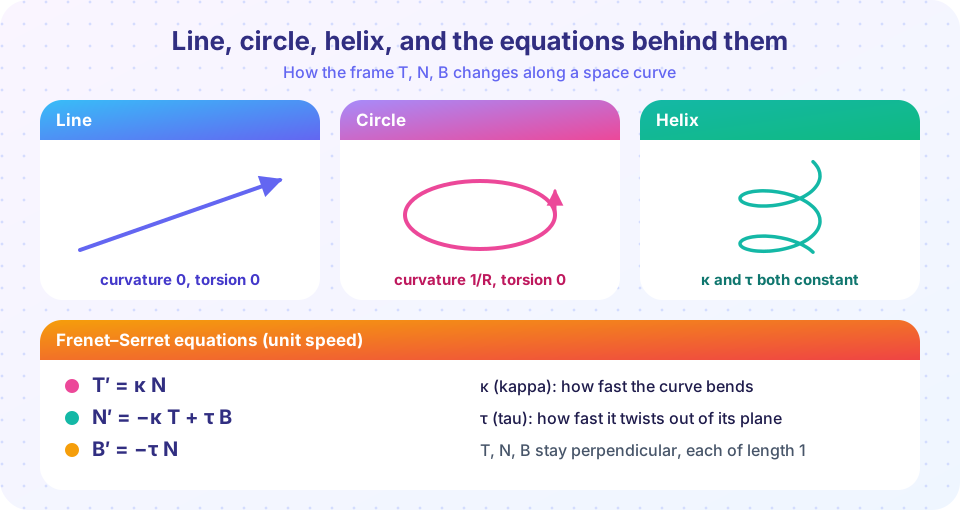
A plane curve can only turn left or right, so one number, the curvature, describes it. A curve in space can also twist: think of a spring, a DNA strand, or the path of a roller coaster. To capture this we attach a small coordinate system to the curve, the Frenet frame, and measure how it rotates as we move along. Two numbers come out: curvature κ (how fast the curve bends) and torsion τ (how fast it twists out of its plane).
What you will learn
- How to build the orthonormal frame
T, N, Balong a space curve - The definitions of curvature and torsion, and the Frenet-Serret equations
- Handy formulas for any regular parametrization
- The values for the helix, and what zero torsion means
Key terms
Unit tangent T: r′ / |r′|.
Principal normal N: the unit vector along T′, pointing toward the bend.
Binormal B: T × N, perpendicular to both.
Torsion τ: how fast B rotates; defined by B′ = −τ N (unit speed).
Osculating plane: the plane spanned by T and N.
Building the frame
Let r(s) be a curve with unit speed (arc length s) and nonzero curvature. Then:
T(s) = r′(s)is the unit tangent.T′(s)is perpendicular toT. Its length is the curvature,κ = |T′| ≥ 0.- The principal normal is
N = T′ / κ, a unit vector that points toward the inside of the bend. - The binormal is
B = T × N. BecauseTandNare unit and perpendicular,Bis unit and perpendicular to both.
The triple (T, N, B) is orthonormal and right-handed at every point: a little moving coordinate system riding along the curve. The plane spanned by T and N is the osculating plane; it is the flat plane that the curve is closest to staying inside, locally. By definition, T′ = κ N.
The Frenet-Serret equations
How does the frame change as we move? Since T, N, B are orthonormal we can write each derivative in terms of the frame itself.
T′ = κ N, by definition.N′ · T = −N · T′ = −κ(differentiateN · T = 0), andN′ · N = 0becauseNis a unit vector. SoN′ = −κ T + τ B, where we defineτ = N′ · B.B′ · T = −B · T′ = −κ B · N = 0andB′ · B = 0, andB′ · N = −B · N′ = −τ. SoB′ = −τ N.
Together:
T′ =        κ N
N′ = −κ T        + τ B
B′ =      −τ N
These are the Frenet-Serret equations. Read them as a description of an airplane's attitude: κ controls how the nose turns toward N, and τ controls roll about the direction of travel T. In matrix form the coefficient matrix is skew-symmetric, which is how orthonormality is preserved.
Torsion and flatness. If τ = 0 along a curve (with κ ≠ 0) then B′ = 0, so B is a constant vector, the osculating plane never changes, and the curve lies in a single plane. Conversely every plane curve has τ = 0. Torsion measures non-planarity. Its sign tells the handedness: a right-handed helix (like a standard screw) has positive torsion.
Formulas for arbitrary parametrizations
You do not have to find a unit-speed parametrization. For any regular curve r(t) with r′ × r″ ≠ 0:
T = r′ / |r′|          B = (r′ × r″) / |r′ × r″|          N = B × T

κ = |r′ × r″| / |r′|³          τ = ((r′ × r″) · r‴) / |r′ × r″|²
The helix. For r(t) = (a cos t, a sin t, b t): r′ = (−a sin t, a cos t, b), r″ = (−a cos t, −a sin t, 0), r‴ = (a sin t, −a cos t, 0). Then r′ × r″ = (a b sin t, −a b cos t, a²), whose length is a √(a² + b²), and |r′| = √(a² + b²). Hence
κ = a / (a² + b²) τ = b / (a² + b²)
Both are constant. Check the limits: b = 0 gives a circle of radius a with κ = 1/a and τ = 0; a → 0 squeezes the helix into a vertical line with κ → 0.
The twisted cubic. For r(t) = (t, t², t³): r′ × r″ = (6t², −6t, 2) and r‴ = (0, 0, 6), so τ = 12 / (36t⁴ + 36t² + 4), which at t = 1 is 12/76. Here both curvature and torsion change along the curve.
A theorem to remember
The fundamental theorem of space curves: given smooth functions κ(s) > 0 and τ(s), there is a unit-speed curve with that curvature and torsion, and it is unique up to a rigid motion. The two functions form a complete "fingerprint" of the curve's shape.
Common misconceptions
"Torsion is a kind of curvature in the plane." Torsion is zero for every plane curve. It only appears when the curve leaves its osculating plane.
"The Frenet frame always exists." It needs κ ≠ 0. On a straight line T′ = 0 and N is undefined, so the frame cannot be built from the definition.
"Positive torsion means the curve is rising." Torsion's sign is about handedness (right-handed versus left-handed twist). Reflecting a curve in a mirror flips it; moving or rotating the curve does not.
Try it
First, symbolic confirmation of the formulas for the helix and the twisted cubic.
Press Run (or Ctrl + Enter) to see the result here.
Program input · what you'd type while the program runs
Type the answers before you press Run, one per line. Each time the program reads a line (with input()), it gets the next line from this box.
Next, draw the Frenet frame at several points of a helix. The program computes T, N, B from the formulas and checks that they are orthonormal.
Press Run (or Ctrl + Enter) to see the result here.
Program input · what you'd type while the program runs
Type the answers before you press Run, one per line. Each time the program reads a line (with input()), it gets the next line from this box.
Finally, a tiny calculator that estimates curvature and torsion from any parametrization, by finite differences. Try it on the helix with a = 1, b = 0.3, where the exact values are 1/1.09 ≈ 0.9174 and 0.3/1.09 ≈ 0.2752. Then edit r to try your own curves.
Press Run (or Ctrl + Enter) to see the console output here.
No output.
Check your understanding
Quick check · 5 questions
of 5 answered You scored / 5 · perfect!
-
1. Which equation defines the binormal vector?
B = T × N is perpendicular to both T and N and completes a right-handed frame. -
2. A space curve has torsion zero everywhere (and nonzero curvature). What can you conclude?
Zero torsion means B is constant, so the osculating plane never changes and the curve lies in that plane. -
3. For the helix (a cos t, a sin t, b t), what is the curvature?
κ = |r′ × r″| / |r′|³ = a √(a² + b²) / (a² + b²)^(3/2) = a / (a² + b²). -
4. In the Frenet-Serret equations, which quantity multiplies B in the formula for N-prime?
N′ = −κ T + τ B. -
5. Which pair of functions determines a space curve up to a rigid motion?
The fundamental theorem of space curves: κ(s) > 0 and τ(s) determine the curve up to rotation and translation.
Summary
- The Frenet frame
T, N, Bis an orthonormal moving frame built from the curve's derivatives; it needsκ ≠ 0. T′ = κ N,N′ = −κ T + τ B,B′ = −τ N.κ = |r′ × r″| / |r′|³andτ = (r′ × r″) · r‴ / |r′ × r″|²for any parametrization.- A helix has constant
κ = a/(a² + b²)andτ = b/(a² + b²); planar curves haveτ = 0.
Next: Chapter 2 Review
Track your progress
Create a free account to tick off lessons and pick up where you left off on any device.
of Differential Geometry lessons completed