


















Lesson 9 of 44 · Curves in the Plane and Space
Curvature of Plane Curves
Define signed curvature of a plane curve, derive the formulas for graphs and parametrized curves, draw osculating circles and rebuild a curve from its curvature.
A road sign says "sharp bend ahead". A mathematician wants a number. The number is curvature: how quickly the direction of travel turns per unit of distance. A straight road has curvature 0, a roundabout of radius 50 m has curvature 1/50 per metre, and a hairpin has a large curvature. In this lesson you will define curvature carefully, get formulas you can compute with, and see the circle that best matches a curve at a point.
What you will learn
- The definition of signed curvature through the unit tangent
- The formulas for a graph and for a parametrized plane curve
- What the osculating circle is and how to find its centre
- How a curvature function determines a curve up to position
Key terms
Unit tangent T: the tangent vector divided by its length.
Unit normal N: T rotated by 90 degrees counterclockwise.
Signed curvature κ: the number with T′ = κ N for a unit-speed curve.
Osculating circle: the circle through the point with the same tangent and the same curvature.
Radius of curvature: ρ = 1 / |κ|.
Definition
Take a plane curve with unit-speed parametrization r(s). Its tangent T(s) = r′(s) has length 1, so T′(s) is perpendicular to T(s). In the plane, there is only one direction perpendicular to T (up to sign). Define the unit normal N(s) by rotating T counterclockwise through 90°: if T = (a, b) then N = (−b, a). Then there is a unique number κ(s) such that
T′(s) = κ(s) N(s).
This κ is the signed curvature. It is positive when the curve turns to the left (toward N), negative when it turns to the right, and its absolute value is the rate of turning of the tangent. If θ(s) is the angle of the tangent direction, then κ = dθ/ds.
The circle. For r(s) = (R cos(s/R), R sin(s/R)): T = (−sin(s/R), cos(s/R)), T′ = (1/R)(−cos(s/R), −sin(s/R)). Rotating T by 90° gives N = (−cos(s/R), −sin(s/R)), which points to the centre, so T′ = (1/R) N and κ = 1/R: constant and positive for a counterclockwise circle.
Formulas for general parametrizations
You rarely have a unit-speed curve. For a regular parametrization r(t) = (x(t), y(t)), the chain rule turns the definition into:
κ(t) = ( x′ y″ − y′ x″ ) / ( x′² + y′² )^(3/2)
For a graph y = f(x) this becomes
κ(x) = f″(x) / ( 1 + f′(x)² )^(3/2)
The denominator corrects for slope: a steep curve with a small f″ can still turn slowly in the geometric sense. Check with a few cases:
- Parabola
y = x²:κ = 2 / (1 + 4x²)^(3/2), maximal at the vertex whereκ = 2. - Ellipse
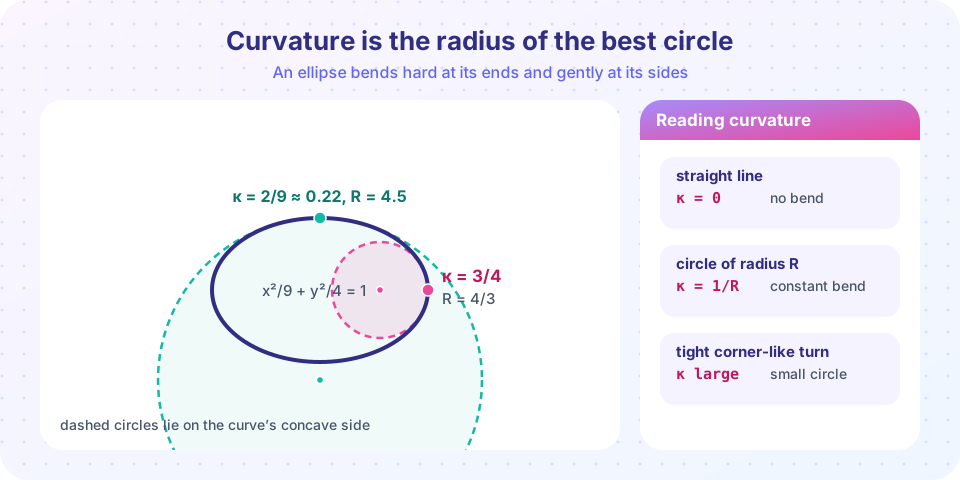
r(t) = (a cos t, b sin t):κ = a b / (a² sin²t + b² cos²t)^(3/2). Att = 0(the end of the major axisa) this isa / b², and att = π/2it isb / a². Witha = 3, b = 2those are3/4and2/9, the numbers in the picture above. The ends of an ellipse are tighter than its sides.
The osculating circle
At a point with κ ≠ 0, the osculating circle ("kissing circle") has radius ρ = 1/|κ| and its centre lies on the normal line, on the side toward which the curve turns:
centre = r + (1/κ) N.
It is the circle with the best possible contact with the curve: same point, same tangent, same curvature. In the picture above, the small dashed circle at the end of the ellipse has radius b²/a = 4/3, and the big one at the top has radius a²/b = 9/2. The path of centres of osculating circles is called the evolute of the curve.
Rebuilding a curve from its curvature
Curvature is a complete description of a plane curve up to position. Given a function κ(s), integrate once to get the tangent angle and again to get the curve:
θ(s) = θ₀ + ∫ κ du, x(s) = x₀ + ∫ cos θ du, y(s) = y₀ + ∫ sin θ du.
This is the fundamental theorem of plane curves: two plane curves with the same curvature function κ(s) differ only by a rigid motion (a rotation and a translation). Some beautiful curves are easiest to describe this way. If κ(s) = s (curvature growing linearly with length) you get the Euler spiral (clothoid), used to design road and railway transitions so that the steering wheel turns smoothly instead of jumping.
Common misconceptions
"Curvature is f″." For a graph, f″ only equals the curvature where the slope is zero. In general you must divide by (1 + f′²)^(3/2).
"Curvature is always positive." The signed curvature of a plane curve changes sign at an inflection point, where the curve passes from turning left to turning right. Often we use the absolute value, but the sign carries information.
"A bigger circle means a sharper bend." The opposite: the osculating radius is 1/κ, so a sharper bend means a smaller circle.
Try it
First let a computer algebra system derive the ellipse formula, and confirm the two special values.
Press Run (or Ctrl + Enter) to see the result here.
Program input · what you'd type while the program runs
Type the answers before you press Run, one per line. Each time the program reads a line (with input()), it gets the next line from this box.
Now draw osculating circles on an ellipse. The code computes the curvature and the centre r + N/κ at three points and prints the radii.
Press Run (or Ctrl + Enter) to see the result here.
Program input · what you'd type while the program runs
Type the answers before you press Run, one per line. Each time the program reads a line (with input()), it gets the next line from this box.
Finally, rebuild curves from their curvature. A constant curvature gives a circle; curvature equal to the arc length gives the Euler spiral; a sinusoidal curvature gives a wavy path.
Press Run (or Ctrl + Enter) to see the result here.
Program input · what you'd type while the program runs
Type the answers before you press Run, one per line. Each time the program reads a line (with input()), it gets the next line from this box.
Check your understanding
Quick check · 5 questions
of 5 answered You scored / 5 · perfect!
-
1. What is the curvature of a circle of radius 5 (traversed counterclockwise)?
κ = 1/R = 1/5 = 0.2, positive because a counterclockwise circle turns left. -
2. For y = x^2, what is the curvature at x = 0?
κ = f″/(1 + f′²)^(3/2) = 2/(1 + 0)^(3/2) = 2. -
3. What is the radius of the osculating circle of an ellipse with a = 3, b = 2 at the end of the major axis?
κ = a/b² = 3/4, so the radius is 1/κ = 4/3. -
4. A curve with curvature function kappa(s) = 0 for all s is...
Zero curvature means the tangent never turns, so the curve is a straight line. -
5. The fundamental theorem of plane curves says that kappa(s) determines the curve up to...
Integrating κ gives the tangent angle up to a constant, and integrating again gives the curve up to a translation.
Summary
- For a unit-speed plane curve,
T′ = κ Ndefines signed curvature;κ = dθ/ds. - For a graph
κ = f″ / (1 + f′²)^(3/2); forr(t),κ = (x′y″ − y′x″) / (x′² + y′²)^(3/2). - The osculating circle has radius
1/|κ|and centrer + N/κ. - Curvature determines a plane curve up to rotation and translation.
Track your progress
Create a free account to tick off lessons and pick up where you left off on any device.
of Differential Geometry lessons completed