


















Lesson 27 of 44 · Geodesics
Chapter 6 overview: geodesics
A tour of Chapter 6: what a straight line becomes on a curved surface, why airplanes fly curved-looking routes, and how geodesics and parallel transport are computed.
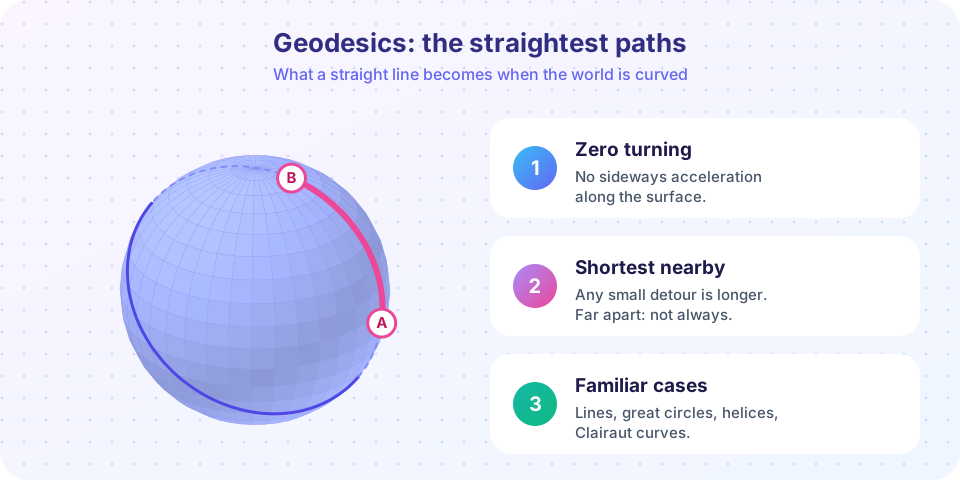
If you draw a line on a flat sheet of paper and keep your pencil from turning, you get a straight line. Now draw on a ball. Which lines are the "straight" ones? You cannot leave the surface, and every path on a ball bends in space. Yet some paths are clearly straighter than others: the equator is straighter than a circle of latitude near the pole, and if you stretch a string tight between two pins on the ball, it follows one of the straight ones.
Those straightest paths are geodesics. In this chapter you will define them precisely, derive the equations they solve, compute them on the sphere, cylinder and torus, and meet the companion idea of parallel transport, which carries a vector along a path without turning it. Parallel transport will also give your first glimpse of how curvature can be detected by walking around a loop.
What you will learn
- What problem geodesics solve and why they matter outside mathematics.
- How the three lessons of the chapter fit together.
- Why flights on a map look curved even though the pilot never turns.
The big picture
Straight, from the inside
How to find them
Examples
Parallel transport
Curvature shows up as holonomy.
What each lesson covers
- Geodesic equations and classic examples defines geodesics through zero tangential acceleration, derives the equations with Christoffel symbols, finds Clairaut's rule for surfaces of revolution and solves the equations on a sphere and a torus.
- Parallel transport and holonomy shows how to carry a vector along a curve, why a vector comes back rotated after a loop on a sphere, and how the rotation equals the enclosed total curvature.
- Chapter 6 review collects the formulas into a picture and tests them.
Why you should care
Geodesics are the routes of long-haul flights and ocean crossings, the paths of light in curved spacetime, the shortest cables on a curved terrain and the solutions behind many animation and mesh algorithms. A short example makes the point concrete.
An air route
Two cities both lie on latitude 60° N, 90° of longitude apart. A pilot could follow the circle of latitude (a constant compass offset) or the great circle (the geodesic). On Earth with radius 6371 km, the formula for the central angle Δ between points (φ, λ₁) and (φ, λ₂) is cos Δ = sin²φ + cos²φ cos(λ₂ − λ₁).
Press Run (or Ctrl + Enter) to see the result here.
Program input · what you'd type while the program runs
Type the answers before you press Run, one per line. Each time the program reads a line (with input()), it gets the next line from this box.
The geodesic is shorter even though it looks longer on a flat map: the map distorts, the sphere does not lie. A quick console check of the midpoint:
Press Run (or Ctrl + Enter) to see the console output here.
No output.
Common misconceptions
"A geodesic is always the shortest path." Locally yes. Globally no: the long way around a great circle is also a geodesic but not the shortest path between its endpoints.
"A geodesic has zero curvature." A great circle has curvature 1/R as a space curve. What vanishes is its geodesic curvature, the part of the bending that happens inside the surface.
Check your understanding
Quick check · 4 questions
of 4 answered You scored / 4 · perfect!
-
1. A geodesic on a surface is a curve whose
Its acceleration points along the normal only: nothing steers it within the surface. -
2. On a sphere the geodesics are
Great circles have centers at the center of the sphere and turn neither left nor right. -
3. Why does the great-circle route look curved on a flat map?
No flat map of a sphere preserves all lengths (Theorema Egregium). -
4. Which lesson explains how a vector can be carried along a path without turning it?
Parallel transport is the subject of lesson 2 of this chapter.
Summary
- Geodesics are the straightest paths on a surface: no tangential acceleration.
- They are found by solving two second-order equations built from
E, F, G. - Parallel transport carries vectors along curves and detects curvature through holonomy.
- A geodesic is locally shortest; flat maps make great circles look curved.
Track your progress
Create a free account to tick off lessons and pick up where you left off on any device.
of Differential Geometry lessons completed