


















Lesson 19 of 44 · The First and Second Fundamental Forms
Area, Angles and the Problem of Flat Maps
Use E, F, G to compute areas and angles on surfaces, check the sphere and torus formulas, and see why no flat map of the Earth can preserve everything.
The first fundamental form does more than measure lengths. Because it tells us the squared length of every tangent vector, it also tells us the angle between any two tangent vectors (by the polarization identity for dot products) and the area of any small parallelogram. This lesson turns that observation into formulas for area and angle and uses it to understand why every flat map of the Earth lies a little.
What you will learn
- The area element
dA = √(EG − F²) du dvand how to integrate it - The angle between two curves on a surface, computed from
E, F, G - Areas of the sphere and the torus as examples
- What conformal and equal-area maps are, and why none is isometric
Key terms
Area element: dA = |r_u × r_v| du dv = √(EG − F²) du dv.
Angle between curves: the angle between their tangent vectors at the intersection point.
Conformal map: one that preserves angles (but not necessarily lengths).
Equal-area map: one that preserves areas.
Tissot indicatrix: the image of a tiny circle under a map; it shows the local distortion.
Area
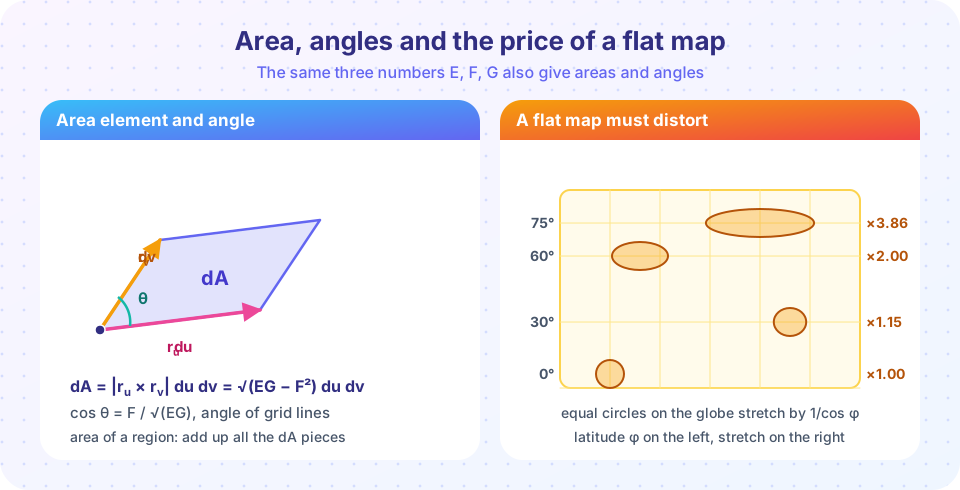
A small rectangle du × dv in the parameter plane maps to a small parallelogram on the surface, spanned by r_u du and r_v dv. Its area is |r_u du × r_v dv| = |r_u × r_v| du dv. By the Lagrange identity,
|r_u × r_v|² = (r_u · r_u)(r_v · r_v) − (r_u · r_v)² = E G − F²
so the area element is dA = √(EG − F²) du dv, and the area of a region D of the parameter domain is
Area = ∬ over D of sqrt(E G − F²) du dv.
Sphere. E = R², F = 0, G = R² sin²u, so √(EG − F²) = R² sin u and
Area = ∫₀^{2π} ∫₀^π R² sin u du dv = 4π R².
Torus. E = (a + b cos v)², F = 0, G = b², so dA = b (a + b cos v) du dv, and the area is ∫₀^{2π} ∫₀^{2π} b(a + b cos v) du dv = 4π² a b. Notice that the cos v term integrates to zero over a full turn: the outer half of the torus (larger circles) exactly balances the inner half.
A graph z = f(x, y): dA = √(1 + f_x² + f_y²) dx dy. For the paraboloid z = (x² + y²)/2 above the unit disc, polar coordinates make the integral easy; the answer is (2π/3)(2^(3/2) − 1) ≈ 3.83.
Angles
Let two curves through the same point have parameter-plane directions (a₁, a₂) and (b₁, b₂); their tangent vectors on the surface are w₁ = r_u a₁ + r_v a₂ and w₂ = r_u b₁ + r_v b₂. Their dot product expands just like the line element:
w₁ · w₂ = E a₁ b₁ + F (a₁ b₂ + a₂ b₁) + G a₂ b₂
so the angle θ between them satisfies
cos θ = ( E a₁ b₁ + F (a₁ b₂ + a₂ b₁) + G a₂ b₂ ) / ( |w₁| |w₂| ), |w|² = E a₁² + 2F a₁ a₂ + G a₂².
A special case: the angle between the two coordinate curves, (1, 0) and (0, 1), has cos θ = F / √(EG). The grid lines cross at right angles exactly when F = 0.
Flat maps of a sphere
A map projection is a patch of the sphere written as a function of (x, y) on a flat sheet. Because the sphere's first form is not that of the plane, every projection distorts something:
- Equirectangular (
x = longitude,y = latitude):ds² = dφ² + cos²φ dλ²on the sphere becomesdx² + dy²on the map, so east-west distances are stretched by1/cos φ. Near the poles the stretching is enormous (the ellipses in the illustration). - Mercator (
y = ln tan(π/4 + φ/2)): preserves angles (it is conformal), which is why it is useful for navigation, but areas near the poles are exaggerated by1/cos²φ. Greenland looks as large as Africa. - Equal-area projections (Lambert, Gall-Peters and others): preserve area but shear shapes.
The reason is the Theorema Egregium: an isometry between the sphere and a plane would require equal Gaussian curvature, and 1/R² ≠ 0. You can have any two of "angles, areas, lengths" only in special cases, never all three.
Common misconceptions
"Angles in the (u, v) plane equal angles on the surface." Only if E = G and F = 0 (a conformal parametrization). In general you must use the first form.
"Area is just du dv." The factor √(EG − F²) accounts for how much the patch stretches the grid.
"A good map projection can preserve everything." The Theorema Egregium forbids it for the sphere. Every projection is a trade-off.
Try it
First, areas computed symbolically and checked numerically for the sphere, the torus and the paraboloid cap.
Press Run (or Ctrl + Enter) to see the result here.
Program input · what you'd type while the program runs
Type the answers before you press Run, one per line. Each time the program reads a line (with input()), it gets the next line from this box.
Next, the distortion of the equirectangular and Mercator maps. The program places small circles of angular radius 5 degrees on the globe at several latitudes, maps them with each projection, and measures how stretched they become.
Press Run (or Ctrl + Enter) to see the result here.
Program input · what you'd type while the program runs
Type the answers before you press Run, one per line. Each time the program reads a line (with input()), it gets the next line from this box.
Finally, the angle formula. The program computes the angle between two curve directions at a point on the sphere in two ways: with E, F, G only, and with 3D tangent vectors.
Press Run (or Ctrl + Enter) to see the console output here.
No output.
Check your understanding
Quick check · 5 questions
of 5 answered You scored / 5 · perfect!
-
1. What is the area element of a patch?
dA = |r_u × r_v| du dv, and |r_u × r_v|² = EG − F². -
2. What is the area of a sphere of radius R computed from the first form?
∫∫ R² sin u du dv = 4πR². -
3. The grid lines of a patch cross at right angles at a point exactly when...
cos θ = F/√(EG) is the cosine of the angle between the coordinate curves. -
4. What does a conformal map preserve?
Conformal maps preserve angles but may change lengths and areas. -
5. Why can't a flat map of the globe preserve lengths, angles and areas at once?
By the Theorema Egregium, an isometry would need equal Gaussian curvature; the sphere's is positive, the plane's is zero.
Summary
dA = √(EG − F²) du dv; area is the integral of this over the parameter domain.cos θ = F/√(EG)for the angle between coordinate curves; the general formula usesE, F, Gon the direction components.- The sphere has area
4πR²and the torus4π²ab. - Flat maps must distort: conformal maps keep angles, equal-area maps keep area, and none keeps lengths.
Track your progress
Create a free account to tick off lessons and pick up where you left off on any device.
of Differential Geometry lessons completed