


















Lesson 8 of 44 · Curves in the Plane and Space
Arc Length and Unit-Speed Parametrization
Derive the arc-length formula from chords, compute lengths for graphs, helices and cycloids, and learn why the unit-speed parametrization simplifies curve theory.
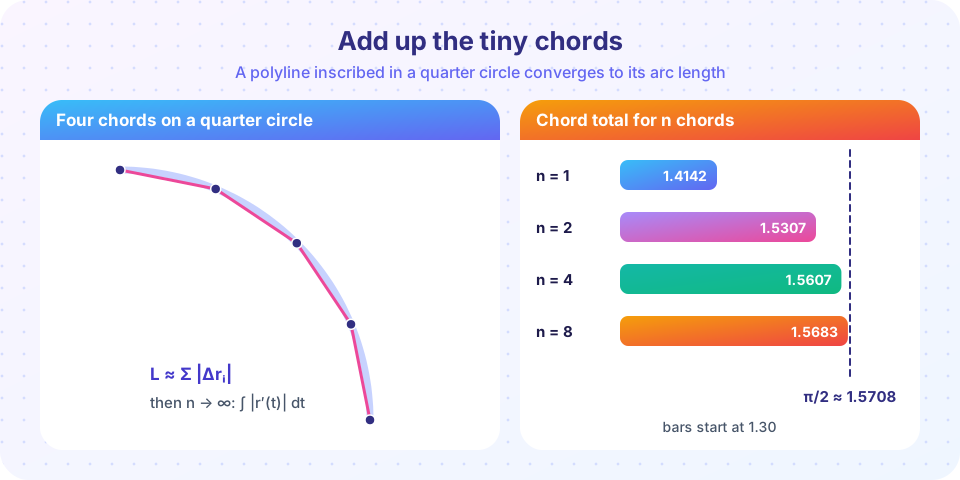
How long is a curve? For a straight segment the answer is a distance. For a winding path, we cut it into tiny nearly-straight pieces, add up their lengths and let the pieces shrink. That limiting process produces one of the most useful formulas in geometry, and the length it measures gives us a natural clock for every curve, one that does not depend on how fast we happen to travel.
What you will learn
- How the arc-length integral comes from adding chord lengths
- How to compute the length of graphs, helices and cycloids
- What the arc-length function
s(t)is - Why every regular curve has a unit-speed reparametrization
Key terms
Arc length: L = ∫ |r′(t)| dt between two parameter values.
Arc-length function: s(t) = ∫ from t₀ to t of |r′(u)| du, the length travelled so far.
Unit-speed curve: a curve with |r′| = 1 everywhere; its parameter is arc length.
Chord: the straight segment joining two points of the curve.
From chords to an integral
Cut the parameter interval [a, b] into small steps t₀ = a < t₁ < … < tₙ = b. The chord from r(tᵢ) to r(tᵢ₊₁) has length |r(tᵢ₊₁) − r(tᵢ)|, and by the definition of the derivative this is approximately |r′(tᵢ)| Δt. Adding these up gives a Riemann sum, so in the limit
L = ∫ from a to b of |r′(t)| dt = ∫ sqrt( x′(t)² + y′(t)² + z′(t)² ) dt
This is "speed times time, summed". It is the same reasoning as distance = speed × time, applied moment by moment.
Arc length does not depend on the parametrization. If t = φ(s) with φ′ > 0, the substitution rule gives ∫ |r′(φ(s))| φ′(s) ds = ∫ |r′(t)| dt. The length belongs to the trace, as it should.
Worked examples
A graph. For y = f(x) take r(x) = (x, f(x)), so |r′| = √(1 + f′(x)²). For the catenary f(x) = cosh x on [0, 1] we get √(1 + sinh² x) = cosh x, and so L = ∫ cosh x dx = sinh 1 ≈ 1.1752.
A circle. r(t) = (R cos t, R sin t) has speed R, so the length over [0, 2π] is 2πR. This is the familiar circumference, now derived instead of assumed.
A helix. r(t) = (a cos t, a sin t, b t) has speed √(a² + b²), constant, so the length over [0, 2π] is 2π√(a² + b²). For a = 1 and b = 3/4 the speed is 5/4.
A cycloid arch. With r′(t) = (1 − cos t, sin t) the speed is √(2 − 2 cos t) = 2 sin(t/2) on [0, 2π], and the integral of this is 8. One arch of a cycloid generated by a wheel of radius 1 has length exactly 8, four times the wheel's diameter. This surprising result was found in the 17th century (the architect Christopher Wren is usually credited with it).
A parabola. For y = x² on [0, 1]: L = ∫ √(1 + 4x²) dx = √5/2 + (1/4) asinh(2) ≈ 1.4789. Most arc-length integrals have no closed form, so numerical integration is the everyday tool.
The arc-length function and unit speed
Fix a starting parameter t₀ and define
s(t) = integral from t₀ to t of |r′(u)| du.
By the fundamental theorem of calculus, s′(t) = |r′(t)| > 0 for a regular curve, so s is strictly increasing and has an inverse t = t(s). Substituting gives a new parametrization r̃(s) = r(t(s)), and by the chain rule
r̃′(s) = r′(t) · dt/ds = r′(t) / |r′(t)|, so |r̃′(s)| = 1.
This is the unit-speed (or arc-length) parametrization. Every regular curve has one. Its tangent vector r̃′(s) is automatically the unit tangent T, and as we showed in chapter 1, T′ ⟂ T. That is exactly what we need to define curvature in the next lesson.
Examples: for the circle r̃(s) = (R cos(s/R), R sin(s/R)); for the helix r̃(s) = (a cos(s/c), a sin(s/c), b s/c) with c = √(a² + b²).
In practice you rarely compute t(s) explicitly (it is usually impossible), but the idea is a powerful theoretical simplification: you can pretend the curve has unit speed when proving formulas, then convert the result back to general parametrizations.
Common misconceptions
"A longer parameter interval means a longer curve." Not if the speed is smaller. The length is ∫ |r′| dt, so a slow curve over a long interval can be shorter than a fast curve over a short one.
"s(t) = |r(t) − r(t₀)|." That is the straight-line distance between the endpoints, which is only equal to arc length for a straight line.
"The unit-speed parametrization is just a formula trick." It is a real, geometric clock: the point has travelled exactly s units of length.
Try it
Compute some lengths with a numerical integrator and compare with the closed forms. The cycloid arch should give 8.
Press Run (or Ctrl + Enter) to see the result here.
Program input · what you'd type while the program runs
Type the answers before you press Run, one per line. Each time the program reads a line (with input()), it gets the next line from this box.
Next, the same idea geometrically: take points spaced equally in t on an ellipse, and points spaced equally in arc length s. The second set is the unit-speed picture.
Press Run (or Ctrl + Enter) to see the result here.
Program input · what you'd type while the program runs
Type the answers before you press Run, one per line. Each time the program reads a line (with input()), it gets the next line from this box.
One more check, this time by hand-made polylines in JavaScript. As the number of chords grows, the total length of the polyline through points on the cycloid arch creeps up to 8.
Press Run (or Ctrl + Enter) to see the console output here.
No output.
Check your understanding
Quick check · 5 questions
of 5 answered You scored / 5 · perfect!
-
1. What is the length of r(t) = (3t, 4t) for t from 0 to 2?
The speed is 5, constant, so the length over an interval of length 2 is 10. -
2. What does the arc-length function s(t) equal in terms of the speed?
s(t) is the accumulated length, the integral of |r′|. -
3. For a unit-speed curve, |r′(s)| equals...
That is the definition: the parameter is arc length, so the speed is 1. -
4. What is the length of one arch of the cycloid generated by a wheel of radius 1?
The integral of 2 sin(t/2) from 0 to 2π equals 8. -
5. Why does a regular curve have a unit-speed parametrization?
A strictly increasing s(t) has an inverse, and using s as the parameter makes the speed 1.
Summary
- Arc length is
L = ∫ |r′(t)| dt: speed integrated over time, the limit of chord sums. - It does not depend on the parametrization.
s(t)measures distance travelled; inverting it gives the unit-speed parametrization of any regular curve.- Many arc-length integrals have no closed form, so numerical integration is common; a polyline check always works.
Track your progress
Create a free account to tick off lessons and pick up where you left off on any device.
of Differential Geometry lessons completed