


















Lesson 2 of 44 · Getting Started
Why study the history of science?
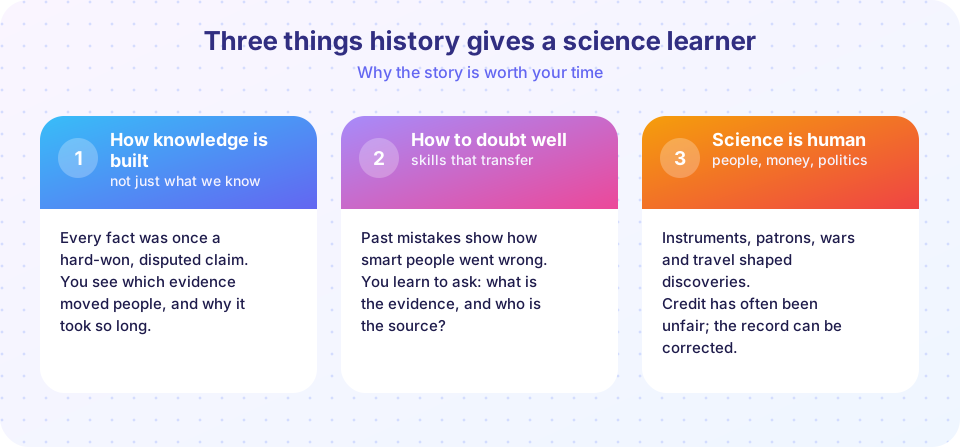
Learn what the history of science teaches that textbooks cannot: how knowledge is built, how to doubt well, and why science is a human activity.
A physics textbook tells you that light travels at about 299,792 kilometres per second. It rarely tells you that for centuries people argued about whether light travelled at all, or arrived instantly. It does not mention the Danish astronomer Ole Rømer, who in 1676 noticed that the moons of Jupiter seemed to run late when Earth was far away, and concluded that light takes time to cross space. That small story contains an idea, an observation, a calculation and a surprise. It is also easier to remember than the number alone.
This lesson explains why the story matters and what you can gain from it.
What you will learn
- Three practical reasons to study the history of science
- How a single case, Rømer and the speed of light, shows the whole process
- Why "finished science" in textbooks hides how knowledge was made
- How historical cases train critical thinking
Key terms
Evidence: observations or measurements that support or challenge a claim.
Hypothesis: a proposed explanation that can be tested.
Paradigm: a widely shared set of ideas and methods that guides a field (a term from Thomas Kuhn, covered in chapter 8).
Anomaly: a result that the current theory cannot explain.
Reason 1: you see how knowledge is built
Textbooks present results in their final, tidy form. Real science starts with confusion. Consider Rømer's work. Jupiter's innermost large moon, Io, disappears behind the planet on a regular schedule, about every 42.5 hours. Astronomers used those eclipses as a clock. Rømer, working in Paris in 1676, saw that when Earth was moving away from Jupiter the eclipses came later than predicted, and when Earth was moving toward it they came earlier. The delay added up to roughly 22 minutes across the whole diameter of Earth's orbit (modern measurements give a bit under 17 minutes; the figure he and his contemporaries used was larger).
His conclusion was that light needs time to travel. Many scholars, including the philosopher René Descartes, had believed it was instantaneous. Rømer did not give a modern value, but Christiaan Huygens used his result and the size of Earth's orbit to estimate a speed of light that was too low yet already enormous. The history shows how an unexpected pattern in data, a clever interpretation and later measurements fit together.
Reason 2: you learn to doubt well
Doubt is not cynicism. Scientific doubt asks: what is the evidence, how good is it, and what else could explain it? The past is full of cases where capable people got it wrong, and studying them is a safe way to practise.
- For about 1,400 years European doctors taught that the liver made blood from food and that blood ebbed and flowed in vessels. William Harvey showed in 1628 that the heart pumps blood in a circuit, partly by measuring how much blood leaves the heart each hour: far more than the body could make from food. The sheer quantity was the argument.
- In the nineteenth century, physicians such as Ignaz Semmelweis showed that handwashing cut deaths from childbed fever, yet many doctors resisted because the idea implied that doctors themselves carried the disease. Evidence can lose to pride and habit.
Learning to spot these patterns helps with modern claims too: a miracle cure, a viral statistic, or a confident prediction.
Reason 3: you see that science is human
Instruments cost money. Observatories needed patrons. Expeditions needed ships. Women, colonised peoples and artisans did essential work and were often left out of the credit. When Eratosthenes measured Earth he used a library's records; when Tycho Brahe measured the planets he used a royal grant of an island. The history of science is therefore also a history of travel, trade, religion, war and money.
This matters for how you read today's news. When a study is funded by a company, or a topic becomes political, you can ask the same questions the historian asks: who benefits, who was included, who was ignored?
Common misconceptions
"History of science is just a list of discoveries and dates." The point is the reasoning behind them: what problem, what evidence, what argument convinced people.
"If an old idea was wrong, there is nothing to learn from it." Wrong ideas often led to right ones. Alchemy and chemistry share methods, and Ptolemy's wrong model predicted the sky accurately enough for 1,400 years.
"Learning the history will make me doubt all science." The opposite: seeing how evidence overturned error builds justified trust in methods that correct themselves.
Try it
The first block recomputes Rømer's logic: if light needs time to cross Earth's orbit, what speed follows? The second is a simple widget that lets you apply the delay to the orbit diameter.
Press Run (or Ctrl + Enter) to see the result here.
Program input · what you'd type while the program runs
Type the answers before you press Run, one per line. Each time the program reads a line (with input()), it gets the next line from this box.
Check your understanding
Quick check · 4 questions
of 4 answered You scored / 4 · perfect!
-
1. What did Rømer notice about Io's eclipses?
The timing shifted with Earth's distance, which he explained by the finite travel time of light. -
2. Why does Harvey's measurement of blood volume matter historically?
The quantity argument made the old one-way model implausible. -
3. Which claim best describes why history builds critical thinking?
Past cases let you practise asking what evidence existed and what else could explain it. -
4. Which is NOT one of the three gains in this lesson?
Memorising dates is not the goal; the three gains are process, doubt and the human side.
Summary
- History shows the process behind results: confusing data, interpretation, argument, revision.
- Cases of error teach doubt as a skill, not a mood.
- Science depends on money, instruments, travel and people, and credit has not always been fairly shared.
- Rømer's 1676 inference that light takes time to travel is a compact example of all three gains.
Track your progress
Create a free account to tick off lessons and pick up where you left off on any device.
of History of Science lessons completed