


















Lesson 25 of 44 · Enlightenment to Darwin
Chapter 5 Review: Enlightenment to Darwin
A recap of chapter 5 with a one-picture summary, a comparison table and a ten-question quiz on Lavoisier, deep time and natural selection.
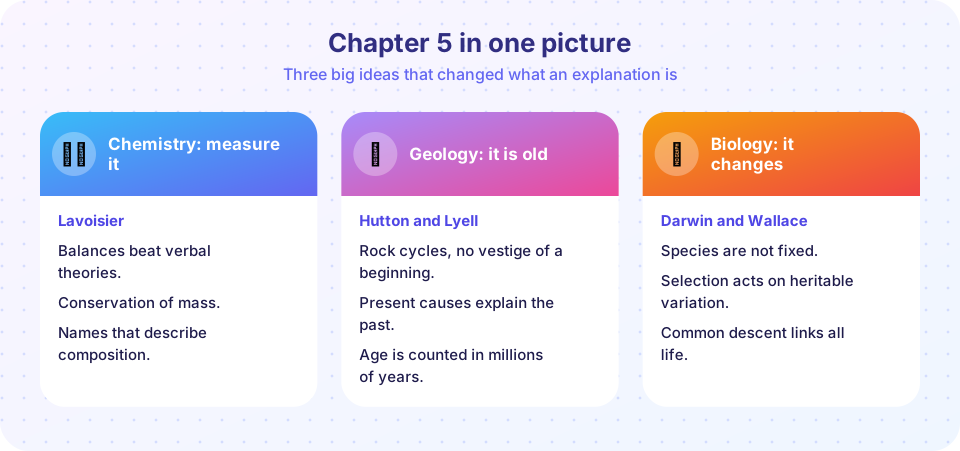
You have seen three big reorganizations of knowledge: chemistry rebuilt on the balance, geology rebuilt on deep time, and biology rebuilt on natural selection. Use this page to check that the ideas, names and dates fit together.
What you will learn
- How the three stories share a method: measurement, patience and natural causes.
- Which names, dates and ideas belong to which field.
- How to spot where credit and context were left out.
The chapter in one table
| Field | Key people | Date | Big idea | Main obstacle |
|---|---|---|---|---|
| Chemistry | Lavoisier, Marie-Anne Paulze Lavoisier, Priestley, Scheele | 1770s to 1789 | Oxygen explains burning; mass is conserved | Phlogiston, caloric |
| Geology | Hutton, Lyell, Cuvier, Anning | 1788 to 1833 | Deep time and present-day causes | Short chronologies, Kelvin's cooling |
| Biology | Darwin, Wallace, Malthus | 1858 to 1859 | Natural selection and common descent | No genetics, short age, blending inheritance |
Key terms
Conservation of mass: the total mass in a closed change is constant.
Unconformity: a surface separating younger from older rocks with a gap of time.
Natural selection: heritable traits that help survival and reproduction become more common.
Modern synthesis: the 1930s to 1940s union of Darwinian selection with Mendelian genetics.
Patterns across the three stories
- A number settled a verbal argument. Weight gain of a calx, thickness and tilt of strata, and population growth against food all became measurable.
- A new tool or concept arrived late. The balance, radioactivity and Mendel's particles each fixed an old gap.
- Credit was uneven. Scheele, Anning, Wallace and Marie-Anne Paulze Lavoisier all contributed more than their popular reputation suggests.
- Great figures were also wrong somewhere. Lavoisier on oxygen and acids, Lyell on gradualism, Darwin on blending inheritance.
Common misconceptions
"One experiment settled each question." In every case, acceptance took years and many arguments.
"The losers were fools." Phlogiston, catastrophism and Kelvin's short age were reasonable given the evidence available.
Try it
A flashcard drill for names and fields. It is a simple demonstration, nothing more.
Press Run (or Ctrl + Enter) to see the result here.
Program input · what you'd type while the program runs
Type the answers before you press Run, one per line. Each time the program reads a line (with input()), it gets the next line from this box.
And an interactive sorter that places each person in the right field. Click a name, then a field.
Check your understanding
Quick check · 10 questions
of 10 answered You scored / 10 · perfect!
-
1. What observation was hardest for phlogiston theory to explain?
Calcination increases mass, which conflicts with something escaping. -
2. Who first prepared oxygen, before Lavoisier explained it?
Scheele and Priestley each prepared the gas in the early 1770s. -
3. What does an unconformity show?
Siccar Point is the classic example that convinced Hutton and Playfair of deep time. -
4. Which scientist argued in 1796 that extinction is real, based on fossil elephants?
Georges Cuvier compared fossil and living elephant anatomy. -
5. Why was Lord Kelvin's age of the Earth too low?
His reasoning was valid for his assumptions, but extra heat sources extended the cooling time. -
6. Which text gave Darwin and Wallace the idea of a struggle for existence?
Both read Malthus and applied the population pressure idea to nature. -
7. What did the modern synthesis combine?
In the 1930s and 1940s selection and genetics were merged into one framework. -
8. Which statement about credit is best supported by the chapter?
Marie-Anne Paulze Lavoisier, Mary Anning and Wallace's assistants are examples. -
9. Which pair of claims did Lavoisier get wrong?
He named oxygen as 'acid former' and kept the caloric fluid; both ideas were later rejected. -
10. What is the best description of Darwin's 'tangled bank' image?
The final passage of the Origin ends with a bank of plants, insects and worms, all produced by natural laws.
Summary
- Chemistry, geology and biology each gained a measurable, natural-cause account.
- The same four patterns recur: numbers, late tools, uneven credit and imperfect heroes.
- Acceptance was slow and argued, not a single moment.
Track your progress
Create a free account to tick off lessons and pick up where you left off on any device.
of History of Science lessons completed