


















Lesson 38 of 44 · Science, Society and Method
Science, War, Empire and Who Gets Heard
Case studies on credit and recognition, empire and collecting, war research from Haber to the Manhattan Project, and the research ethics that followed.
A textbook says: "Meitner and Frisch explained nuclear fission." A prize list says the 1944 Nobel Prize in Chemistry went to Otto Hahn alone. Both statements are true, and the gap between them is the subject of this lesson. Science is done by people in institutions with budgets, rivalries, prejudices and political pressure. Looking at those conditions does not make science less reliable; it explains who was able to contribute, who got credit and what was done with the results.
What you will learn
- How credit is distributed, and why recognition lags or goes to some people and not others.
- How empire and trade shaped natural history and surveying, and whose knowledge was used.
- How war reshaped research and raised ethical questions.
- How research ethics rules developed after abuses.
Key terms
Matthew effect: Robert Merton's term (1968) for the tendency of already famous scientists to receive extra credit.
Matilda effect: Margaret Rossiter's term (1993) for the systematic under-recognition of women scientists' work.
Informed consent: a research participant's voluntary agreement given with knowledge of risks.
Dual use: research that can serve both beneficial and harmful purposes.
Who gets the credit
Merton described norms that scientists claim to follow: sharing results, judging claims by evidence not by the person, avoiding self-interest and being skeptical. Reality is imperfect. Credit tends to flow to the senior and famous (the Matthew effect), and historians have documented many cases where women, assistants and collaborators from outside elite institutions were overlooked.
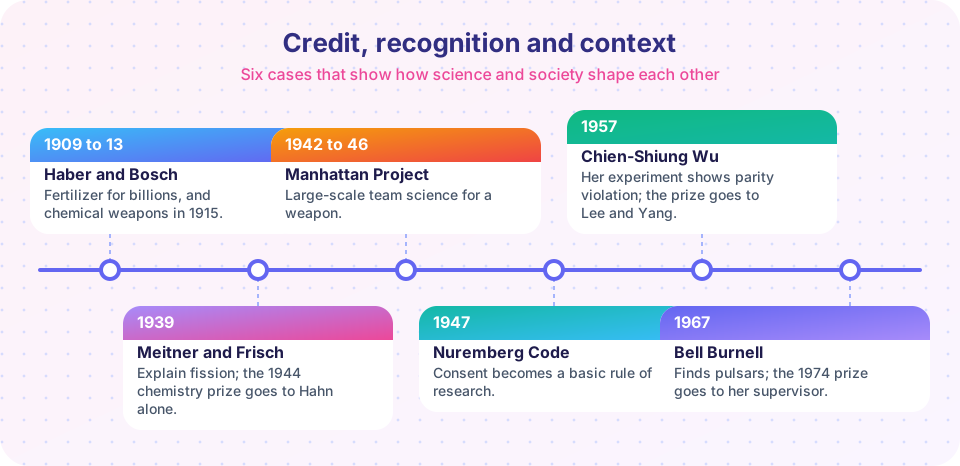
- Lise Meitner (Austrian-Swedish physicist) worked for decades with the chemist Otto Hahn in Berlin. She fled Nazi Germany in 1938. When Hahn and Fritz Strassmann found barium after bombarding uranium with neutrons, they wrote to her, and Meitner and her nephew Otto Frisch explained it in late 1938 and early 1939 as the splitting of the nucleus, naming it fission. The 1944 Chemistry prize went to Hahn alone. Historians point to the difficulty of interdisciplinary credit, the wartime political situation and Hahn's own later statements, and agree her contribution was essential.
- Chien-Shiung Wu designed and performed the 1956 to 1957 experiment on cobalt-60 that showed that the weak interaction does not respect mirror symmetry (parity violation), confirming the proposal of Tsung-Dao Lee and Chen-Ning Yang. The 1957 Physics prize went to Lee and Yang.
- Jocelyn Bell Burnell, a graduate student in Cambridge, spotted the odd signal that became the first pulsar in 1967. The 1974 Physics prize was awarded to her supervisor Antony Hewish (with Martin Ryle for other work). She later took the view that it was a prize for the team's work and has been gracious about it, donating money from a later award to support students.
- Marie Curie won the 1903 Physics Prize (shared with Pierre Curie and Henri Becquerel) and the 1911 Chemistry Prize. The 1903 nomination originally omitted her; a committee member alerted Pierre, who insisted she be included.
Empire and collecting
European expansion supplied specimens, instruments and funding. Joseph Banks sailed with Cook on the Endeavour (1768 to 1771) and later directed the Royal Botanic Gardens at Kew as a hub for collecting plants worldwide. The British quinine supply for malaria depended on cinchona trees taken from the Andes in the 1850s and 1860s, a project shaped by local guides and by colonial economic interests. In India the Great Trigonometrical Survey (begun 1802) mapped the subcontinent with help from Indian surveyors, some of whom were trained as secret explorers beyond the border; their names are less known than those of the British officers who published their data.
Alfred Russel Wallace's collections in the Malay Archipelago relied on assistants, including Ali, who learned to collect and prepare specimens. Historians now talk of "go-betweens": local experts, translators, guides and intermediaries whose knowledge became part of European science. Some knowledge was acknowledged; much was taken without credit. These histories matter today in debates over museum collections and who controls biological samples and data.
War and research
War changes what science is funded to do. Fritz Haber developed the process to make ammonia from nitrogen and hydrogen, scaled up by Carl Bosch at BASF in 1913. The Haber-Bosch process made synthetic fertilizer possible and today supports a large share of the world's food production. Haber also led the German chlorine gas attack at Ypres in April 1915, and he received the 1918 Chemistry Prize amid protests. The same chemist is both a benefactor and a figure of war: a standard example of dual use.
The Manhattan Project (1942 to 1946) gathered tens of thousands of people, including physicists who had fled Europe, to build nuclear weapons under US military direction. The first test, Trinity, took place on 16 July 1945, and bombs were dropped on Hiroshima and Nagasaki on 6 and 9 August. Some scientists, such as Leo Szilard and the authors of the Franck Report, urged a demonstration or political control; others took part without reservation. The project also created a model of large, well-funded "big science" that continued after the war, with radar, computing, antibiotics and operations research also advanced by wartime work.
Ethics after abuses
The Nuremberg Doctors' Trial (1946 to 1947) examined Nazi medical experiments on prisoners. The judgment included ten points known as the Nuremberg Code (1947), whose first sentence says that the voluntary consent of the human subject is absolutely essential. The World Medical Association's Declaration of Helsinki (1964) added further guidance. In the United States, the Tuskegee study (1932 to 1972) observed the course of untreated syphilis in hundreds of African American men without informing them or offering effective treatment after penicillin became standard. Its exposure led to the National Research Act of 1974 and the Belmont Report of 1979, which established respect for persons, beneficence and justice as the principles of research ethics. Eugenics, a term coined by Francis Galton in 1883, shows how scientific language was used to justify forced sterilizations and racist policy in many countries; later genetics rejected its claims.
Common misconceptions
"Prize lists show who did the science." Prizes are limited to three people, usually in senior positions, and often lag behind the discovery.
"Science is neutral, so it carries no responsibility." Choices about funding, applications and consent are human choices with consequences.
"Empire only took from the colonies." It also built institutions, but the benefits and credit were unevenly shared, which is why historians trace both sides.
Try it
First, a table of recognition. The years are the discovery or experiment and the prize year. Times are approximate and the cases are chosen only to illustrate the lesson.
Press Run (or Ctrl + Enter) to see the result here.
Program input · what you'd type while the program runs
Type the answers before you press Run, one per line. Each time the program reads a line (with input()), it gets the next line from this box.
Second, a bar chart of the years between discovery and prize for these cases.
Press Run (or Ctrl + Enter) to see the result here.
Program input · what you'd type while the program runs
Type the answers before you press Run, one per line. Each time the program reads a line (with input()), it gets the next line from this box.
Check your understanding
Quick check · 5 questions
of 5 answered You scored / 5 · perfect!
-
1. What is the Matthew effect in science?
Merton named it after a verse about those who have receiving more. -
2. Who explained nuclear fission in 1938 to 1939 with Otto Frisch?
Meitner, in exile in Sweden, and Frisch provided the theoretical explanation of Hahn and Strassmann's result. -
3. What is 'dual use' research?
The Haber-Bosch process is a classic example: fertilizer and weapons chemistry. -
4. What is the first principle of the Nuremberg Code?
The code came from the Doctors' Trial of 1946 to 1947. -
5. What led to the Belmont Report (1979)?
The National Research Act of 1974 created the commission that wrote it.
Summary
- Credit flows unevenly: prizes and citations favor the senior and well-placed.
- Empire used and often under-acknowledged local knowledge and labor.
- War funded large-scale research and created dual-use dilemmas.
- Research ethics rules (Nuremberg, Helsinki, Belmont) grew from documented abuses.
- Asking who, for whom and under what conditions makes the history more accurate.
Next: Chapter 8 review
Track your progress
Create a free account to tick off lessons and pick up where you left off on any device.
of History of Science lessons completed