


















Lesson 40 of 44 · Projects and Practice
Project 1: Build a Timeline of a Scientific Idea
A guided project: choose a scientific idea, collect and check dated events with sources, link causes and effects, and write an argument-driven paragraph.
A timeline looks innocent: a list of dates. But every timeline is an argument, because someone chose which events to include, which to leave out and how to connect them. In this project you will build a timeline of one idea (for example, the periodic law, continental drift or the double helix), check every date, show causes and effects and then write a paragraph that says what pattern the timeline reveals. The result is a small piece of real historical work.
What you will learn
- How to choose a focused topic and collect events with sources.
- How to verify dates using two independent references.
- How to mark causes, effects and gaps, and to ask who is missing.
- How to turn the timeline into a short argument.
Key terms
Primary source: a document or object from the time itself, such as a letter, lab notebook or published paper.
Secondary source: a later account that interprets primary sources, such as a textbook or biography.
Causation versus sequence: B following A does not mean A caused B; you need a reason.
Periodization: dividing a history into phases, which always involves judgment.
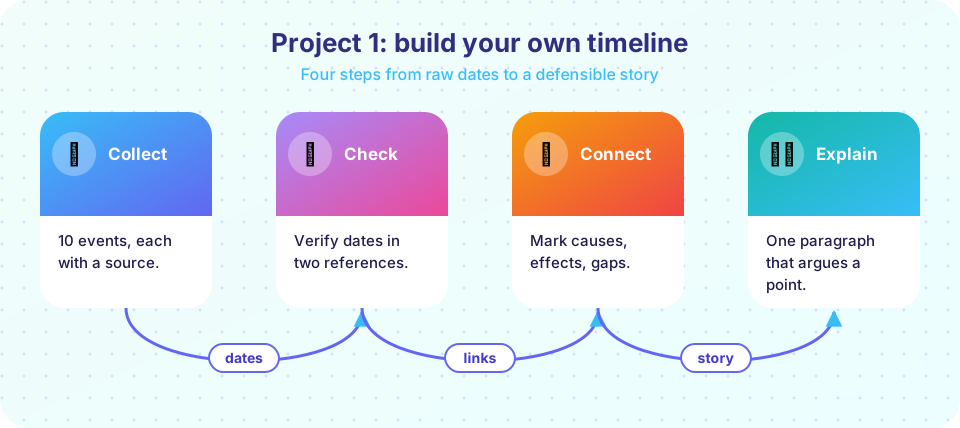
Step 1: choose and collect
Pick a topic small enough to finish. Good examples from this course: the discovery of oxygen, Mendeleev's table, the acceptance of plate tectonics, the path to the double helix, or the measurement of the age of the Earth. Collect about ten events that matter to the story, ranging from the first hint to broad acceptance. For each event record the date, what happened, who was involved, and where you found it. Include at least two events that involve people other than the best-known name, such as assistants, rivals or critics.
Step 2: check
Dates in popular sources are often wrong or vague. Check each one against two independent sources and prefer primary or scholarly ones. Note when a date has more than one meaning: the day an experiment was done, the day a paper was read, the day it was published and the day the work was widely accepted can differ by years (Mendel: experiments in the 1850s and 1860s, publication 1866, rediscovery 1900). If sources disagree, say so and explain which you trust.
Step 3: connect
Draw arrows between events when one influenced another: a measurement enabled a theory, an instrument opened a field, a rejection led to a new test. For each arrow ask: Is there evidence? A letter in which one scientist cites another is stronger than a plausible guess. Mark gaps: long periods with no events may signal missing sources, a lack of tools or simply less interest. Ask whose story is not here and why.
Step 4: explain
Write one paragraph that makes a claim a reader could disagree with. A weak summary says "Many scientists worked on heredity." A stronger claim says "Heredity became a science of molecules only after X-ray crystallography provided a tool that classical genetics lacked." Use at least three events from your timeline as evidence, and mention one source of uncertainty.
Common misconceptions
"More events make a better timeline." A focused set that supports an argument is better than a long list.
"The first person to publish is the discoverer." Priority is often contested and depends on definitions of discovery.
"A timeline shows causes." It shows order; causes need arguments and evidence.
Try it
Use this builder. Replace the sample events with your own, and it will sort them, show gaps, flag events with fewer than two sources and print a draft outline.
Press Run (or Ctrl + Enter) to see the result here.
Program input · what you'd type while the program runs
Type the answers before you press Run, one per line. Each time the program reads a line (with input()), it gets the next line from this box.
The second tool is a small interactive checklist that scores how complete your project is.
Check your understanding
Quick check · 4 questions
of 4 answered You scored / 4 · perfect!
-
1. Why check each date against two independent sources?
Independent confirmation catches mistakes and ambiguity. -
2. What is a primary source?
Primary sources come from the people and period studied. -
3. What does a timeline show on its own?
Causes need separate evidence and argument. -
4. Which is the strongest final claim?
A claim someone could dispute, supported by events, is an argument.
Summary
- Choose a focused idea and collect about ten sourced events.
- Check every date twice and note ambiguities.
- Mark causes with evidence and ask who is missing.
- Write a claim that can be disputed, supported by events and honest about uncertainty.
Track your progress
Create a free account to tick off lessons and pick up where you left off on any device.
of History of Science lessons completed