


















Lesson 17 of 44 · The Scientific Revolution
Heliocentrism: from Copernicus to Kepler
Follow the moving-Earth idea from Copernicus in 1543 through Tycho Brahe's precise data to Kepler's three laws, and why ellipses replaced circles.
For fourteen centuries astronomers computed planetary positions with Ptolemy's Earth-centred model. In 1543 Nicolaus Copernicus argued that the Sun, not Earth, sits near the centre and that Earth is one planet among several. His book started a chain of work that ended with Johannes Kepler showing that planets move in ellipses at speeds that follow exact mathematical rules.
What you will learn
- Why Copernicus proposed a moving Earth and what it explained
- Why many astronomers did not accept it at first
- How Tycho Brahe's observations set a new standard of precision
- What Kepler's three laws say and how he found them
Key terms
Retrograde motion: the apparent backward drift of a planet against the stars for some weeks.
Parallax: the apparent shift of a nearby object against a distant background when the observer moves.
Ellipse: a closed curve like a stretched circle, with two focus points.
Astronomical unit (AU): the average Earth-Sun distance, about 149.6 million km.
Copernicus (1473 to 1543)
Copernicus, a Polish canon and astronomer, worked for decades before publishing De revolutionibus orbium coelestium in 1543. The book appeared as he lay dying; the printer's unsigned preface (by Andreas Osiander) said the model was only a calculating device, which Copernicus did not intend.
His model had real advantages. If Earth and other planets orbit the Sun, the retrograde loops of planets follow naturally: Earth overtakes slower outer planets, and from Earth they seem to move backward for a while. No special epicycle size is needed for each. The model also orders the planets by orbital period (Mercury fastest, Saturn slowest) and gives their relative distances, which Ptolemy's system did not.
Yet it had problems. It kept perfect circles and still needed small epicycles to match the data, so it was no more accurate than Ptolemy's. It implied that Earth spins and flies through space, which conflicted with Aristotelian physics, with everyday experience and with certain Bible readings. And it predicted stellar parallax: stars should seem to shift as Earth moves around its orbit. No one could see it. The reason is that stars are extremely far away: parallax was first measured by Friedrich Bessel in 1838.
Tycho Brahe (1546 to 1601)
The Danish nobleman Tycho Brahe saw a new star (a supernova) in 1572 and a comet in 1577, both showing that the heavens were not unchanging. With royal support he built the Uraniborg observatory on the island of Hven and designed large, precise instruments. Observing with the naked eye, he measured positions to about one arcminute (1/60 of a degree), far better than earlier records. He proposed a compromise system in which the planets orbit the Sun while the Sun orbits a fixed Earth. His real legacy was a huge, accurate table of observations, collected over twenty years.
Kepler (1571 to 1630)
Johannes Kepler, a German mathematician, joined Tycho in Prague in 1600 and inherited his data when Tycho died in 1601. He set out to find the orbit of Mars. After years of calculation, he found a circular model that fitted Tycho's data to within eight arcminutes, a tiny error. Because he trusted Tycho's accuracy, he refused to accept the discrepancy and abandoned circles. This is a landmark of method: a small, reliable measurement overturned a beautiful theory.
His results, published in 1609 and 1619, are called Kepler's three laws:
- Ellipses. Each planet moves on an ellipse with the Sun at one focus.
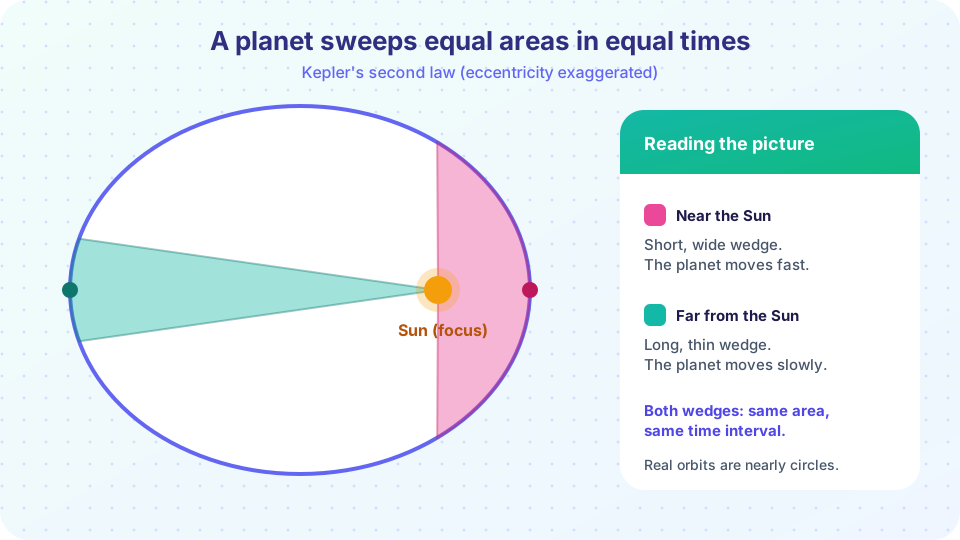
- Equal areas. The line from the Sun to a planet sweeps out equal areas in equal times. Hence a planet moves faster near the Sun.
- Harmonic law. The square of a planet's orbital period T is proportional to the cube of its average distance a: T² = a³ when T is in years and a in AU.
The third law is a striking numerical relation. For Mars, a = 1.524 AU gives a³ = 3.54, and the period is 1.881 years, whose square is 3.54. Kepler had no explanation of why planets obey it. Newton later showed it follows from an inverse-square force of gravity (next lesson).
Real orbits are nearly circles: Mars's eccentricity is 0.093, so its minor axis is only about 0.4 percent shorter than its major axis. It took exceptional data to detect the difference.
Common misconceptions
"Copernicus proved the Sun is at the centre." He proposed it. Evidence (Galileo's observations, Kepler's laws, Newton's physics, stellar parallax in 1838) accumulated over three centuries.
"Kepler's orbits are very elongated ellipses." Most planetary orbits are nearly circular. Textbook diagrams exaggerate the shape so that you can see it.
"Kepler discovered gravity." He suspected the Sun exerts a force but did not state a law of gravitation.
Try it
First, test Kepler's third law with real orbital data and plot it. Second, see how small the Mars discrepancy was.
Press Run (or Ctrl + Enter) to see the result here.
Program input · what you'd type while the program runs
Type the answers before you press Run, one per line. Each time the program reads a line (with input()), it gets the next line from this box.
Press Run (or Ctrl + Enter) to see the result here.
Program input · what you'd type while the program runs
Type the answers before you press Run, one per line. Each time the program reads a line (with input()), it gets the next line from this box.
Check your understanding
Quick check · 5 questions
of 5 answered You scored / 5 · perfect!
-
1. What did Copernicus's model explain naturally?
Earth overtaking an outer planet makes it appear to move backward. -
2. Why did Tycho Brahe's data matter?
He used large naked-eye instruments with careful methods. -
3. What was the key reason Kepler abandoned circles?
He trusted the data. -
4. What does Kepler's third law say, in units of years and AU?
The relation holds for all planets. -
5. When was stellar parallax first measured?
Friedrich Bessel measured it for 61 Cygni in 1838.
Summary
- Copernicus (1543) proposed a Sun-centred system that explained retrograde motion but kept circles and lacked a physics.
- The lack of observable parallax was a serious objection; parallax appeared only in 1838.
- Tycho Brahe supplied observations accurate to about one arcminute.
- Kepler's laws: ellipses, equal areas, and T² = a³.
- A small, reliable discrepancy in Mars's orbit overturned the circle.
Track your progress
Create a free account to tick off lessons and pick up where you left off on any device.
of History of Science lessons completed